BoozeMakers · The Master Class
The Framework for Decoding Every Bottle on the Back Bar
There are tens of thousands of spirits in the world. There are exactly three decisions behind all of them. Learn the three, and the ten thousand take care of themselves.

Most spirits books hand you a pile of facts to memorize. This one hands you the logic that generates the facts. Every spirit on earth is one set of answers to three production decisions:
What sugar got fermented — grain, cane, agave, fruit, or neutral. It sets the flavor ceiling before a single drop hits the still.
Pot, column, or hybrid. The counter-intuitive rule the label never prints: lower distillation strength means more flavor, not less.
What wood, how long, in what climate — the barrel contributes most of an aged spirit's flavor, and all of its color.
From those three, the whole spirits world sorts into Seven Roots — and every variation within a root is a single decision swapped. Bourbon becomes rye by changing one grain. Tequila becomes mezcal by changing how the agave is cooked. Once you see the swaps, you stop memorizing categories and start watching them move.
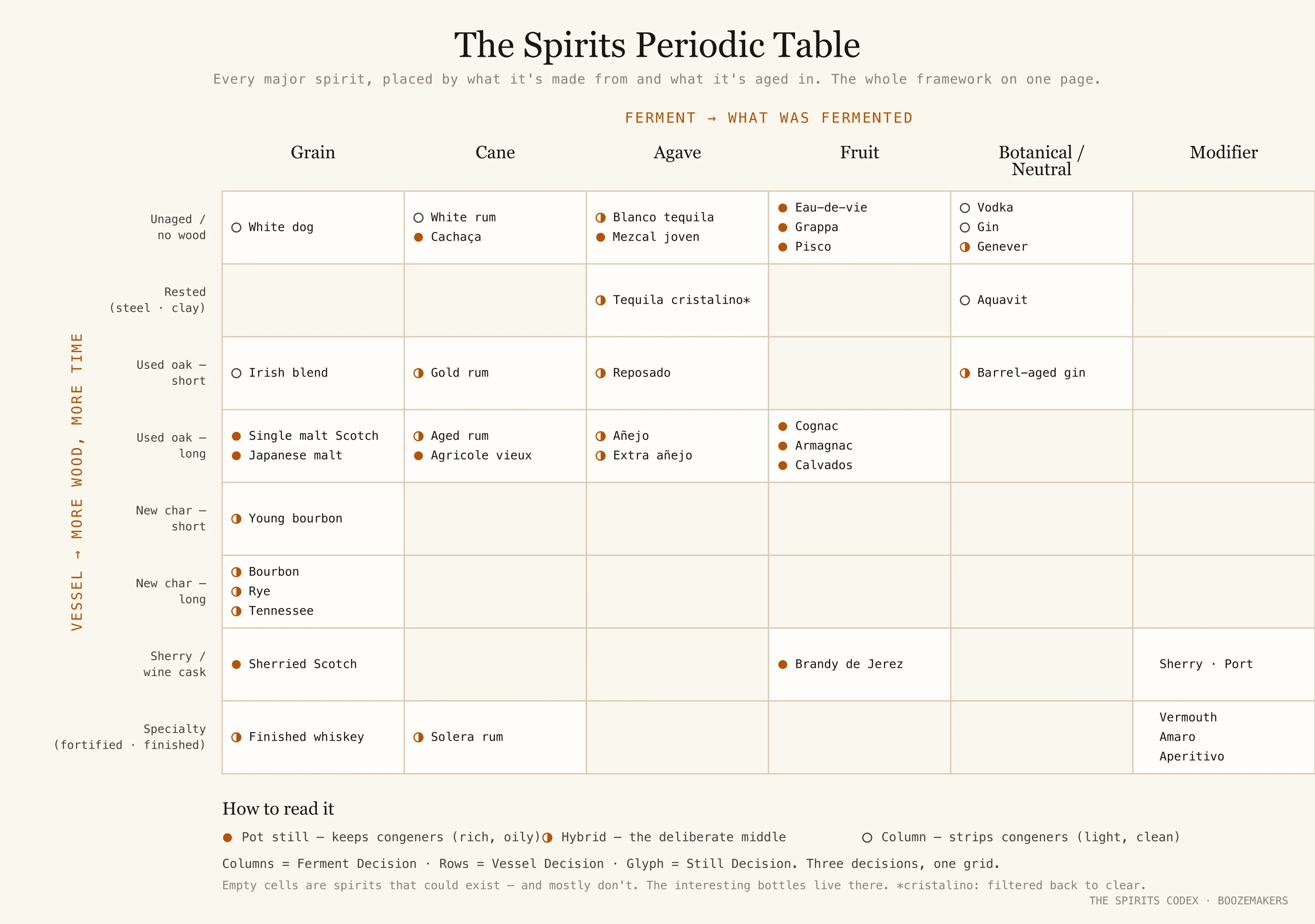
The centerpiece
One page that places every major spirit by what it’s made from and what it’s aged in, with the still encoded in every cell. By the end of Chapter 1 you can read it. By the end of the book you can redraw it from memory and find the empty cells — the spirits that could exist and mostly don’t, where the interesting bottles live.
Dog-ear it, photograph it, tape it inside a cabinet door. It’s the whole book on one page.

Ten chapters and four appendices — a glossary, a master flight index, and a fully sourced bibliography (manufacturer and official standards only).
The whole engine. Ferment, still, and vessel, taught from the ground up — every other chapter is a variation on this one.
Bourbon as the platonic ideal; rye, Tennessee, wheated, and single malt as one-decision swaps. The MGP open secret, decoded.
Single malt Scotch and its global cousins. Why a 12-year Scotch and a 12-year bourbon aren't measuring the same thing.
The loosest rules of any category, and the best teacher of how far three decisions can swing. Molasses, cane juice, and funk.
Tequila and mezcal, where how you cook the plant is as loud as any still. The diffuser problem and the additive question.
One fruit family spanning the whole vessel axis, from clear unaged pisco to decades-old Cognac. Why Armagnac is underrated.
The blank neutral canvas and what botanicals paint onto it — plus an honest look at what you're paying for in a vodka.
Vermouth, amaro, aperitivo — the family that bends the framework and makes half the cocktail canon possible.
The whole book compressed into a four-move procedure you run in your head, plus the label tricks designed to fool you.
A fifty-bottle library built so the bottles teach each other, with the decision-swap pairings worth tasting first.
You taste deliberately and own a shelf that means something. You're past 'what should I buy' and onto 'what is this, actually.'
You need to read any bottle a guest or rep puts in front of you, fast, and explain it without reaching for a phone.
Studying for a WSET-style exam? This is the production logic underneath the flashcards, organized so it actually sticks.
For the serious drinker in your life who has every bottle and no framework to hang them on. This is the one book they don't have.
No. It assumes you already taste deliberately — that you've read something like our Drink Smarter or built the habit on your own. If you're brand new, start there and come back when the back-bar moment starts to bother you.
A 150+ page PDF, illustrated with 17 custom diagrams including the Spirits Periodic Table. You get an instant download link the moment you pay — yours to keep, read on anything.
Drink Smarter teaches you how to taste. Spirits Codex teaches you how to understand what's in the glass at a production level — the framework that decodes every category, not just how to nose a pour.
That's the whole point, and we pressure-tested it: the framework correctly decoded 19 of 20 deliberately obscure bottles from production facts alone. Chapter 9 shows the method, the worked examples, and the one honest place it has a limit.
By the last page, you can pick up a bottle you’ve never seen and know what’s in it, how it was made, and what it should taste like — and explain it to the person next to you.
$29 $14.50 with code HALFOFF · instant PDF download · for adults of legal drinking age
Newer to spirits? Start with Drink Smarter.