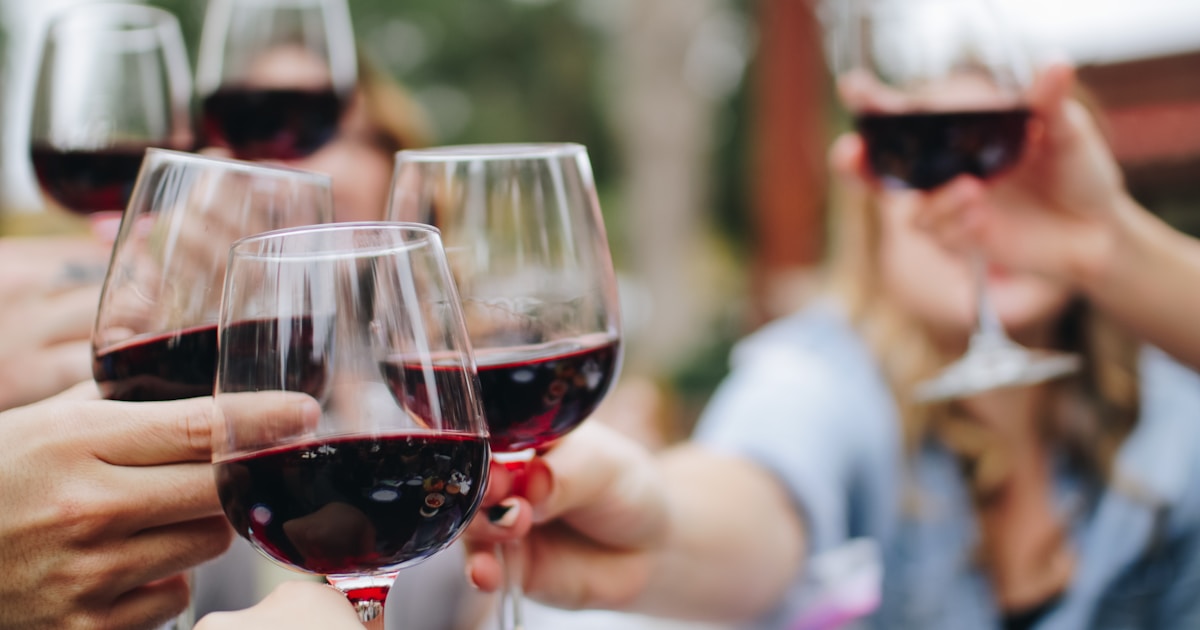
"How much wine will get me drunk?" is a fair question — and the useful answer isn't a number of glasses, because a "glass" of wine is one of the most misleading measures in drinking. Two people can pour wildly different amounts and both call it "a glass." Here's how to actually gauge it, and drink wisely.
The standard glass vs. the glass you actually pour
A U.S. standard drink is 5 oz of 12% wine — that's 14 grams of pure alcohol, the same as a 12 oz beer or a 1.5 oz shot of spirits. The problem: almost nobody pours 5 oz at home. A generous restaurant or dinner-party pour is often 8–9 oz, which means one glass can quietly be 1.5 to 2 standard drinks. That's the single biggest reason wine sneaks up on people.
So a rough guide — reaching about the 0.08% BAC legal driving limit over an hour or two — lands around 2–3 standard 5 oz glasses for many people. But if your "glasses" are really 8 oz, that's the same alcohol in just 1–2 pours.
Wine ABV varies more than you'd think
Beer clusters around 5%. Wine doesn't. It ranges from roughly 11% in a light white or many sparkling wines to 13–14% in most reds, and 14–15%+ in big California Zinfandels, Syrahs, and many New-World reds. Fortified wines like port and sherry run 18–20%. A glass of high-ABV red can carry 30–40% more alcohol than the same glass of a crisp Riesling — so the wine type changes the answer as much as the pour size. The ABV is printed on every label; it's worth a glance.
What determines how fast it hits you
- Body weight and composition — more body water means a lower BAC from the same amount.
- Biological sex — on average women reach a higher BAC than men from an identical pour, due to body-water and enzyme differences.
- Food — wine on an empty stomach absorbs much faster; a meal slows it down.
- Pace — your liver clears only about one standard drink per hour. Sipping across a dinner is very different from three quick glasses.
- The bubbles — sparkling wine tends to hit a little faster, as the carbonation speeds absorption.
Practical ways to keep it in check
Pour into a measured glass at least once so you can see what 5 oz actually looks like. Alternate each glass with a glass of water. Eat while you drink. And if you're driving, the safe amount is none — impairment begins well before the legal limit, and BAC keeps climbing for a while after your last sip as alcohol finishes absorbing.
Want to enjoy wine for the flavor rather than the effect? That's the whole point of drinking well. Browse our wine and winemaking coverage for where to start.