BOOZEMAKERS
New Release · Digital Guide

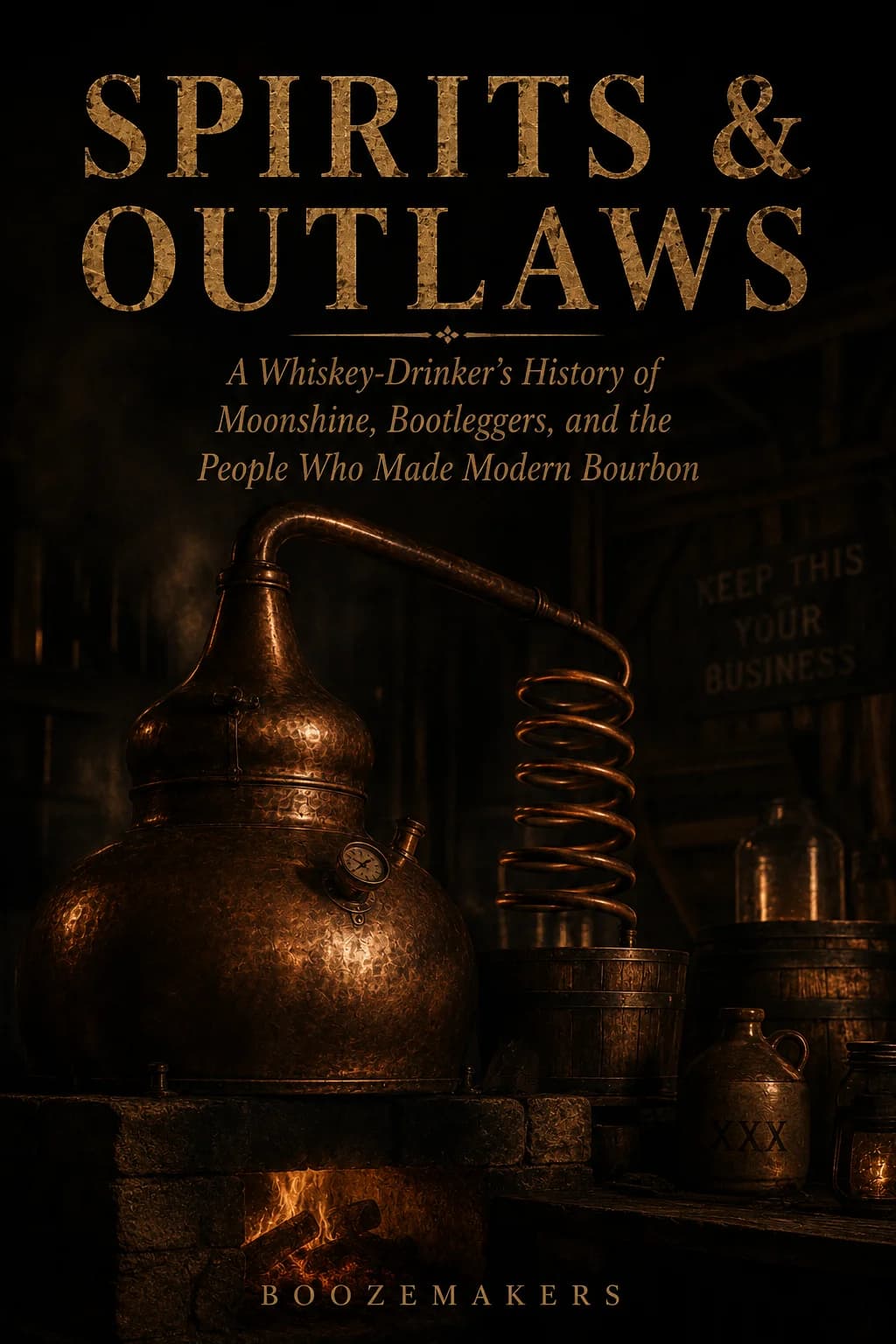
Spirits
& Outlaws

A Whiskey-Drinker’s History of Moonshine, Bootleggers, and the People Who Made Modern Bourbon

From the editors of Boozemakers — 140+ pages, 9 chapters, 4 appendices, a 230-year timeline, and a 10-bottle drinking companion that lets you taste your way through the history.

FreePDF · 140+ pages

Drop your email below — we’ll send the PDF straight to your inbox. No payment, no upsell wall.
Instant download. We’ll add you to our newsletter — unsubscribe anytime. Zero spam, occasional bottle picks.

Boozemakers Presents

Spirits
& Outlaws

A Whiskey-Drinker’s
History of Moonshine,
Bootleggers, and the
People Who Made
Modern Bourbon

From the Editors of Boozemakers

What's Inside

Nine Chapters.
230 Years of American Moonshine.

From George Washington's 13,000 federal troops to Junior Johnson's 1960 Daytona 500, from Popcorn Sutton's 2009 suicide to the $400M legal moonshine industry of 2026 — the whole story, told straight.

ChapterPages 5–14
01

What Moonshine Actually Is

Chapter 01 · Pages 5–14

The First Time I Saw Real Moonshine Was In A Mason Jar In A Tin Shed Outside Bryson City, NC. The Man Who Handed It To Me Made It That Morning. Every Bottle You'll Buy In A Liquor Store Today Is Something Else Entirely.

Federal definitions, the corn-sugar split, and why every commercial 'moonshine' is technically flavored vodka.

  • On page 7, the federal definition of moonshine — which doesn't exist. Why 'moonshine' has no legal category, and how that absence shaped the entire commercial industry.
  • Page 9 — the corn-sugar split. The two distinct moonshine traditions — pure-corn craft moonshine and sugar-shine commercial production — and why nearly every romantic image you've seen describes the first while the actual economics described the second.
  • On page 12, the 5 levels of legality from licensed craft distilling to fully outlaw mountain production. Where the tradition actually lives — and why the federal apparatus has only partially won.
ChapterPages 16–28
02

The Whiskey Rebellion: 1791

Chapter 02 · Pages 16–28

George Washington Personally Led 13,000 Federal Troops Across The Allegheny Mountains To Crush A Tax Revolt. He Won The Battle. He Lost The Argument. The People Just Migrated South.

Washington's tax, the Scots-Irish refusal, and the migration that planted bourbon in Kentucky and moonshine in the mountains.

  • On page 19, why western Pennsylvania farmers in 1791 couldn't pay the federal whiskey tax — and why the tax structure was designed to crush small distillers and consolidate American whiskey in eastern hands. (It failed.)
  • Page 22 — the Battle of Bower Hill, July 16, 1794. Tax collector John Neville's house burns. The first federal-vs-rebel armed confrontation in American history.
  • On page 26, the migration. Tens of thousands of Scots-Irish settlers fled western Pennsylvania between 1795 and 1810. Two American whiskey traditions were planted: bourbon in Kentucky, moonshine in the mountains. The split has lasted 230 years.
ChapterPages 30–46
03

The Appalachian Tradition

Chapter 03 · Pages 30–46

Five Thousand Stills, Twenty Federal Revenuers Killed Between 1879 And 1882, And A Cultural Code That Made Federal Enforcement Almost Impossible For 100 Years.

Mountain isolation, kinship networks, the federal revenuers, and the 100-year arc that built the outlaw archetype.

  • On page 33, the geography that protected mountain operators — narrow hollows, dense forest, marginal agricultural land, kinship-based community structure. Federal agents on horseback couldn't penetrate it.
  • Page 38 — the economics of moonshining. A typical 1910 still produced $4-$15 profit per run. For a mountain farmer with limited cash income, that was 4-10x the typical farming income. The economic engine that drove the tradition for 150 years.
  • On page 43, the cultural code — quality reputation, trust in distribution, discretion, hospitality with strangers, community defense. The internal rules that sustained an illegal economy across multiple generations.
ChapterPages 48–62
04

Prohibition: 1920–1933

Chapter 04 · Pages 48–62

Prohibition Wasn't A Moonshine Disaster. It Was The Best Thing That Ever Happened To The Mountain Economy. Demand Tripled. The Pipeline Went National. Overnight, Mountain Stills Were Feeding New York Speakeasies.

Volstead, speakeasies, the rum-runners, and the cultural pivot that turned moonshining into a national racket.

  • On page 51, the five channels of illegal alcohol during Prohibition — Caribbean rum-running, hijacked industrial alcohol, bathtub gin, Mexican imports, and Appalachian moonshine. Channel 5 was the largest by volume.
  • Page 55 — the mountain-to-city pipeline structure. Producers stayed poor. Trippers (the runners) made significant money. Urban wholesalers and crime syndicates captured most of the profit. Same structural logic that runs every illegal-drug economy since.
  • On page 60, why Prohibition ended. The federal alcohol-poisoning program had killed 10,000 Americans by 1933. Tax revenue lost. Crime industrialized. The 21st Amendment delegated alcohol regulation back to states — which is why state liquor laws are so wildly varied to this day.
ChapterPages 64–78
05

From Trippers to Daytona

Chapter 05 · Pages 64–78

Junior Johnson Never Lost A Race To A Federal Agent In His Entire Moonshine-Running Career. He Won The 1960 Daytona 500. Reagan Pardoned Him In 1986. And NASCAR Spent The Next 30 Years Pretending The Connection Didn't Exist.

Junior Johnson, Lloyd Seay, Curtis Turner, and NASCAR's deliberately-forgotten moonshine origins.

  • On page 67, Lloyd Seay — the lost star of pre-NASCAR racing. Won 3 of the major southern races in 1941, then was shot dead by his cousin over a $90 moonshine partnership dispute. He was 21. The 'what if' of pre-NASCAR racing.
  • Page 71 — what the trippers brought to racing. Higher speeds. Knew their cars cold. No fear of contact. No fear of risk. Local fan base. The competitive advantages they had over rich-man racers in 1949.
  • On page 75, the formalization. Big Bill France's Streamline Hotel meeting in 1947. The first NASCAR Strictly Stock race in 1949 — won by a moonshine-style modified car (which was disqualified for altered springs). The 30-year corporate scrubbing that followed.
ChapterPages 80–94
06

Popcorn Sutton

Chapter 06 · Pages 80–94

On March 16, 2009, Marvin 'Popcorn' Sutton Sat In His 1961 Ford Fairlane Outside His Maggie Valley Home And Asphyxiated Himself Rather Than Report To Federal Prison The Next Morning. The Cultural Argument That Followed Is Still Playing Out In 2026.

The last real moonshiner. The 2009 funeral. And the cultural argument his death sparked.

  • On page 83, who Sutton was. Sixth-generation moonshiner. Genuine craftsman. Theatrical self-promoter. Repeat federal offender. Cultural symbol. The contradictions that made him the last clear illustration of the old tradition.
  • Page 87 — the 2008 bust. Federal ATF agents seized 850 gallons of moonshine and 6,000 gallons of mash. Felony charges. 18 months federal prison. Home detention denied. And then the suicide.
  • On page 91, the Sugarlands partnership. After Sutton's death, his widow licensed the brand to a federally taxed commercial spirits operation that does exactly what Sutton refused to do for 50 years. The complicated, morally fraught afterlife of the man who chose death over compliance.
ChapterPages 96–110
07

The Legal Moonshine Boom

Chapter 07 · Pages 96–110

In 2008, The Legal Moonshine Industry Essentially Didn't Exist. By 2026 It's Over $400 Million. Joe Baker's Mason Jar With Folksy Marketing Built An Industry On A 230-Year-Old Cultural Tradition That Was Already Dying.

Joe Baker, Ole Smoky, Sugarlands. The $400M industry built on a Mason jar and a memory.

  • On page 99, the four types of liquid sold as 'moonshine' in 2026. Real unaged corn whiskey, neutral grain spirit cut with flavoring, hybrid products, and cream-based liqueurs. The labels don't always make this clear.
  • Page 103 — the cultural costs. The original tradition has thinned further. The cultural memory has been commercialized. The federal-vs-mountain conflict has been resolved on federal terms. The aesthetic has been monetized while the practice fades.
  • On page 107, the best legal moonshines to drink in 2026. Belle Meade. Buffalo Trace White Dog. Sugarlands Silver Cloud. New Riff Bottled in Bond White. The bottles that get you closest to the historical flavor without breaking federal law.
ChapterPages 112–126
08

The Outlaw Aesthetic

Chapter 08 · Pages 112–126

The 'Outlaw Moonshiner' Archetype Is One Of The Most Commercially Reliable Cultural Products In Modern American Media. It Generates Billions Annually. And It Costs Real Things — Erasure Of Black And Female Moonshiners, Romanticization Of Violence, Cultural Appropriation As A Profit Center.

From Lawless to Yellowstone, country music to NASCAR, what it costs to keep romanticizing the tradition.

  • On page 115, the archetype defined. Male, white, working-class, southern, family-bound, suspicious of authority, capable of controlled violence, modest about success. Where this character appears in 2026 — Lawless, Yellowstone, Tyler Childers, NASCAR, Carhartt, Yeti.
  • Page 119 — the costs. Erasure of complexity. Mythologization of violence. Romance of poverty. Cultural appropriation as profit center. The aesthetic enabling actual outlaw behavior. The honest accounting most marketing won't do.
  • On page 123, what honest engagement looks like. Matt Bondurant's book. Tyler Childers' songs. Daniel Riffe's Sutton biography. The work that doesn't deny the romance but also shows the costs.
ChapterPages 128–142
09

The Moonshine Trail

Chapter 09 · Pages 128–142

If You Want To Do More Than Read About Moonshine, There's A Real Geographic Trail You Can Follow. Five Stops. Three States. The Cultural Memory Lives In The Geography.

The towns, museums, distilleries, festivals — a road-trip guide for the curious modern visitor.

  • On page 131, the 5-day drive. Knoxville → Gatlinburg → Maggie Valley → Wilkes County → Franklin County → Roanoke. The optimal trip for someone who wants to engage with the moonshine tradition as a thoughtful outsider.
  • Page 135 — how to behave on the trip. Spend money in local communities. Respect actual privacy (don't go knocking on doors looking for moonshiners). Listen more than you talk. Take the history seriously.
  • On page 139, what the trip won't give you. You won't have an authentic moonshine experience in the historical sense. You won't meet 'real' moonshiners. The romance of the tradition is what you bring with you. The reality is something different — and arguably more interesting once you've engaged with it on its own terms.

Plus

The Reference Companion

Four appendices designed for reference and re-reading — including a 10-bottle drinking companion that lets you taste your way through every era covered in the chapters.

A

A Moonshine Timeline (1791–2026)

230+ years of American moonshining history in dates and events. From Hamilton's tax to Popcorn Sutton's funeral to the 2024 Ole Smoky private equity acquisition.

B

A Character Glossary

30 names, places, and terms — Hamilton, Washington, Capone, Junior Johnson, Lloyd Seay, Popcorn Sutton, plus the geography and the cultural language.

C

Ten Bottles To Drink Through This History

A drinking accompaniment to the chapters. One bottle per chapter, all available at retail, that lets you taste the part of the moonshine tradition under discussion.

D

Further Reading

Books, films, podcasts, music, and primary sources for going deeper. Matt Bondurant. Daniel Okrent. Tyler Childers. The whole bibliography.

After You’ve Read the Story

Spirits & Outlaws is the history. Drink Smarter is the practice.

If this book made you want to actually drink your way through American whiskey, Drink Smarter is the playbook — the tasting framework, the bottles to buy, the home library to build.

You’re downloading

Spirits & Outlaws

Free

  • 9 chapters of moonshine history (140+ pages)
  • 230-year timeline (1791 → 2026)
  • Whiskey Rebellion deep-dive
  • Prohibition + NASCAR origins
  • Popcorn Sutton story in full
  • 10-bottle drinking companion
  • 5-day road-trip itinerary
Upgrade

The flagship

Drink Smarter

$9.50$19HALFOFF
  • Everything in Spirits & Outlaws — plus
  • The practical bourbon-buying playbook
  • Universal tasting framework (every spirit)
  • Scotch, Irish, Japanese whisky chapters
  • Tequila + mezcal mastery
  • 50-bottle multi-category home library
  • Pairing tables for every category
  • 100+ pages, 50+ bottle recommendations
  • Lifetime updates
See the Drink Smarter Guide

Who This Is For

The Whiskey Drinker

You drink bourbon. You're curious about where it comes from culturally — not just where it's distilled, but the 230-year story that explains why American whiskey is what it is.

The History Buff

You like books that explain how things actually happened. The Whiskey Rebellion, Prohibition, Popcorn Sutton — you want the full context, not the Hollywood version.

The Road-Tripper

You're planning a southern trip and want a thoughtful guide to the moonshine sites worth visiting. The museums, festivals, and distilleries that go beyond the tourist-trap experience.

Ready to Drink the Whole Story?

Drop your email below — we’ll send the PDF in under a minute. 140+ pages of moonshine history, no payment, no upsell wall. Read it tonight with whatever’s on your shelf.

Instant download. We’ll add you to our newsletter — unsubscribe anytime. Zero spam, occasional bottle picks.