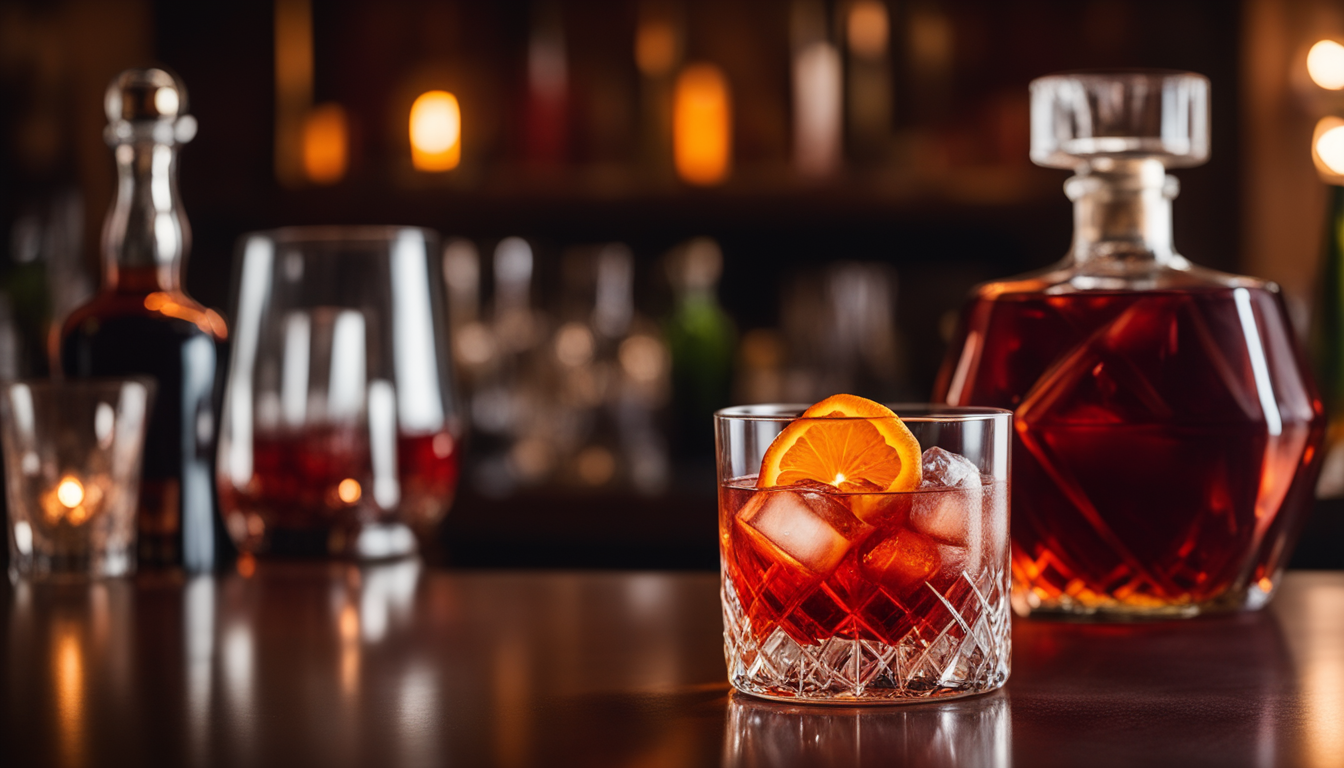
I first had a proper Boulevardier at Employees Only in New York, sitting at the bar on a Wednesday night when the place was half-empty and the bartender had time to talk. He'd just returned from a trip to Paris and was obsessed with the cocktail's origin story—how Erskine Gwynne, an American expat writer running a magazine called The Boulevardier, would order this drink at Harry's New York Bar in the 1920s. Gwynne wasn't Hemingway-famous, but he moved in those circles: the literary expatriates drinking their way through Paris, writing about it afterward, making it all look impossibly glamorous.
The bartender stirred the drink for what felt like a full minute, the ice clicking against glass in a steady rhythm. When he finally strained it over fresh ice and expressed an orange peel the size of a business card, the drink glowed dark red in the bar light. That first sip hit like the Negroni's sophisticated older brother—same bitter backbone from the Campari, same herbal complexity from the vermouth, but the bourbon brought this whole other layer of vanilla, oak, and caramel that made it feel less like an aperitif and more like a proper cocktail. I've been making them at home ever since, usually when I want something that feels special but doesn't require fourteen ingredients and a smoking gun.
Here's the thing about the Boulevardier: it's essentially a Negroni with bourbon instead of gin, but that swap changes everything. Where the Negroni is bright and botanical, the Boulevardier is rich and warming. Where the Negroni wakes you up before dinner, the Boulevardier settles you in. It's the drink for when you want bitter and complex but also want to taste the whiskey you paid for. And unlike some classic cocktails that require specific brands or techniques, the Boulevardier is remarkably forgiving—as long as you understand the basic principles, you can make it your own.
The Recipe
The classic Boulevardier follows the Negroni's equal-parts template, though many bartenders now lean bourbon-forward. We'll give you both versions.
Ingredients
- 1.5 oz bourbon (or 1 oz for equal parts)
- 1 oz Campari
- 1 oz sweet vermouth
- Orange peel for garnish
- Large ice cubes (for serving on the rocks)
Equipment
- Mixing glass or pint glass
- Bar spoon
- Hawthorne strainer or julep strainer
- Rocks glass (or coupe if serving up)
- Vegetable peeler or paring knife for orange peel
Instructions
- Prep your glass: Fill your rocks glass with ice and set aside. If serving up, place your coupe in the freezer for 10 minutes before you start.
- Combine ingredients: Add bourbon, Campari, and sweet vermouth to your mixing glass. Fill with ice until it reaches just above the liquid level.
- Stir properly: Using your bar spoon, stir smoothly for 30-40 seconds. You want 40-50 rotations total. The outside of the mixing glass should frost over and feel ice-cold. This isn't a cocktail you rush—proper dilution is essential to mellowing the Campari's bitterness.
- Strain: Dump the ice from your rocks glass and add one large cube (2-inch if you have it). Strain the cocktail over the fresh ice. If serving up, strain into your chilled coupe.
- Express and garnish: Cut a wide swath of orange peel, about 2 inches long and 1 inch wide. Hold it over the drink, colored side down, and give it a firm twist to spray the oils across the surface. You should see a fine mist if you're doing it right. Rub the peel around the rim of the glass, then drop it in or perch it on the edge.
Quick Version
Stir 1.5 oz bourbon, 1 oz Campari, 1 oz sweet vermouth with ice for 40 seconds, strain over a large ice cube, express orange peel.
The Details That Matter
The Boulevardier seems simple—three ingredients, basic technique—but the details determine whether you get a balanced cocktail or a bitter mess.
The Ratio Debate
Traditionalists swear by equal parts: 1 oz bourbon, 1 oz Campari, 1 oz sweet vermouth. This follows the original Negroni formula and creates a drink where all three ingredients share equal billing. The problem is that Campari is aggressively bitter, and bourbon—especially mid-proof bourbon around 80-90 proof—can get lost in the mix. You end up tasting mostly Campari with some sweetness and a whisper of whiskey.
The bourbon-forward ratio (1.5:1:1) has become standard in most craft cocktail bars. That extra half-ounce of bourbon gives the whiskey enough presence to stand up to the Campari without overwhelming the drink. You get more vanilla, more oak, more of what makes bourbon interesting, while still maintaining that bitter-sweet balance. Some bartenders go even further to 2:1:1, which is basically a bourbon cocktail with bitter and sweet modifiers. Try equal parts first to understand the classic, then experiment with more bourbon to find your preference.
Campari vs. Alternatives
Campari is the standard bitter liqueur for a reason—it's got that distinct bitter orange flavor with herbal complexity and a vibrant red color. But it's polarizing. Some people taste it and immediately understand why this cocktail exists. Others recoil at the bitterness like they just licked a grapefruit peel dipped in quinine.
If Campari's too much for you, Aperol is the obvious substitute—same family, same Italian pedigree, but significantly less bitter and slightly lower proof. An Aperol Boulevardier is sweeter, more approachable, and honestly a different drink. It's not wrong, just lighter. Other options include Contratto Bitter or Gran Classico, both of which split the difference between Campari's intensity and Aperol's mellowness.
Sweet Vermouth Selection
Cheap vermouth ruins cocktails. Period. If you're still using that dusty bottle of Martini & Rossi that's been in your cabinet since 2019, throw it out. Vermouth is a wine product—it oxidizes, it goes bad, it needs to be refrigerated after opening and used within a few months.
Carpano Antica Formula is the gold standard for Manhattan-style drinks, and it works beautifully here. It's got rich vanilla notes, a hint of chocolate, and enough body to stand up to both the bourbon and Campari. Cocchi di Torino is another excellent choice—slightly sweeter, more fruit-forward, a bit lighter. Dolin Rouge is perfectly fine if you're on a budget. Whatever you choose, buy the 375ml bottle if you're not making cocktails every week, and keep it in the fridge.
Stirring Technique and Dilution
Stirring matters more in this cocktail than in almost any other. Under-stir and you get a harsh, disjointed drink where the ingredients don't meld. Over-stir and you get a watery mess. The goal is about 25-30% dilution—you're adding roughly 0.75 oz of water through melting ice.
Use a smooth, continuous motion with your bar spoon, keeping the back of the spoon against the inside of the glass as you rotate. Don't churn the ice like you're making butter. The motion should be almost effortless, with the spoon gliding around the perimeter. After 30-40 seconds, the mixing glass should be frosted and painful to hold with your bare hand. That's when you know you're done.
Serving: Rocks vs. Up
Most bars serve Boulevardiers on the rocks, which is how the drink was traditionally served in Paris. The large ice cube continues diluting the drink as you sip, slowly opening up the flavors. It stays cold longer, and there's something satisfying about the heft of a proper rocks glass.
Serving up in a coupe is the Negroni approach—elegant, refined, forces you to drink it before it warms up. The advantage is that you control the exact dilution during stirring and the drink doesn't change as you sip it. The disadvantage is that it warms up quickly and you lose that visual appeal of the dark red liquid over clear ice. Both are correct. Try both and see which you prefer.
Our Bourbon Picks
Not every bourbon works in a Boulevardier. You need something with enough proof and flavor intensity to stand up to Campari's bitterness. Delicate wheated bourbons or anything under 90 proof tends to disappear.
Best Overall: Wild Turkey 101
At 101 proof and around $25, Wild Turkey brings the intensity this cocktail needs. It's got bold caramel and vanilla notes, a slightly spicy finish, and enough proof that it doesn't get bullied by the Campari. The higher alcohol content also means better texture in the final drink—more viscosity, more mouthfeel. This is the bourbon most craft bartenders reach for when making Boulevardiers.
Best Premium: Woodford Reserve
If you want something more refined, Woodford Reserve at $35-40 brings elegant oak, dried fruit, and baking spice notes. It's 90.4 proof, which is on the lower end but works because of the bourbon's flavor density. The drink becomes more sophisticated, less aggressive, with subtle complexity that reveals itself over the course of the glass. This is the version you make when you're trying to impress someone.
Best Budget: Evan Williams Bottled-in-Bond
At $18-20, Evan Williams BiB punches way above its price point. Bottled-in-bond means it's 100 proof, aged at least four years, and made at a single distillery in one season. You get solid bourbon character—vanilla, oak, a touch of caramel—with enough proof to hold its own. It won't blow your mind, but it'll make a damn good Boulevardier without making you feel guilty about using it in a cocktail.
Best High-Rye: Bulleit Bourbon
With a high-rye mashbill (28% rye), Bulleit brings extra spice and complexity at 90 proof and $28. The rye's spiciness plays beautifully with Campari's herbal bitterness, creating a more complex flavor profile. If you like rye-forward bourbons or if you sometimes make your Boulevardiers with straight rye whiskey, this is your gateway bottle.
Shop these bourbons at Bourbon & Whisky — use code BOOZEMAKERS5 for 5% off your order.
What Our Panel Says
Marcus Chen, The Explorer: "I discovered the Boulevardier at this speakeasy in Austin called Midnight Cowboy—you have to text ahead for a reservation, whole secret password thing. I was trying to impress a date and wanted something that sounded sophisticated but wasn't a Manhattan. The bartender recommended it, and I watched him stir it for what felt like forever. First sip and I immediately understood why people get obsessed with craft cocktails. It was bitter, sweet, strong, and somehow all balanced. The date went well too. Now it's my go-to when I want something that feels special but isn't too fussy to make at home. I use Wild Turkey because it's cheap and it works."
William Hayes, The Connoisseur: "I had my first proper Boulevardier at Harry's Bar in Venice—not the original Parisian location where Erskine Gwynne invented it, but close enough in spirit. I was there for a conference in the early 2000s, and after three days of Bellinis and tourists, I asked the bartender for something bitter and stirred. He made me this without asking what it was called. When I inquired, he said 'Boulevardier—American drink, Italian ingredients, French name. Very appropriate for you.' I've been making them ever since, usually with Carpano Antica because the vanilla notes complement a good bourbon beautifully. It's become my pre-dinner drink of choice, especially in winter."
Sophia Laurent, The Host: "I served Boulevardiers at a dinner party last fall—Italian menu, wanted a cocktail that felt appropriate. I made a big batch beforehand using the bourbon-forward ratio and kept it in the fridge, then just stirred individual servings with ice as guests arrived. Everyone was asking what it was and commenting on how beautiful it looked in the glass with that orange peel. One friend who normally hates Negronis loved it—said the bourbon made it more approachable. I used Woodford Reserve because I wanted something smooth, and paired them with a charcuterie board before dinner. The bitter aperitif thing really works—everyone was ready to eat by the time we sat down."
Variations
The Old Pal
Replace sweet vermouth with dry vermouth and use rye whiskey instead of bourbon. Named after another 1920s American expat (William "Sparrow" Robinson), this is the Boulevardier's drier, spicier cousin. The dry vermouth makes it more austere, the rye adds bite. It's a more challenging drink—less immediately appealing but intellectually interesting.
Left Hand
Use Campari, sweet vermouth, and bourbon, but add a bar spoon of chocolate bitters. The chocolate deepens the drink without making it sweet, playing off the Carpano Antica's chocolate notes if you're using it. This is the version for when you want something richer and more dessert-adjacent.
Mezcal Boulevardier
Swap bourbon for mezcal and you get smoke, agave, and a whole different character. Use a relatively mild mezcal like Del Maguey Vida so the smoke doesn't overwhelm the Campari and vermouth. This is divisive—people either love the smoky complexity or hate that it's no longer recognizable as a Boulevardier.
White Boulevardier
Use Suze (French gentian liqueur) instead of Campari, and Lillet Blanc instead of sweet vermouth. Keep the bourbon. You get a lighter, more floral drink that's still bitter and complex but works better in spring and summer. It's barely a Boulevardier at this point, but it follows the same template.
Common Mistakes
Using Bad Vermouth
Old, oxidized vermouth tastes like sadness and wine vinegar. If your vermouth has been open for more than three months or hasn't been refrigerated, replace it. The difference between fresh Carpano Antica and six-month-old room-temperature Martini is the difference between a great cocktail and pouring money down the drain.
Not Stirring Long Enough
Twenty seconds of half-hearted stirring produces a harsh, unbalanced drink. You need 30-40 seconds of smooth, continuous stirring to properly dilute and chill the cocktail. The mixing glass should hurt to hold. If it doesn't, keep stirring.
Using Small Ice Cubes
Small ice melts too fast and over-dilutes the drink as you sip it. Use the largest ice cube that fits in your rocks glass—ideally a 2-inch cube. If you don't have large ice molds, buy one. They're $10 on Amazon and they transform every cocktail you make on the rocks.
Skipping the Orange Peel Expression
Just dropping a peel in the drink does almost nothing. You need to express the oils over the surface—hold the peel colored-side-down and give it a firm twist about 4-6 inches above the drink. Those orange oils completely change the aromatic experience of the cocktail. Without them, you're just drinking bitter and sweet with bourbon.
Using Weak Bourbon
Anything under 86 proof struggles in this cocktail. The Campari and vermouth are both assertive ingredients, and a delicate bourbon gets lost. Use at least 90 proof, ideally 100 proof. This isn't the cocktail for your subtle, wheated, easy-sipping bourbon. Save that for drinking neat.
The Bottom Line
The Boulevardier is what happens when you take the Negroni's brilliance and make it American—richer, bolder, more warming. Make it once with equal parts to understand the classic, then bump up the bourbon to taste your whiskey. Use good vermouth, stir properly, and express that orange peel. It's bitter, sophisticated, and exactly what 1920s Paris expats were drinking when they pretended to write novels.