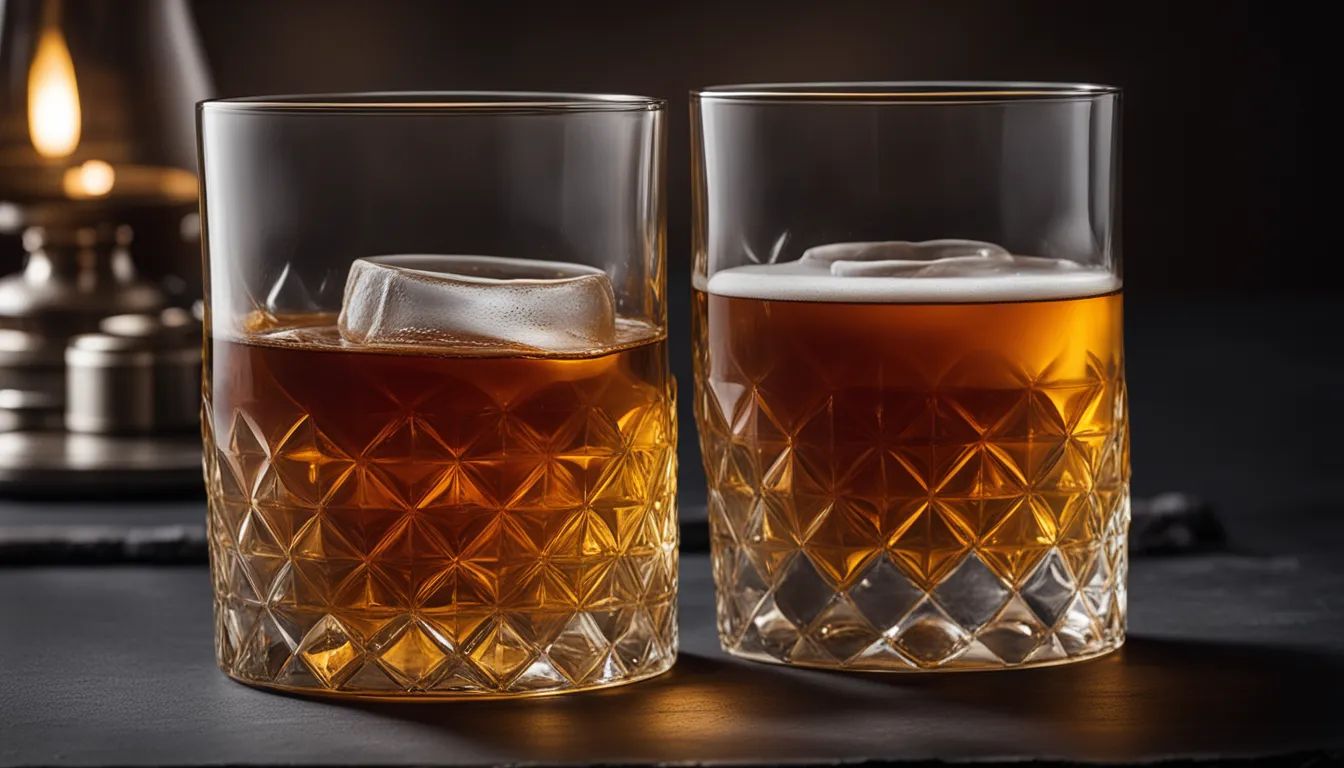
At the same proof, bourbon, scotch, rye, and Irish whiskey have essentially identical calories. There's no metabolic magic happening in a Kentucky rickhouse that doesn't happen in a Scottish warehouse. The calorie content of any whiskey comes from one thing — alcohol — and alcohol doesn't care whether it was fermented from corn, barley, or rye. The real gap between whiskey categories? Most bourbons ship at 90-100+ proof while many scotches and Irish whiskeys sit at 80 proof. That's the whole story. But the details are worth knowing, especially if you're tracking macros or just curious why your Booker's habit hits different than your Jameson nights.
I've written about whiskey calories brand by brand before, but this piece puts all four major whiskey styles side by side so you can see exactly where the numbers land — and why proof is the only variable that matters.
Why All Whiskey Calories Are Basically the Same
Here's the boring science that makes this whole article possible: after distillation and aging, straight whiskey contains no carbs, no sugar, no fat, and no protein. Zero. The only macronutrient contributing calories is ethanol, which clocks in at 7 calories per gram — roughly halfway between carbs (4 cal/g) and fat (9 cal/g).
Doesn't matter if the mash bill was 75% corn (bourbon), 100% malted barley (single malt scotch), or 95% rye (some rye whiskeys). Once that liquid has been distilled to a clear spirit and aged in oak, the caloric content is determined entirely by how much alcohol is in the bottle. A 90-proof bourbon and a 90-proof scotch have the same calories per ounce, full stop.
The formula is straightforward: calories per 1.5oz shot ≈ ABV% x 1.5 x 29.57 x 0.789 x 7 / 100. Or, more usefully: multiply the proof by roughly 1.22 and you'll land within a calorie or two of the actual number. An 80-proof pour? About 97 calories. A 100-proof pour? About 123 calories. It scales linearly, no surprises.
So why do bourbon and scotch keep showing up in "which has fewer calories" search results like they're different foods? Because people compare Maker's Mark (90 proof) to Glenfiddich (80 proof) and assume the style matters. It doesn't. The proof matters. If you're wondering about carbs in bourbon specifically — there aren't any. Same for scotch, rye, and Irish.
Bourbon Calories
Bourbon tends to run hotter than the other categories. While plenty of entry-level bourbons (Jim Beam, Evan Williams) sit at 80 proof, the bottles most enthusiasts actually drink — Buffalo Trace, Wild Turkey 101, Knob Creek — land between 90 and 101 proof. And barrel-proof releases like Booker's, Stagg Jr., and Elijah Craig Barrel Proof push well past 120.
For a standard 1.5-ounce shot, here's what the popular bottles look like:
| Bourbon | Proof | Calories (1.5 oz) |
|---|---|---|
| Jim Beam White Label | 80 | ~97 |
| Buffalo Trace | 90 | ~110 |
| Maker's Mark | 90 | ~110 |
| Woodford Reserve | 90.4 | ~111 |
| Elijah Craig Small Batch | 94 | ~115 |
| Knob Creek | 100 | ~123 |
| Four Roses Single Barrel | 100 | ~123 |
| Wild Turkey 101 | 101 | ~124 |
| Old Forester 1920 | 115 | ~141 |
| Booker's | ~125 | ~154 |
The range is wide. A shot of Jim Beam at 97 calories is in the same neighborhood as a light beer. A pour of Booker's at 154 calories is approaching IPA territory. Most popular bourbons land between 110 and 125 calories per 1.5-ounce serving.
And if you're into barrel-proof bourbons — Stagg Jr. at 130+ proof, Elijah Craig Barrel Proof at 120-140 proof — you're looking at 150-170 calories per shot. That's the trade-off for undiluted flavor. Worth it? Usually. But worth knowing.
Scotch Calories
Scotch runs cooler by convention. The Scotch Whisky Regulations require a minimum of 40% ABV (80 proof), and most blended scotch sits right at that floor. Single malts tend to be bottled a touch higher — 43% (86 proof) is the sweet spot for many distilleries — but even the bold ones rarely exceed 46% for their standard range.
That lower average proof means a typical scotch pour runs 97-113 calories — noticeably below the bourbon average, but only because of the ABV difference, not some mystical barley advantage.
| Scotch | Proof | Calories (1.5 oz) |
|---|---|---|
| Glenfiddich 12 | 80 | ~97 |
| Glenlivet 12 | 80 | ~97 |
| Johnnie Walker Black | 80 | ~97 |
| Macallan 12 (Sherry Oak) | 86 | ~106 |
| Lagavulin 16 | 86 | ~106 |
| Laphroaig 10 | 86 | ~106 |
| Highland Park 12 | 86 | ~106 |
| Balvenie 12 DoubleWood | 86 | ~106 |
| Talisker 10 | 91.6 | ~112 |
| Ardbeg 10 | 92 | ~113 |
Notice the cluster at 86 proof — that 43% ABV is practically an industry default for single malts. It's a comfortable middle ground between the minimum and a proof that lets more flavor compounds through than 40%.
Of course, cask-strength scotch is a different animal. Ardbeg Corryvreckan (57.1% ABV, 114.2 proof) hits about 140 calories per shot. Aberlour A'bunadh, typically released around 120 proof, pushes past 145. Cask-strength scotch matches or exceeds barrel-proof bourbon calorie for calorie. The category you're drinking doesn't lower the number — the proof does.
Rye Whiskey Calories
Rye whiskey occupies a similar proof range to bourbon, which makes sense — many are produced by the same distilleries with the same bottling philosophies. The calorie profile tracks accordingly.
| Rye Whiskey | Proof | Calories (1.5 oz) |
|---|---|---|
| Templeton Rye | 80 | ~97 |
| Bulleit Rye | 90 | ~110 |
| Sazerac Rye | 90 | ~110 |
| High West Double Rye | 92 | ~113 |
| Rittenhouse Rye BiB | 100 | ~123 |
| WhistlePig 10 Year | 100 | ~123 |
Most rye whiskeys fall between 97 and 123 calories per shot, depending on whether you're drinking an 80-proof sipper or a bottled-in-bond 100-proofer. The spicier flavor profile of rye doesn't add or subtract calories — it's still just ethanol and water doing the math.
If you're counting calories and love rye's peppery bite, the 90-proof options (Bulleit, Sazerac) give you full flavor at a moderate 110 calories. Not a bad deal.
Irish Whiskey Calories
Irish whiskey is the calorie counter's quiet friend. Almost every major Irish brand bottles at exactly 40% ABV (80 proof). Jameson, Bushmills, Tullamore D.E.W., Powers, Paddy — all 80 proof. Even the premium single pot still expressions from Redbreast and Green Spot stick to the 80-proof floor for their standard releases.
The result: a shot of most Irish whiskeys is about 97 calories. Consistently. Boringly.
| Irish Whiskey | Proof | Calories (1.5 oz) |
|---|---|---|
| Jameson | 80 | ~97 |
| Bushmills Original | 80 | ~97 |
| Tullamore D.E.W. | 80 | ~97 |
| Redbreast 12 | 80 | ~97 |
| Green Spot | 80 | ~97 |
That 97-calorie number makes Irish whiskey the lowest-calorie whiskey category on average — but only because the industry standardized on the lowest legal proof. There's nothing inherently lighter about the liquid. A hypothetical Irish whiskey bottled at 100 proof would have the same 123 calories as Knob Creek or Rittenhouse.
The exception worth noting: Redbreast 12 Cask Strength, bottled around 116 proof, jumps to approximately 142 calories per shot. It's spectacular whiskey, but it doesn't get the low-cal pass that regular Redbreast earns by default.
Japanese and Canadian Whiskey Calories
Two other major categories worth a quick mention, since both show up in home bars regularly.
Japanese Whisky
Most Japanese whisky is bottled at 43% ABV (86 proof), putting it in the same calorie range as single malt scotch. Expect about 106 calories per 1.5-ounce pour from bottles like Suntory Toki, Nikka Coffey Grain, and Hibiki Harmony. The higher-proof releases (Nikka From the Barrel at 102.4 proof) push to about 125 calories, but those are less common on most shelves.
Canadian Whisky
Canadian whisky follows the Irish playbook — almost universally 40% ABV (80 proof). Crown Royal, Canadian Club, Lot 40 — all about 97 calories per shot. Clean, simple, predictable. The smoothness that defines most Canadian whisky comes from blending and distillation technique, not from any caloric shortcut.
The Real Comparison Table
Here's everything side by side so you can stop googling and start pouring. This table covers typical proof ranges and the average calorie count you'll actually encounter per 1.5-ounce serving.
| Whiskey Type | Typical Proof Range | Avg Calories (1.5 oz) |
|---|---|---|
| Irish Whiskey | 80 | ~97 |
| Scotch (Blended) | 80 | ~97 |
| Canadian Whisky | 80 | ~97 |
| Scotch (Single Malt) | 80-92 | ~97-113 |
| Japanese Whisky | 86 | ~106 |
| Rye Whiskey | 80-100 | ~97-123 |
| Bourbon | 80-101 | ~97-124 |
| Barrel/Cask Strength (Any) | 110-140 | ~135-172 |
Sorted from lowest to highest average. The pattern is obvious: the less alcohol, the fewer calories. Category is irrelevant. A 130-proof Stagg Jr. and a 130-proof Aberlour A'bunadh are nutritional twins. A Jameson and a Crown Royal are caloric clones. The label on the bottle tells you the style. The proof on the label tells you the calories.
What About Mixers? That's Where It Gets Ugly
A shot of any whiskey neat is one of the most calorie-efficient ways to drink alcohol. At 97-125 calories per serving, you're well below a craft IPA (200-300 calories), a margarita (275+ calories), or a Long Island iced tea (roughly 300 calories if someone actually measures, which nobody does).
But the moment you start mixing, the math changes fast:
- Whiskey and Coke (8 oz Coke): add 95 calories — total ~200-220
- Whiskey Sour (with simple syrup): add 70-100 calories — total ~170-225
- Old Fashioned (sugar cube + bitters): add 25-30 calories — total ~125-155
- Whiskey and ginger ale (8 oz): add 80 calories — total ~180-205
- Whiskey neat or on the rocks: add 0 calories — total stays at 97-125
The Old Fashioned is the sneaky winner among whiskey cocktails — a sugar cube is about 4 grams of sugar (16 calories), plus a couple dashes of bitters (negligible). You get a full cocktail experience for maybe 30 extra calories. Meanwhile, the Coke nearly doubles the calorie count of the drink, and a whiskey sour with real simple syrup can push past 220.
If you're thinking about the relationship between whiskey and weight, we covered the full picture in our does whiskey make you fat breakdown. Spoiler: the whiskey isn't the problem. The third pour and the 1 AM pizza are the problem.
A Note for Keto and Low-Carb Drinkers
Straight whiskey — any style, any origin — has zero carbs, zero sugar, and zero fat. That makes it technically compatible with keto, Atkins, carnivore, and most low-carb diets. The alcohol itself still has calories and your body still prioritizes metabolizing it (which temporarily pauses fat burning), but it won't kick you out of ketosis the way a beer or sugary cocktail will.
We wrote a full deep dive on whiskey and keto if you want the detailed version. The short version: neat whiskey is one of the safest alcohol choices on a low-carb plan.
The Bottom Line
If calories matter to you, look at the proof, not the style. A 90-proof bourbon, a 90-proof scotch, and a 90-proof rye all deliver the same ~110 calories per 1.5-ounce shot. The category differences people debate online are really just proof differences in disguise.
That said, here's the practical hierarchy if you want to minimize calories without giving up whiskey:
- Irish whiskey and blended scotch — almost always 80 proof, ~97 calories per shot
- Canadian and Japanese whisky — 80-86 proof, ~97-106 calories
- Standard bourbon and rye — 90-100 proof, ~110-123 calories
- Barrel/cask strength anything — 110-140 proof, ~135-172 calories (add water to taste and you'll dilute the calories too)
Drink it neat, skip the sugary mixers, and a whiskey pour remains one of the leanest ways to enjoy alcohol. Two shots of Jameson at 194 total calories is fewer calories than a single pint of most craft beer. Three fingers of Buffalo Trace is less than a glass of wine with dinner.
Pick the whiskey you actually enjoy drinking. The calorie difference between styles is 15-25 calories per serving at most — roughly the caloric equivalent of three cashews. Not worth choosing a whiskey you like less over a rounding error your body won't notice. Pour what you love. Just maybe know what's in the glass.