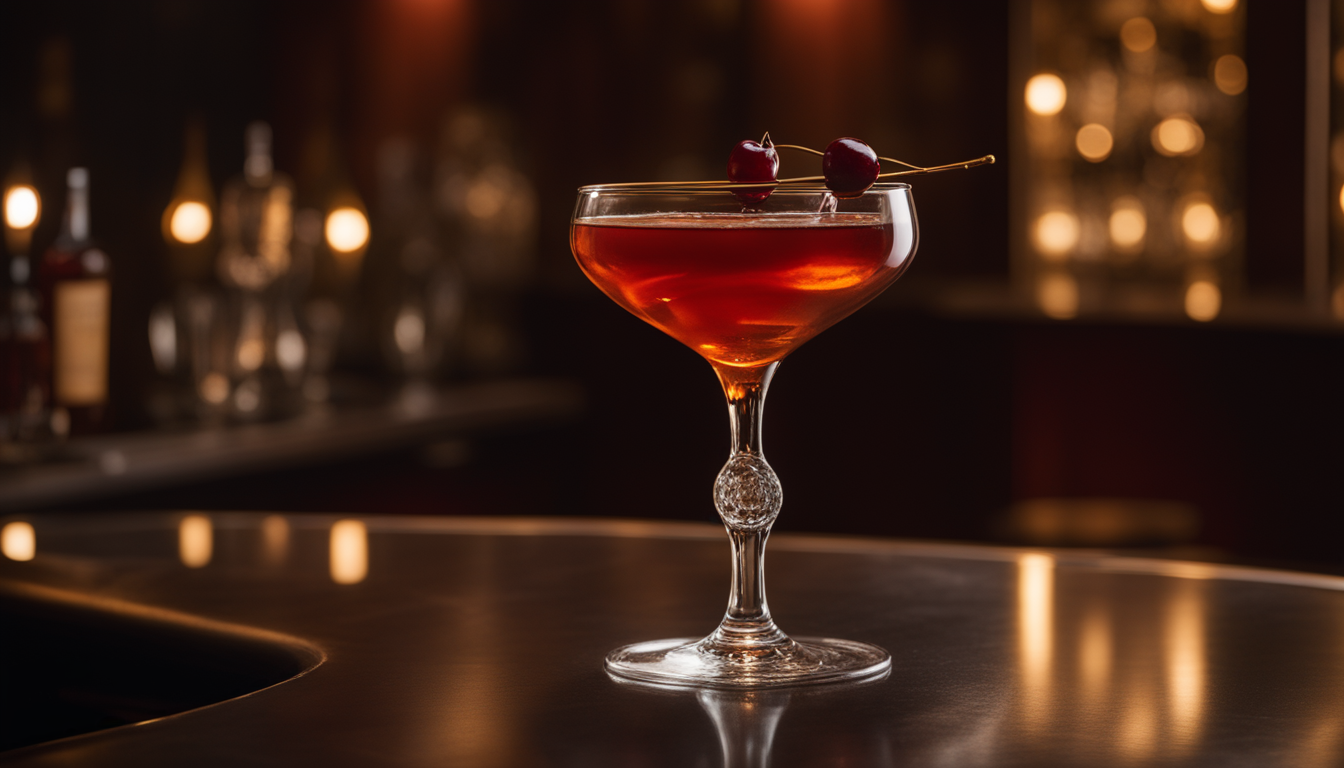
I learned to make a proper Manhattan at Employees Only in New York's West Village, standing at the bar while a bartender named Jason walked me through the ritual with the patience of a philosophy professor. He stirred for exactly fifty rotations — I counted — then strained the amber liquid into a chilled coupe with a motion so practiced it looked effortless. "The Manhattan," he said, placing a Luxardo cherry in the center with tweezers, "is the cocktail that separates people who drink whiskey from people who understand it."
He was right. The Manhattan demands precision. There's nowhere to hide — no citrus to mask cheap bourbon, no sugar to smooth rough edges, no elaborate presentation to distract from mediocre ingredients. It's bourbon, vermouth, bitters, and technique. That's it. Get any element wrong and you'll taste it immediately.
This is the most sophisticated cocktail in American bourbon culture. Not because it's complicated — the recipe is deceptively simple — but because it requires taste, restraint, and an understanding that sometimes less is considerably more. Let me show you how to make it properly.
The Classic Manhattan Recipe
This is the foundation. Master this before you start experimenting.
Ingredients:
- 2 oz rye whiskey (or bourbon — we'll discuss this)
- 1 oz sweet vermouth (Carpano Antica Formula recommended)
- 2 dashes Angostura bitters
- 1 Luxardo Maraschino cherry
- Ice for stirring
Method:
- Chill your coupe glass in the freezer for at least 15 minutes
- Add whiskey, vermouth, and bitters to a mixing glass
- Fill with ice to just above the liquid line
- Stir for 30 seconds (approximately 50 rotations)
- Strain into the chilled coupe
- Garnish with the cherry
- Express an orange peel over the surface (optional but recommended)
Notes: The 2:1 ratio (whiskey to vermouth) is traditional. Some prefer 3:1 for a drier Manhattan. I prefer 2.5:1 with Rittenhouse Rye — it has enough backbone to stand up to full-flavored vermouth without overwhelming it.
The Perfect Manhattan
Despite the name, this isn't "perfect" in the qualitative sense — it's a technical term meaning equal parts sweet and dry vermouth. The result is more complex and less sweet than the classic.
Ingredients:
- 2 oz rye whiskey
- 0.5 oz sweet vermouth (Carpano Antica Formula)
- 0.5 oz dry vermouth (Dolin Dry)
- 2 dashes Angostura bitters
- 1 Luxardo cherry
Method: Same technique as above. The dual vermouth approach creates layers of flavor — you get the rich, vanilla notes from sweet vermouth balanced by the herbaceous, savory character of dry vermouth. This version pairs exceptionally well with steak or aged cheese.
The Reverse Manhattan
This is for afternoons when you want the sophistication of a Manhattan without the full bourbon commitment. Vermouth-forward and lower proof — think of it as the Manhattan's more conversational cousin.
Ingredients:
- 1 oz bourbon (something gentler — Four Roses Single Barrel works beautifully)
- 2 oz sweet vermouth
- 1 dash Angostura bitters
- Orange peel
Method: Same stirring technique. Express the orange peel over the glass and drop it in rather than using a cherry. This drink is lighter, more elegant, and surprisingly food-friendly. I make these before dinner parties while guests arrive — potent enough to be interesting, restrained enough that people can still hold conversations.
The Vermouth Question: Where Most Manhattans Fail
Here's what nobody tells you about vermouth: it's wine. Fortified wine, yes, but wine nonetheless. That bottle of Martini & Rossi you bought three years ago and left in your liquor cabinet? It's been oxidized garbage since month three. You've been making Manhattans with spoiled wine.
Carpano Antica Formula is the gold standard for sweet vermouth in a Manhattan. It's richer, more complex, with notes of vanilla, dried fruit, and baking spices that complement bourbon's natural sweetness without overwhelming it. At around $30 per bottle, it's expensive for vermouth but transformative for the cocktail.
Dolin Rouge is the best value option — lighter, more delicate, less sweet. It won't dominate like Carpano, which makes it ideal if you're using a more subtle bourbon. Around $15 and widely available.
Storage rules (non-negotiable):
- Refrigerate opened vermouth immediately
- Use within 2 months (1 month is better)
- If it smells flat or tastes bitter, it's dead — throw it out
- Buy smaller bottles and replace more often
The ratio debate: Traditional is 2:1 (bourbon to vermouth). Many modern bartenders prefer 3:1 for a drier drink. I've found that 2.5:1 is the sweet spot — enough vermouth to create complexity and mouthfeel, but not so much that you're drinking fortified wine with bourbon notes.
One more thing: If you order a Manhattan "extra dry," what you're actually saying is "I don't like vermouth, so please make me a chilled bourbon with bitters." Which is fine, but it's not a Manhattan. Just drink your bourbon neat.
The Cherry Question: This Matters More Than You Think
Luxardo Maraschino cherries are the only acceptable answer. These are not the neon-red abominations from your childhood Shirley Temples. Luxardo cherries are Marasca cherries preserved in syrup from their own juice — dark, complex, slightly bitter, with a texture that doesn't disintegrate when you touch it. One jar costs around $20 and contains about 50 cherries. It will last you months and transform every Manhattan you make.
Amarena Fabbri cherries are the acceptable Italian alternative — similar quality, slightly different flavor profile, equally expensive. If you can't find Luxardo, these work.
Bright red "maraschino" cherries in the plastic jar at the grocery store are not cherries. They're bleached, brined, artificially colored sugar bombs that taste like regret and childhood. Using them in a Manhattan is like putting ketchup on a dry-aged ribeye. Technically you can do it, but why would you?
If you absolutely cannot find or afford proper cherries, skip the garnish entirely. An expressed orange peel is more elegant than bad cherries.
Technique: Why Stirring Matters
James Bond famously ordered his Martinis "shaken, not stirred." This is presented as sophisticated, but bartenders know the truth: Bond has terrible taste. Shaking a Manhattan (or Martini) is cocktail sacrilege for several reasons.
Stirring dilutes and chills without aeration. The goal is a silky, cold cocktail with crystalline clarity. Shaking introduces air bubbles, creates ice chips, and makes the drink cloudy. It also over-dilutes — you'll end up with watery bourbon instead of a properly integrated cocktail.
The proper technique:
- Use a mixing glass (not a shaker)
- Add your spirits first, then ice
- Stir with a bar spoon in smooth, continuous circles
- 30 seconds of stirring = approximately 50 rotations
- The motion should be effortless — you're guiding, not forcing
You'll know it's ready when condensation forms on the outside of the mixing glass and the liquid looks almost viscous as you stir. The temperature matters — you want it just above freezing, cold enough that it numbs your tongue slightly on first sip.
Strain into a chilled coupe. Not a martini glass (too large, impractical shape), not a rocks glass (wrong temperature dynamics), not a Nick & Nora (too small). A proper 5-6 oz coupe, chilled in the freezer. The shape concentrates aromatics, the size is perfect for the recipe's yield, and the temperature stays consistent longer.
Our Bourbon and Rye Picks for Manhattans
Best Rye: Rittenhouse Rye Bottled in Bond — $30
This is the Manhattan rye. 100 proof, bold, spicy, with enough character to punch through vermouth and bitters without becoming harsh. The bottled-in-bond designation ensures consistency. Every bartender I know keeps a bottle behind the bar.
Best Bourbon: Old Forester 1920 Prohibition Style — $65
If you prefer bourbon to rye (I often do), this is your bottle. At 115 proof, it's got the structure to handle vermouth while maintaining bourbon's characteristic sweetness. Rich, full-bodied, with notes of chocolate and cherry that echo the Luxardo garnish beautifully.
Best Value: Wild Turkey 101 — $25
Don't let the low price fool you. At 101 proof, this bourbon has everything a Manhattan needs — spice, sweetness, enough proof to maintain character when diluted. I've served these at dinner parties where guests assumed I was using something twice the price.
Best Splurge: Michter's 10-Year Single Barrel Rye — $180
For special occasions when you want a Manhattan that costs more than the dinner it accompanies. This is rye at its most refined — elegant, complex, incredibly smooth even at proof. The 10-year age statement means depth and integration that cheaper ryes can't match. Worth it? For the right evening, absolutely.
Find these bottles and more at Bourbon & Whisky — use code BOOZEMAKERS5 for 5% off your order.
What Our Panel Says
Marcus Chen, The Explorer: "I thought Manhattans were drinks for guys who wear suspenders unironically. Then a bartender in Chicago made me one with Four Roses Single Barrel and Carpano Antica — I'd been making them wrong for years. The good vermouth costs as much as the bourbon, which felt insane until I tasted the difference. Now I keep both refrigerated and actually use them before they die. My go-to is 2.5 oz Four Roses, 1 oz Carpano, two dashes Angostura. Around $35 for the bourbon and worth every dollar."
William Hayes, The Connoisseur: "I ordered my first Manhattan at the Oak Bar in the Plaza Hotel in 1987. The bartender used Rittenhouse Rye and what I later learned was Carpano Antica, though I didn't know enough to ask at the time. That drink — perfectly stirred, properly cold, garnished with a single cherry — taught me that cocktails could be as serious as the spirits in them. The Manhattan is bourbon culture's litmus test. If someone makes a good one, they understand whiskey. Most people don't."
Sophia Laurent, The Host: "Manhattans are my secret weapon for dinner parties. I batch them before guests arrive — 12 oz bourbon, 6 oz vermouth, 12 dashes bitters in a pitcher, then refrigerate. When people show up, I just stir over ice and strain. Last month I made them with Wild Turkey 101 before a steak dinner — seven people, all finished their drinks, three asked for the recipe. The cherry matters more than you'd think. I serve Luxardo exclusively. They're expensive but one jar lasts months and the difference is immediately obvious."
Manhattan Variations Worth Knowing
The Rob Roy — Replace bourbon or rye with a good blended Scotch (Famous Grouse, Compass Box). Same recipe, completely different character. More smoke, less sweetness, sophisticated in a tweed-jacket sort of way.
The Black Manhattan — Substitute half the sweet vermouth with Averna amaro. The result is darker, more bitter, with herbal complexity that makes it excellent as a digestif after heavy food. This is what I drink after steak dinners when I'm too full for dessert but want something to sip.
The Bourbon Manhattan — Technically not a variation since Manhattan recipes have always accepted bourbon as an alternative to rye, but the flavor profile shifts significantly. Bourbon Manhattans are sweeter, rounder, less aggressive. I prefer them in fall and winter when I want comfort rather than conversation.
The Brooklyn — Add 0.25 oz dry vermouth and 0.25 oz Maraschino liqueur, reduce sweet vermouth to 0.75 oz. More complex, slightly drier, named after Manhattan's more interesting borough.
Common Mistakes (And How to Avoid Them)
1. Using old vermouth — If you bought it more than two months ago and it's been sitting at room temperature, throw it out. Start over. This single mistake ruins more Manhattans than everything else combined.
2. Shaking instead of stirring — I've addressed this, but it's worth repeating: shaking is wrong. Cloudiness, ice chips, over-dilution, improper texture. Just don't.
3. Wrong cherry choice — Those neon-red cherries belong in children's desserts, not in a $15 cocktail made with bourbon that costs $30 per bottle. Luxardo or nothing.
4. Inadequate chilling — The glass should be frozen, the cocktail should be stirred until condensation forms on the mixing glass, and you should serve immediately. A warm Manhattan is an oxymoron.
5. Using cheap bourbon — The Manhattan exposes every flaw in your whiskey. That bottom-shelf bourbon you bought for parties? It will taste harsh, thin, and bitter in a Manhattan. Use something you'd actually drink neat — Wild Turkey 101 is the bare minimum.
6. Over-garnishing — One cherry. One expressed orange peel if you're feeling ambitious. That's it. This isn't a tiki drink. Restraint is sophistication.
Final Thoughts
The Manhattan is bourbon culture's defining cocktail because it demands that you care about ingredients, technique, and precision. There's no forgiveness for mediocre vermouth, no hiding rough bourbon, no elaborate presentation to distract from the fundamentals. It's honest, elegant, and uncompromising — exactly what whiskey culture should be.
Master this drink and you'll understand why serious bourbon enthusiasts respect it. Now go chill a coupe and make one properly.
Don't have the bottles yet? Here's how to build a $500 home bar that punches like $5,000 — everything you need to make this and dozens of other classics.