For 88 years there was no legal whiskey distillery in Manhattan. From the start of Prohibition in January 1920 until Great Jones Distilling Co. opened the doors at 686 Broadway in NoHo in 2021, the borough that gave the world the cocktail had no place where the cocktail's main ingredient was actually being made. That's the kind of statistic that makes you re-examine what you thought you knew about American whiskey geography. New York is one of the original whiskey states. The Hudson Valley supplied rye to the colonial economy. Brooklyn made beer and whiskey at industrial scale until Volstead. The city is the original American whiskey market and was, for two centuries, also a serious producer.
The modern New York whiskey trail is the story of a state rebuilding what Prohibition broke. Tuthilltown Spirits opened in Gardiner in 2005 as the first New York distillery since Prohibition — the source of the Hudson Whiskey brand William Grant later bought. Kings County Distillery opened at the Brooklyn Navy Yard in 2010 and is now the oldest operating in NYC. Hillrock Estate Distillery in Ancram floor-malts grain on the same Hudson Valley land where it's grown — the first U.S. distillery since pre-Prohibition to do that. Widow Jane in Red Hook proofs every bottle with limestone water shipped from the same Rosendale mines whose cement built the Brooklyn Bridge. New York Distilling Company in Williamsburg makes Ragtime Rye from a 72% rye mash bill that's pure New York. And Great Jones, in 2021, completed the symbolic return.
What follows is the four-day route — Manhattan to Brooklyn to the Hudson Valley — plus the lodging, the bars to drink at between distilleries, and the bottles worth shipping home. New York is the most concentrated, most varied, and most unusual whiskey trail in the country. Land at JFK on Friday morning. Drink at six distilleries by Monday night.
Distillery Directory(6 of 6)
Great Jones Distilling Co.
Manhattan (NoHo)
Manhattan's first legal whiskey distillery since Prohibition began in 1920. Opened 2021 at 686 Broadway. 100% NY-sourced grain and water.
Hillrock Estate Distillery
Hudson Valley (Ancram)
First U.S. distillery since pre-Prohibition to floor-malt grain on site from estate-grown stock. World's first solera-aged bourbon.
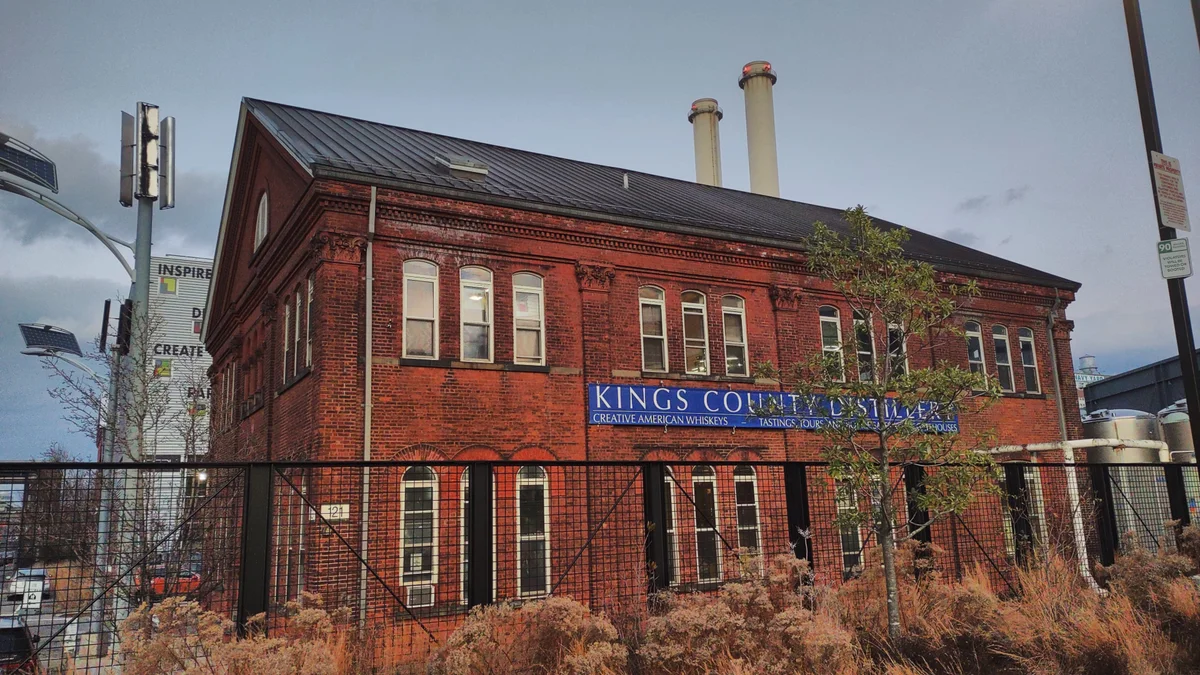
Kings County Distillery
Brooklyn (Brooklyn Navy Yard)
Oldest operating whiskey distillery in NYC. Founded 2010, housed in the historic 1899 Paymaster Building inside the Brooklyn Navy Yard.
New York Distilling Company
Brooklyn (East Williamsburg)
Founded 2011. Ragtime Rye flagship: 72% rye / 16% corn / 12% malted barley, NY-grown rye, distilled and aged on East Williamsburg's Cherry Street block.
Tuthilltown Spirits / Hudson Whiskey
Hudson Valley (Gardiner)
Founded 2005 — New York's first distillery since Prohibition. William Grant & Sons acquired the brand 2010 and the full 36-acre facility 2017.
Widow Jane Distillery
Brooklyn (Red Hook)
Limestone-water-proofed bourbon at 218 Conover St. Water shipped from the Rosendale Mines whose cement built the Brooklyn Bridge.
Photo credits
- Kings County Distillery: Jim.henderson, CC BY 4.0
Three ways to do this trail depending on how much time you have. Switch between them to see what fits and what gets cut.
City-only weekend. Skip the Hudson Valley. Brooklyn-heavy.
Manhattan · Great Jones
Land at JFK or LGA. Drop bags. Great Jones tour afternoon. Dinner in the Lower East Side.
Brooklyn day · Kings County + Widow Jane + NYDC
All three Brooklyn distilleries in one day. Kings County morning, Widow Jane afternoon, NYDC evening. Fly out late from JFK.
Use the Drive Time Matrix above to refine timing if you adjust the route.
Pick a starting distillery; see the time and distance to each of the others. Stops on the same trail page.
| Destination | Distance | Drive Time | Notes |
|---|---|---|---|
Kings County Distillery Brooklyn (Brooklyn Navy Yard) | 4 mi | 25 min | Manhattan to Brooklyn Navy Yard via Manhattan Bridge. ~25 min by rideshare. |
Widow Jane Distillery Brooklyn (Red Hook) | 5 mi | 30 min | Manhattan to Red Hook via Brooklyn Bridge or Battery Tunnel. |
New York Distilling Company Brooklyn (East Williamsburg) | 4 mi | 25 min | Manhattan to East Williamsburg via Williamsburg Bridge. |
Tuthilltown Spirits / Hudson Whiskey Hudson Valley (Gardiner) | 90 mi | 1h 40m | Manhattan to Gardiner via Palisades or Taconic. ~1.5-2 hrs. |
Hillrock Estate Distillery Hudson Valley (Ancram) | 130 mi | 2h 25m | Manhattan to Ancram. ~2.5 hrs via Taconic. |
Times are rough sober-driving estimates. Add 25-50% during peak commute hours in cities.
Hotels and restaurants by city, picked for proximity to the distilleries on this trail.
The Bowery Hotel
Manhattan (East Village)
Boutique, walking distance to Great Jones.
The Standard, East Village
Manhattan (East Village)
Modern, walkable to NoHo.
The Marlton
Manhattan (Greenwich Village)
Small, classic, central.
The Wythe Hotel
Brooklyn (Williamsburg)
Manhattan skyline views, walkable to NY Distilling Co.
Mohonk Mountain House
New Paltz (Hudson Valley)
Iconic 1869 resort, 10 minutes from Tuthilltown.
Inn at Stone Ridge
Stone Ridge (Hudson Valley)
Boutique, central.
Hampton Inn New Paltz
New Paltz (Hudson Valley)
Reliable mid-range.
What to chase at the distillery, what to skip and buy back home, and what's only available on the resale market.
Hillrock Solera Aged Bourbon
Hillrock Estate Distillery · Hudson Valley (Ancram)
World's first solera-aged bourbon. Distillery has best in-stock window after annual release.
Hillrock Double Cask Rye
Hillrock Estate Distillery · Hudson Valley (Ancram)
Estate-grown rye, finished in second cask.
Hillrock Single Malt
Hillrock Estate Distillery · Hudson Valley (Ancram)
Estate-grown, floor-malted barley. Newest expression.
Widow Jane 10-Year Bourbon
Widow Jane Distillery · Brooklyn (Red Hook)
Limestone-water-proofed. The flagship bourbon.
Widow Jane Paradigm Rye
Widow Jane Distillery · Brooklyn (Red Hook)
The Widow Jane rye expression.
Widow Jane Tequila Ocho Cask Finish
Widow Jane Distillery · Brooklyn (Red Hook)
Spring 2026 release. 8-month tequila-cask finish on bourbon. Limited.
Kings County Empire Rye
Kings County Distillery · Brooklyn (Brooklyn Navy Yard)
75% NY-grown rye. Empire Rye regional designation.
Kings County Peated Bourbon
Kings County Distillery · Brooklyn (Brooklyn Navy Yard)
Scotch-style peated barley alongside corn. One of few American bourbons doing this seriously.
Kings County Bourbon
Kings County Distillery · Brooklyn (Brooklyn Navy Yard)
High-malted-barley four-grain flagship.
NY Distilling Co Ragtime Rye Bottled-in-Bond
New York Distilling Company · Brooklyn (East Williamsburg)
100 proof, 4-year minimum. Underpriced for the quality.
NY Distilling Co Ragtime Rye
New York Distilling Company · Brooklyn (East Williamsburg)
The standard 4-year Ragtime.
Hudson Bright Lights, Big Bourbon
Tuthilltown Spirits / Hudson Whiskey · Hudson Valley (Gardiner)
William Grant–era flagship. Longer-aged than original Hudson Baby.
Hudson Baby Bourbon
Tuthilltown Spirits / Hudson Whiskey · Hudson Valley (Gardiner)
The original 3-gallon-cask bourbon. The category creator for NY.
Hudson Manhattan Rye
Tuthilltown Spirits / Hudson Whiskey · Hudson Valley (Gardiner)
The Hudson rye expression.
Great Jones Bourbon
Great Jones Distilling Co. · Manhattan (NoHo)
Manhattan-distilled, 100% NY-sourced. The symbolic bottle of the trail.
Great Jones Rye
Great Jones Distilling Co. · Manhattan (NoHo)
The Great Jones rye expression.
Click each row to cycle through not started → researching → booked. Saved in this browser; survives a refresh.
What to order at the bourbon bars between distilleries on the The New York Distillery Trail. Each entry has the recipe, the right time to order it, and the line to give a bartender to get it the way you want.
The Build
- 2 oz whiskey (anything 90+ proof)
- 1 sugar cube (or 1/2 tsp simple syrup)
- 2-3 dashes Angostura bitters
- Orange peel garnish, no fruit muddling
- One large ice cube — never crushed ice
Ask the bartender
"Old Fashioned, please — whiskey-forward, no fruit, large cube."
Bourbon style
High-rye 90-100 proof bourbons. The rye spice cuts the sugar and bitters.
Why the New York whiskey scene is its own thing
Three things to understand before you book the trip.
The pre-Prohibition heritage. The Hudson Valley grew rye for the colonial whiskey trade. Brooklyn's Bushwick and Greenpoint neighborhoods housed dozens of distilleries through the late 1800s — the Brooklyn Eagle's archives are full of distillery-fire stories from that era. By 1920 it all stopped. The 88-year gap is why New York whiskey feels new even when its raw materials are old: the producers operating today are mostly the first generation, building on grain and water sources that have been there since the 1600s but with no continuous distilling tradition to inherit.
The grain-to-glass radicalism. New York's craft distillers, more than any other state's, lean into heritage practice. Hillrock floor-malts on site. Coppersea (currently in transition between facilities) is one of only four U.S. distilleries with floor-malting space. Tuthilltown's Hudson Whiskey was originally made in 3-gallon barrels — small-cask aging that compresses oak interaction into months instead of years. New York Distilling Company's Ragtime Rye uses New York–grown rye exclusively. The state's distilleries don't compete on volume; they compete on raw-material specificity.
The geographic split. The trip has two halves: city distilleries (Manhattan + Brooklyn) and Hudson Valley distilleries (Gardiner, New Paltz, Ancram). The city stops are tasting-room-and-tour experiences in dense urban blocks. The Hudson Valley stops are working farms with grain in the ground and barrels in the rickhouse. You move between them, and the move itself — Metro-North or Amtrak up the Hudson, or a one-way rental car — is part of the experience.
The flagship distilleries — what to drink, where to taste, what makes them matter
1. Great Jones Distilling Co. — Manhattan (NoHo)
The symbolic return. Great Jones opened in 2021 at 686 Broadway as the first legal whiskey distillery in Manhattan since Prohibition began in 1920. Eighty-eight years, one borough, zero whiskey production. The name is the address-adjacent Great Jones Street, the NoHo block running parallel to Broadway just south of Astor Place. The space is purpose-built: visible production floor, a tasting room, a full restaurant and bar, and event space.
The whiskeys are 100% New York–sourced — grain from upstate, water from the city, distilled and aged on premises. The flagship lineup includes the Great Jones Bourbon and Great Jones Rye, both four-grain mash bills using New York–grown corn, rye, and barley. The hour-long tour walks you through milling, mashing, fermenting, and distilling, then ends with a four-whiskey tasting flight in the bar. The bar itself is reason enough to come: classic cocktails poured by people who know what's in them, snacks that work, tablecloths, real glassware. The kind of midtown-adjacent stop that justifies the price tag.
Practical: tours run by reservation through their site. Located steps from Bleecker Street and the 6/B/D/F/M trains. If you can only do one Manhattan stop, this is it.
2. Kings County Distillery — Brooklyn (Brooklyn Navy Yard)
Founded 2010 in the Brooklyn Navy Yard, Kings County is the oldest operating whiskey distillery in New York City. The home base is the historic 1899 Paymaster Building inside the Navy Yard, a federal landmark that's been repurposed into one of the more atmospheric distillery experiences anywhere in the country. The 45-minute tour walks the full whiskey-making process — milling, mashing, fermenting, distilling, barrel aging — and ends with a guided tasting flight of four signature whiskeys plus a sample of their unaged moonshine.
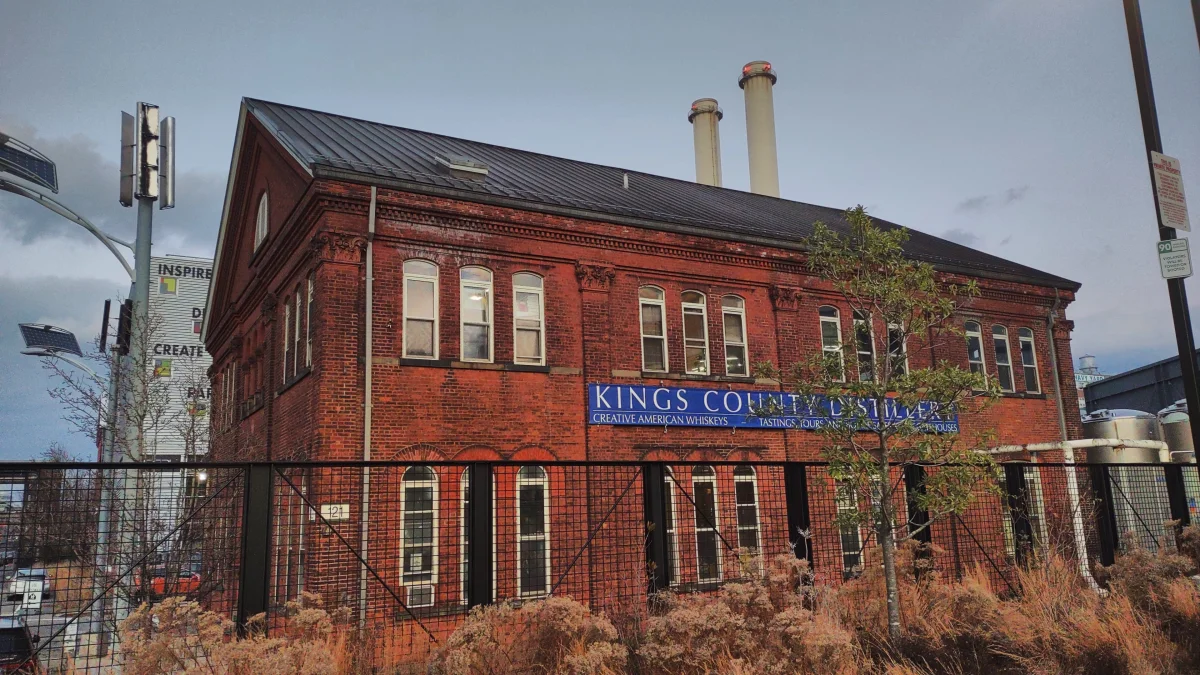
The lineup is intentionally varied. The flagship Kings County Bourbon is a high-malted-barley four-grain pour. The Peated Bourbon uses Scotch-style peated barley alongside corn — one of the few American bourbons doing this seriously. The Empire Rye is a New York State–defined regional designation (75% New York–grown rye, distilled and aged in NY) and Kings County is one of its most committed practitioners. They also produce a chocolate whiskey (real, intentional, surprising) and rotating single-cask experiments.
Practical: tours start at the Gatehouses on the corner of Sands and Navy Streets (mapping software: 299 Sands St). $40 per person, including the full tasting. Free cancellation up to 24 hours. Public tours run on a regular schedule — book ahead, especially for weekend afternoons.
3. Widow Jane Distillery — Brooklyn (Red Hook)
The Red Hook neighborhood is one of those Brooklyn pockets that still feels like a different city. Cobblestone streets, harbor views, IKEA at one end, the Tesla showroom at another, and at 218 Conover Street, Widow Jane Distillery and tasting room. Founded as part of the Cacao Prieto chocolate / Catskill Distilling family of producers, Widow Jane is now its own brand and one of the most distinctive small-batch operations in the country.
The differentiator is the water. Widow Jane proofs every bottle with pure limestone-mineralized water shipped from the Rosendale Mines in upstate New York — the same mines whose hydraulic cement was used to build the Brooklyn Bridge, Statue of Liberty pedestal, and Empire State Building foundation. The brand pays homage with the name (Widow Jane was one of the original Rosendale mines), and the result is a whiskey with a distinctive minerality you don't find in most American bourbons.
The flagship Widow Jane 10-Year is a sourced-and-blended bourbon proofed with the limestone water. Paradigm Rye is the rye expression. Apple Wood Rye uses applewood-finished maple staves for a distinctive secondary flavor profile. As of April 2026, Widow Jane released a Tequila Ocho Cask Finish Bourbon aged eight months in casks from one of Mexico's most respected tequila producers — the kind of small-run experiment that defines the brand.
Practical: public tours Friday, Saturday, Sunday, $27 per person, capped at 10 guests. Private weekday tours $37. The tasting includes the 10-Year, Paradigm Rye, and Apple Wood Rye. Walk to Sunny's after — the Red Hook bar that's the right finish to a Widow Jane afternoon.
4. New York Distilling Company — Brooklyn (East Williamsburg)
Founded 2011 by Allen Katz and the founders of Flatiron Wines, New York Distilling Company is the Williamsburg whiskey operation. Their flagship is Ragtime Rye, a New York–defined Empire Rye made from 72% rye, 16% corn, and 12% malted barley — the rye grown in New York State, the whiskey distilled and aged on East Williamsburg's industrial Cherry Street block. They release both a standard four-year Ragtime Rye and a Bottled-in-Bond version (100 proof, four-year minimum, single-distillery) that's one of the better-priced bottled-in-bond ryes coming out of any state.
NY Distilling's tasting room — The Shanty — is the on-site bar that pours everything they make plus rotating guest spirits. It's an industrial-block bar in the best Brooklyn sense: poured-concrete floor, exposed steel, a long copper-topped bar, and the actual still visible through the glass. Worth visiting for the whiskey, worth staying for the cocktail program.
Practical: tours run on a published schedule, typically weekend afternoons. The Shanty is open most evenings. Take the L to Morgan Avenue or the G to Broadway.
5. Tuthilltown Spirits / Hudson Whiskey — Hudson Valley (Gardiner)
Founded 2005 by Ralph Erenzo and Brian Lee, Tuthilltown was the first distillery in New York State since Prohibition. It put New York whiskey back on the federal map. William Grant & Sons (parent of Glenfiddich and Balvenie) acquired the Hudson Whiskey brand in 2010 and bought the entire 36-acre Tuthilltown facility in 2017. The campus today operates as a working distillery, a tasting room and visitor center, a gourmet restaurant, and a scenic property with riverfront views.
The original Hudson Whiskey lineup — Hudson Baby Bourbon, Hudson Manhattan Rye, Hudson Four Grain — was famously aged in 3-gallon barrels, a small-cask approach that compressed oak interaction and let the brand bring younger whiskey to market faster. The William Grant ownership has expanded the program with longer-aged expressions: Hudson Bright Lights, Big Bourbon, Do The Rye Thing, and a series of single-barrel releases. The tasting room flight is the right way to taste the evolution.
Practical: 14 Grist Mill Lane, Gardiner. Visitor center open Mon and Wed 12-6, Thu-Sun 12-8. Tours run as scheduled experiences — the Bourbon Renewal Tour ($30, 45 minutes) is the standard option, the Whiskey Cocktails 101 mixology class ($50) is the small-group alternative. The on-site restaurant takes reservations. Worth pairing with a New Paltz overnight.
6. Hillrock Estate Distillery — Hudson Valley (Ancram)
The serious one. Hillrock Estate sits on a Berkshire-foothills farm at 408 Pooles Hill Road in Ancram, two hours north of New York City and about 45 minutes east of the Tuthilltown / New Paltz cluster. Founded by Jeff Baker, Hillrock is the first U.S. distillery since pre-Prohibition to floor-malt grain on site from estate-grown stock. The floor-malting room is open during tours; you can walk on the malting grain, see the process at every stage, watch the kiln, and end at the still room where the distilled spirit comes off the column.
The flagship is the Hillrock Solera Aged Bourbon — the world's first solera-aged bourbon. The solera method, more often associated with Sherry, Port, and Madeira, ages multiple vintages in the same barrel by continually mingling younger and older whiskey, producing a progressively older average age. Hillrock's solera bourbon has been running for over a decade, which means a 2026 bottle includes some of the 2014 inaugural distillation. The Double Cask Rye is rye grown and distilled on the estate, finished in a second cask. The Single Malt is the latest expression — American single malt from estate-grown, floor-malted barley, in the same Hudson Valley aging conditions.
Practical: open Monday through Sunday, 11 AM – 5 PM. Tours by reservation through the site. The drive from New York City is about two hours; the drive from New Paltz is 45 minutes through eastern Hudson Valley farmland. Plan a half-day; the property and tasting are worth slowing down for.
The tier-two stops worth a detour
If you have an extra day or you're already in the area:
- Coppersea Distilling (New Paltz) — Heritage-grain, floor-malting craft distillery, currently in transition between facilities. Confirm operating status before driving. When open, one of the more academically rigorous whiskey programs in New York.
- Catskill Distilling (Bethel) — The Catskill Mountains operation that includes the Dancing Cat Saloon. Worth the detour if you're already heading west.
- Black Dirt Distillery (Pine Island, Warwick) — Black Dirt Bourbon and Apple Brandy from the unique "black dirt" soil of Orange County's onion-and-fruit farmland.
- Long Island Spirits (Baiting Hollow) — Pine Barrens vodka and whiskey from the eastern Long Island farm belt. A different trip, but on the geographic edge of the New York scene.
- Forthave Spirits / Owney's Rum (Brooklyn) — Not whiskey, but the Owney's Rum operation in East Williamsburg is an interesting stop if you want to vary the base spirit.
The four-day route — Manhattan to Brooklyn to the Hudson Valley
Day 1 — Manhattan
Morning: arrive at JFK or LGA. Take the AirTrain + LIRR or rideshare into Manhattan. JFK→Manhattan via AirTrain + LIRR is about 50 minutes for $11; rideshare is 45-90 minutes for $60-90 depending on traffic.
Lunch: Lupa (170 Thompson St, SoHo) for Roman pasta and a glass of Frascati. Joe's Pizza on Carmine Street if you want the New York classic. Russ & Daughters Cafe if you want bagels-and-lox at sit-down level.
Afternoon: Great Jones Distilling Co. 686 Broadway, NoHo. Reserve the hour-long tour ahead of time. Tour ends with a four-whiskey flight in the upstairs bar. Worth ordering a cocktail off the menu before you leave.
Late afternoon: walk the Lower East Side. Manhattan's whiskey-bar density is the highest in the country. The Up & Up (MacDougal St), Death & Co (E 6th St), Attaboy (Eldridge St), Milk & Honey heritage at PDT (St. Marks) — pick one, drink one cocktail, move on.
Dinner: Carbone if you want the Italian-American spectacle ($$$$, reserve a month ahead). Frenchette in Tribeca for the bistro angle. Joe Allen in Theatre District if you want the after-Broadway scene.
Lodging: The Bowery Hotel — boutique, walking distance to Great Jones. The Standard, East Village — modern, walkable to NoHo. The Marlton — small, classic Greenwich Village.
Day 2 — Brooklyn
Morning: Kings County Distillery. 299 Sands St (Brooklyn Navy Yard). Reserve the 11 AM or 12 PM tour. 45-minute walkthrough of the historic Paymaster Building, ending with a four-whiskey tasting flight. Buy at least one bottle of the Empire Rye on the way out.
Lunch: walk to DUMBO. 15 minutes from the Navy Yard. Vinegar Hill House for a sit-down farm-to-table lunch in the converted-warehouse aesthetic. Juliana's Pizza for the coal-oven classic. Time Out Market at Empire Stores if you want options.
Afternoon: Widow Jane Distillery. 218 Conover St, Red Hook. About 25 minutes from DUMBO via rideshare. Public tour 2 PM or 3 PM ($27, max 10 guests). Tasting includes the 10-Year, Paradigm Rye, and Apple Wood Rye. Take a 10-Year home.
Late afternoon: New York Distilling Company / The Shanty. 79 Richardson St, East Williamsburg. About 30 minutes from Red Hook. Walk-in to The Shanty bar, taste through the Ragtime Rye lineup including the Bottled-in-Bond.
Dinner: stay in Williamsburg. St. Anselm — chef-driven steakhouse, no reservations, worth the wait. Lilia — Missy Robbins' fresh pasta, reserve weeks ahead. Roberta's — the Bushwick pizza institution, casual.
Lodging: If you want to stay in Brooklyn, The Wythe Hotel in Williamsburg is the play — Manhattan skyline views, walkable to NYDC. Otherwise return to Manhattan for the night.
Day 3 — Hudson Valley (Gardiner / New Paltz)
Morning: leave the city. Three options. (a) Drive — pick up a one-way rental at LaGuardia or Brooklyn, take the FDR up to the Henry Hudson, north on the Palisades or Taconic State Parkway. About 90 minutes to Gardiner. (b) Amtrak from Penn Station to Poughkeepsie, then 30-minute rideshare to Gardiner. (c) Metro-North Hudson Line to Poughkeepsie, same connection.
Late morning: Tuthilltown Spirits / Hudson Whiskey. 14 Grist Mill Lane, Gardiner. Reserve the Bourbon Renewal Tour ($30, 45 minutes) ahead. The tasting room is the highlight — pour through the full Hudson Whiskey lineup, including any limited single-barrel releases.
Lunch: at the Tuthilltown on-site restaurant if you've reserved. Otherwise drive 20 minutes to The Bistro at the Mountain Brauhaus in Gardiner, or 25 minutes to Main Street Bistro in New Paltz.
Afternoon: New Paltz / Coppersea (if open). Coppersea is in transition between facilities — call before driving the 10 minutes from Tuthilltown. If they're closed, alternative: walk the SUNY New Paltz campus, have coffee at Mudd Puddle, or hike the Mohonk Preserve trails (one of the best short hikes in the eastern US).
Dinner: A Tavola Trattoria in New Paltz (Italian, neighborhood-favorite, reserve), or drive 20 minutes to Crew Restaurant in Poughkeepsie for the chef-driven New American option.
Lodging: Mohonk Mountain House — the iconic 1869 Hudson Valley resort, 10 minutes from Tuthilltown. Pricier but unforgettable. Inn at Stone Ridge — boutique, central. Hampton Inn New Paltz for reliable mid-range.
Day 4 — Drive to Ancram, Hillrock, return to NYC
Morning: drive east to Ancram. About 45 minutes from New Paltz. The route runs through eastern Hudson Valley farmland — barns, horse pastures, the Berkshire foothills rising on the eastern horizon. One of the prettier rural drives in the Northeast.
11:00 AM — Hillrock Estate Distillery. 408 Pooles Hill Rd, Ancram. Reserve the tour ahead. 11 AM – 5 PM Mon-Sun. The full tour walks the floor-malting room, the still house, the rickhouse, and ends at the tasting bar. Take home a Solera Aged Bourbon — it's the unique-to-Hillrock bottle worth the trip.
Lunch: drive 15 minutes to Hudson, NY. The town is one of the more interesting small-town New York food scenes. Gaskins for farm-to-table (in nearby Germantown, 15 min from Hillrock). Lil' Deb's Oasis for the chef-driven, queer-art-scene-favored Latin-Caribbean menu. Bartlett House in Ghent for an excellent bakery-and-cafe lunch.
Afternoon: drive back to NYC. Hudson to Manhattan via the Taconic is about 2 hours, slightly less via the Thruway. Or board the Amtrak Empire Service at Hudson station — 2 hours direct to Penn Station, the more civilized option after a day of tasting.
If you have time before your flight: One last bourbon bar in Manhattan. Maison Premiere in Williamsburg, The Dead Rabbit in the Financial District, Pouring Ribbons in Alphabet City. Each is the right place for one quiet pour and a New York send-off.
The bottles to bring home
If you can ship six bottles, here's the case we'd send.
- Hillrock Solera Aged Bourbon (~$120). The world's first solera-aged bourbon. Estate-grown, floor-malted, ten-plus years of solera mingling. Nothing else in American whiskey tastes like this.
- Widow Jane 10-Year Bourbon (~$80). The limestone-water bottle. Distinctively mineral, soft, balanced. The Brooklyn pour that feels like New York.
- Kings County Empire Rye (~$60). The New York State–defined regional rye. 75% NY-grown rye, NY-aged, NY-distilled. The right rye for a Sazerac in a Brooklyn brownstone.
- Hudson Bright Lights, Big Bourbon (~$50). The William Grant–era Tuthilltown bourbon — longer aged than the original Hudson Baby Bourbon, broader flavor profile, the bottle most likely to convert a Kentucky drinker.
- NY Distilling Co. Ragtime Rye Bottled-in-Bond (~$50). The Williamsburg flagship. 100 proof, four-year minimum, single-distillery. Underpriced for the quality.
- Great Jones Bourbon (~$60). The Manhattan return-to-form. 100% NY-sourced. The bottle to gift the friend who didn't think New York could do bourbon.
Practical logistics
Best months to visit. Late April through late October. New York summer is hot and humid (July-August can hit 90s + dewpoint) but the city distilleries are climate-controlled and the Hudson Valley is 10°F cooler than the city. The fall — late September through October — is the absolute sweet spot: foliage in the Hudson Valley, 60s-70s temps, cocktail-bar weather in the city. Avoid mid-summer if you can; January-February if you want to skip cold-and-snow concerns for the inter-city drives.
Airport priority. JFK is the best entry point for international flights. LGA is faster to Manhattan but smaller. If you're flying into JFK and out of Albany (ALB), you can do a one-way trip ending in the Hudson Valley — fly into JFK, do the city days, drive north, fly home from Albany. ALB is 90 minutes from Hillrock and rents most of the same major car brands.
Tour booking lead times. Great Jones: 1-2 weeks for weekend slots. Kings County: 1-2 weeks for weekend tours. Widow Jane: 1 week (limited 10-guest cap). NYDC / The Shanty: walk-in for the bar, tours run weekend afternoons. Tuthilltown: 1 week for tours. Hillrock: 1-2 weeks. The bigger constraint is your own scheduling — six distilleries in four days is the right pace, not five, not seven.
The grain story. Empire Rye is a New York State–defined regional designation: 75% New York-grown rye, distilled and aged in NY, no minimum age but typically 2+ years. Kings County, NY Distilling Co, Hillrock, and several others produce official Empire Rye expressions. Worth knowing the term — it's the closest American whiskey has to an appellation system.
Public transit / driving. The city distilleries are subway-accessible. The Hudson Valley distilleries are not — you need a car or a rideshare from a Metro-North / Amtrak station. Cars rent cheaper at LGA than Manhattan; Amtrak Empire Service from Penn Station to Poughkeepsie or Hudson is the no-rental alternative.
Frequently asked questions
Can I do this trip without a car?
Mostly. The Manhattan and Brooklyn distilleries are subway-accessible. For the Hudson Valley legs, take Metro-North or Amtrak to Poughkeepsie or Hudson, then rideshare 15-30 minutes to the distillery. Hillrock specifically is easier with a car — Ancram is rural and Uber availability is limited. If you're car-free, plan to base in Hudson, NY (the town) for a night and rideshare to and from Hillrock.
What's Empire Rye and why does it matter?
Empire Rye is a regional designation defined by the Empire Rye Whiskey Association in 2015: 75% New York-grown rye in the mash bill, distilled and aged in New York, single-distillery (no blending of out-of-state spirit). It's the closest American whiskey has to an appellation. Kings County, NY Distilling Co, Hillrock, Coppersea, Tuthilltown, and Black Dirt all produce certified Empire Rye expressions. Worth ordering when you see it on a menu.
Is the Hudson Valley actually different from Kentucky bourbon country?
Yes. Two main differences. First, climate: Hudson Valley aging is cooler and more even than central Kentucky's brutal swings, which means slower oak interaction and a different aging curve. Second, grain: New York rye is the historic American rye-whiskey variety, distinct from the Kentucky standard, and the grain shows up in the finished whiskey. Drink a Hillrock Solera blind next to a Kentucky bourbon; most palates will pick the Hillrock as the more elegant, less aggressive pour.
What if I only have two days?
Pick the city. Day 1: Great Jones (Manhattan). Day 2: Kings County and Widow Jane (Brooklyn). You'll skip the Hudson Valley story but the city distilleries are the more time-efficient version of the New York whiskey trail. Save the Hudson Valley for a weekend trip later.
The why-now
For 88 years New York whiskey was a hole. The original 1700s rye tradition, the 1800s Brooklyn distillery boom, the colonial Hudson Valley grain economy — Prohibition wiped all of it off the map and nothing replaced it for almost a century. The trip you can take in 2026 — Manhattan to Brooklyn to the Hudson Valley, six distilleries in four days, Empire Rye to estate-grown solera bourbon — exists because of a 2005 small-business decision in Gardiner that opened the door, a Brooklyn Navy Yard lease in 2010 that made the city a working whiskey town again, and a Manhattan permitting victory in 2021 that closed the symbolic loop.
It's also still early. The producers on this trail are nearly all first-generation. The aging stocks are still building. The Empire Rye designation is barely a decade old. The trip will be different in 2030 — bigger, more polished, more crowded — but it won't be more authentic. Right now you can walk into Hillrock and meet the head distiller. You can take a tour at Kings County led by someone who started there before the Navy Yard had this many tenants. Land at JFK on Friday. Drink at six distilleries by Monday night. Bring back the Solera, the limestone water, the Empire Rye. New York is rebuilding its whiskey scene one bottle at a time, and the trip is the best way to see it before the secret gets out.
Plan another trip — more trail guides
The Boozemakers Annual · Coming Soon
The bottles to bring back home
The year’s Best 100 bottles — the bottle picks behind every distillery in this guide, scored and price-stamped. Use code HALFOFF for $14.50.
Join the launch waitlistOur Spirits Partner
Stock up before the trip
Cask Cartel ships allocated and hard-to-find bottles nationwide. Worth a look before you fly out — line up the pours you want to taste so you know what’s worth hunting for on the trail (and hauling home in the carry-on).
Shop bottles at Cask Cartel