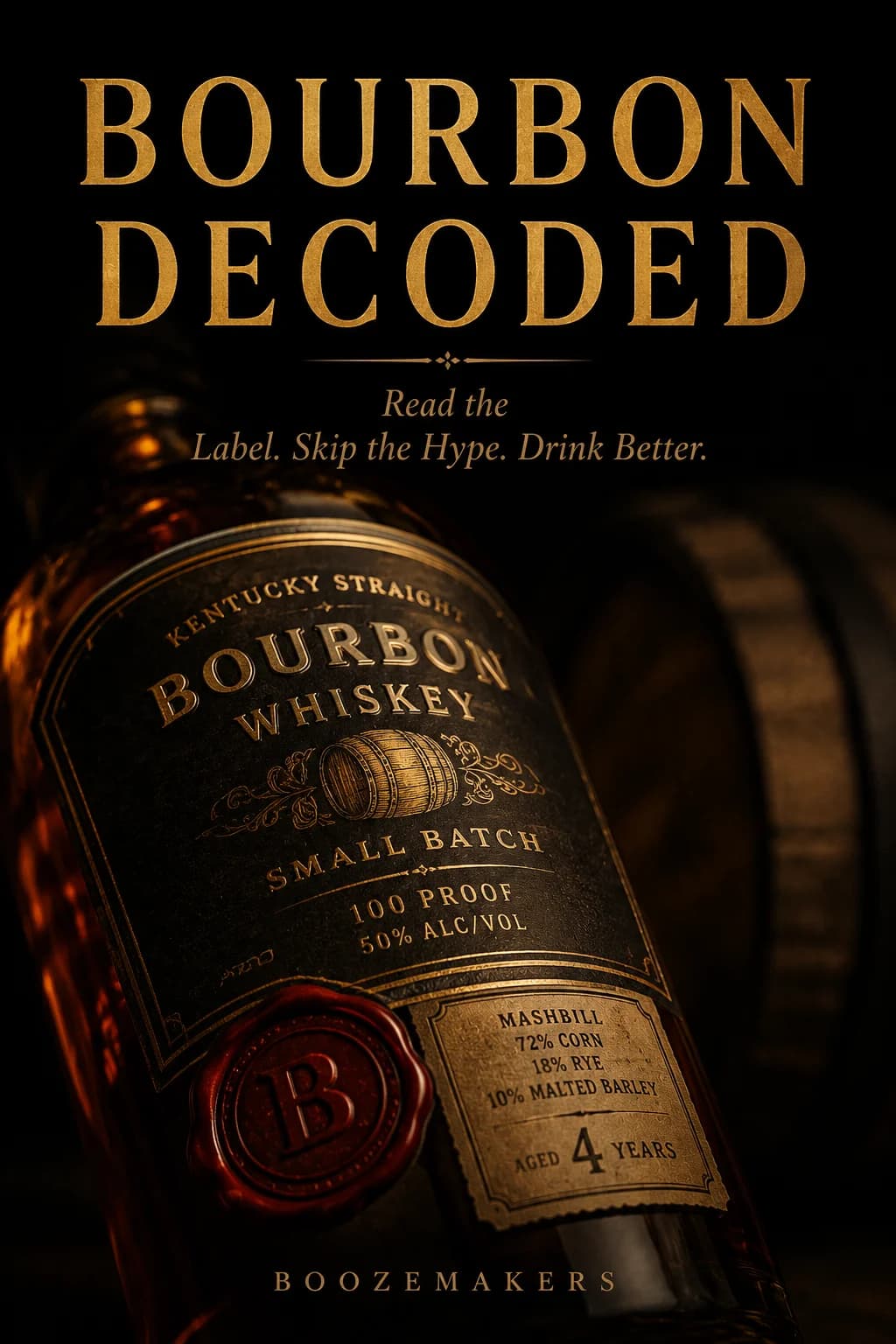
Bourbon
Decoded
Read the Label. Skip the Hype. Drink Better.
From the editors of Boozemakers — 140+ pages, 9 chapters, 4 cheat-sheet appendices, a full bourbon glossary, and the 30-bottle library you’ll build for years.
Drop your email below — we’ll send the PDF straight to your inbox. No payment, no upsell wall.
Plus
The Back-of-Book Reference Library
Four appendices designed to be lifted out and pinned to a wall — built for the second, third, and fiftieth time you open the book.
Cheat Sheets
Every framework from the book in one place — the 30-second label read, the four mashbills, the six houses, the age decoder, the allocated tier matrix, the hunter's calendar.
The Bourbon Glossary
Every word you'll encounter, what it actually means, and which marketing terms to ignore. 100+ entries.
30-Bottle Quick-Buy List
The shopping-list version of the Chapter 8 library — sorted by tier, with smart substitutions for sold-out bottles.
Further Reading
Books, podcasts, websites, and the distillery trips worth your time after this one.
Want the Whole Bar?
Bourbon Decoded covers bourbon. Drink Smarter covers everything.
If Bourbon Decoded is the start of your spirits library, Drink Smarter is the whole shelf — every category, every framework, in one paid flagship guide.
You’re downloading
Bourbon Decoded
Free
- 9 chapters of bourbon-specific frameworks
- DSP-code distillery lookup
- Four-mashbill flavor framework
- 9-year sweet-spot calculator
- 30-bottle bourbon library
- Hunter's calendar + Pappy honest take
- 4 cheat-sheet appendices + glossary
The flagship
Drink Smarter
- Everything in Bourbon Decoded — plus
- Universal tasting framework (works for every spirit)
- Scotch, Irish, Japanese whisky chapters
- Tequila + mezcal mastery
- Rum, gin, vodka covered in depth
- 50-bottle multi-category home library
- Spirit-specific glassware and pairing tables
- 100+ pages, 50+ bottle recommendations
- Lifetime updates
Who This Is For
The Promoted Beginner
You've graduated from Jack Daniel's and Maker's. You can tell wheated from high-rye. Now you want the structural understanding that turns drinking into a craft.
The Hunter
You chase BTAC and Pappy lotteries each fall. You want the honest framework on what's actually worth chasing — and the calendar to maximize your access.
The Library Builder
You want to build a thoughtful home shelf instead of accumulating bottles randomly. You want the 30-bottle plan with substitutions, tiers, and intent.
Start Here — Free
Read a Bourbon Label in 30 Seconds
You don’t need the book to stop overpaying. Most of a bourbon label is marketing; only a handful of terms are defined by federal law and actually guarantee something. Learn those, and you can walk any aisle with confidence.
The four terms that mean something
- Bourbon. Federally defined (27 CFR § 5.143): at least 51% corn, distilled to no more than 160 proof, aged in new charred oak, and nothing added but water. If it says bourbon, it cleared a real bar. Here’s how bourbon is actually made.
- Straight. Aged at least two years with no added coloring or flavoring. Under four years, the label must state the age.
- Bottled-in-Bond. One distillery, one distiller, one season; at least four years in a federally bonded warehouse; bottled at exactly 100 proof. The strictest guarantee on the shelf — and often the best value under $40.
- Age statement. When present, it names the youngestwhiskey in the bottle. Older isn’t automatically better — here’s what age statements really tell you.
The words that mean nothing
“Small batch,” “handcrafted,” “artisanal,” “select,” and “reserve” have no legal definition — a producer can print them on anything. “Aged in oak” is meaningless too, since all bourbon must be. Trust the four terms above; treat the rest as decoration. Ready to go deeper? Browse all our bourbon coverage or start with our bourbon production guide.
Bourbon Questions, Answered
What does “Bottled-in-Bond” mean on a bourbon label?
Bottled-in-Bond is a federal standard from the 1897 Bottled-in-Bond Act, still enforced by the TTB. To use the term, a whiskey must be the product of one distillery, one distiller, and one distillation season, aged at least four years in a federally supervised bonded warehouse, and bottled at exactly 100 proof (50% ABV). It is the strictest quality guarantee on an American whiskey label — and it is often the smartest value on the shelf, because many bonded bottles sell for under $40.
What legally makes a whiskey “bourbon”?
Federal law (27 CFR § 5.143) requires bourbon to be made from a mash of at least 51% corn, distilled to no more than 160 proof, put into new charred oak barrels at no more than 125 proof, bottled at no less than 80 proof, and produced in the United States. Nothing but water may be added — no coloring, no flavoring. There is no minimum age unless the label says “straight,” which requires at least two years.
What is a bourbon mashbill, and what are the four families?
A mashbill is the grain recipe. The four practical families are traditional (corn, rye, malted barley), high-rye (a larger rye portion for spice), wheated (wheat replaces rye for a softer, sweeter profile — the Weller and Pappy family), and four-grain (corn, rye, wheat, and barley together). Learning to taste the difference between wheated and high-rye side by side is the single fastest way to build a bourbon palate.
Is older bourbon always better?
No. Older is different, not automatically better. Bourbon pulls flavor and tannin from the barrel every year, and past a certain point — often around 12 to 15 years, depending on the barrel’s warehouse position — the oak can dominate the whiskey. Many drinkers find the sweet spot sits around nine years, where barrel character and grain character are in balance.
What is MGP, and why do so many “craft” bourbons taste alike?
MGP is a large distillery in Lawrenceburg, Indiana that produces whiskey for hundreds of brands. Many “craft” bourbons from states with no distilling history are actually MGP-distilled spirit bottled under a local label. That is not inherently bad — some MGP juice is excellent — but it explains why bottles with very different stories can taste strikingly similar. The DSP code on the label reveals who really made it.
Which words on a bourbon label are just marketing?
“Small batch,” “handcrafted,” “artisanal,” “select,” “reserve,” and “barrel select” have no federal definition — a producer can print them on anything. “Aged in oak” is meaningless too, since all bourbon must be. Trust the federally defined terms (bourbon, straight, bottled-in-bond, age statements) and treat the rest as decoration.
Do I need to chase Pappy Van Winkle?
No. Pappy is a wheated bourbon from Buffalo Trace, and it can be excellent — but it comes from the same wheated mashbill as W.L. Weller, which costs a fraction of the secondary-market price. A thoughtfully built 30-bottle shelf will out-serve an all-allocated collection on any given evening. Chase the experience, not the label.
What is a “store pick” or single-barrel selection?
A store pick is a single barrel chosen by a specific retailer, bar, or club, then bottled just for them. Because it comes from one barrel rather than a blend, it can outperform the standard bottling at a similar price — a $52 Russell’s Reserve single-barrel pick can drink like an $80–$120 bourbon. Ask who picked it and from which warehouse before you buy.
Ready to Decode Bourbon?
Drop your email below — we’ll send the PDF in under a minute. 140+ pages, no payment, no upsell wall. Read it tonight on your phone or print it for the cabinet.