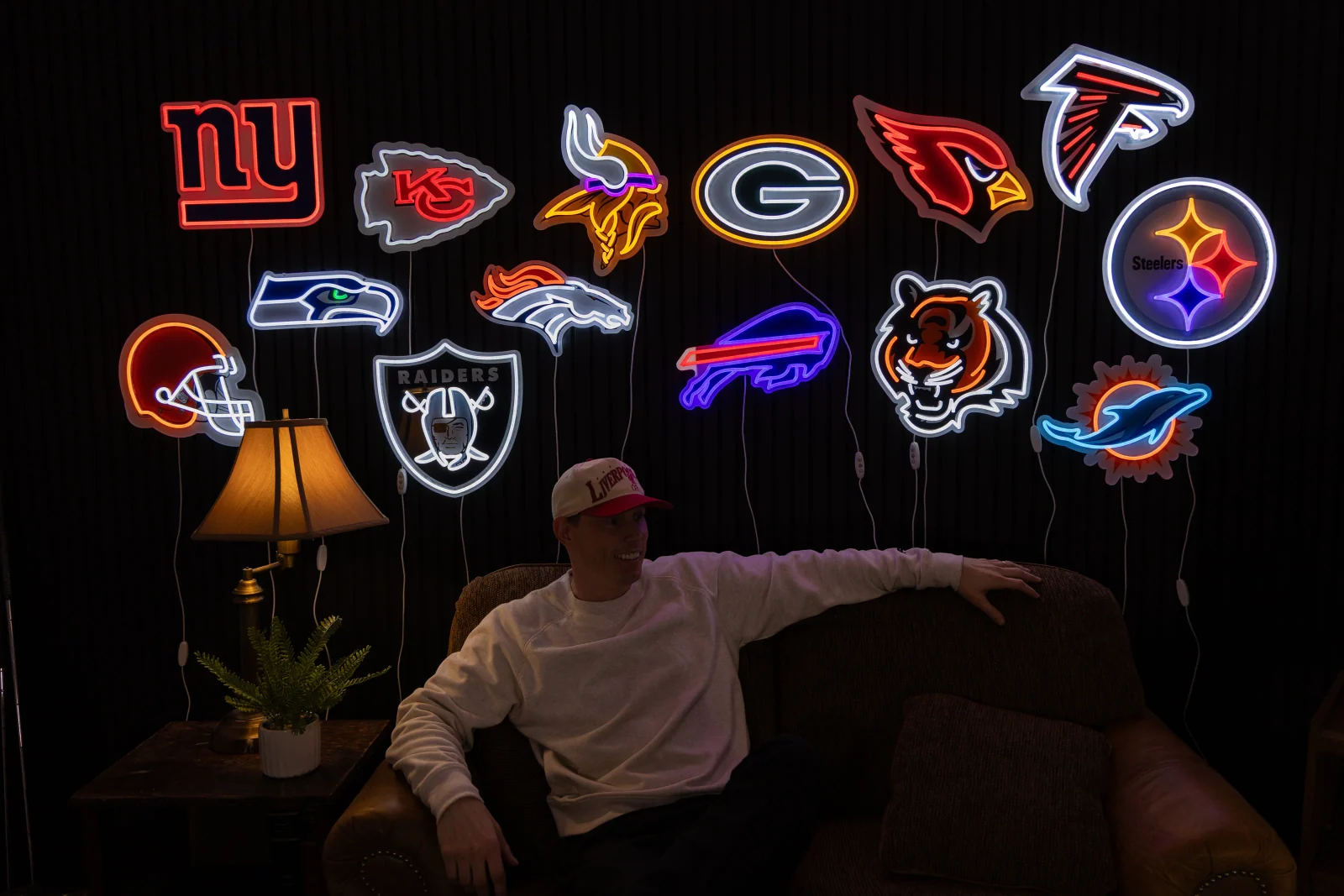
Welcome back to the BoozeMakers Interview Series. The home bar isn't just about what you pour — it's the room you pour it in. This time we're talking to the operator who's quietly become the dominant licensed-LED-neon player in the U.S. sports market, and whose product is the single most-asked-about thing in any well-built fan cave we've toured this year.
Meet Marc Schaer
In the early Saturday Neon days, Marc Schaer and his co-founder Will — both University of Colorado Boulder grads, class of 2003–2007 — would bring a single illuminated CU Buffs sign to every tailgate, prop it against the truck, the trailer, or the corner of a tailgating table, and watch fifty yards of parking lot turn its head. That was the whole marketing strategy. It worked.
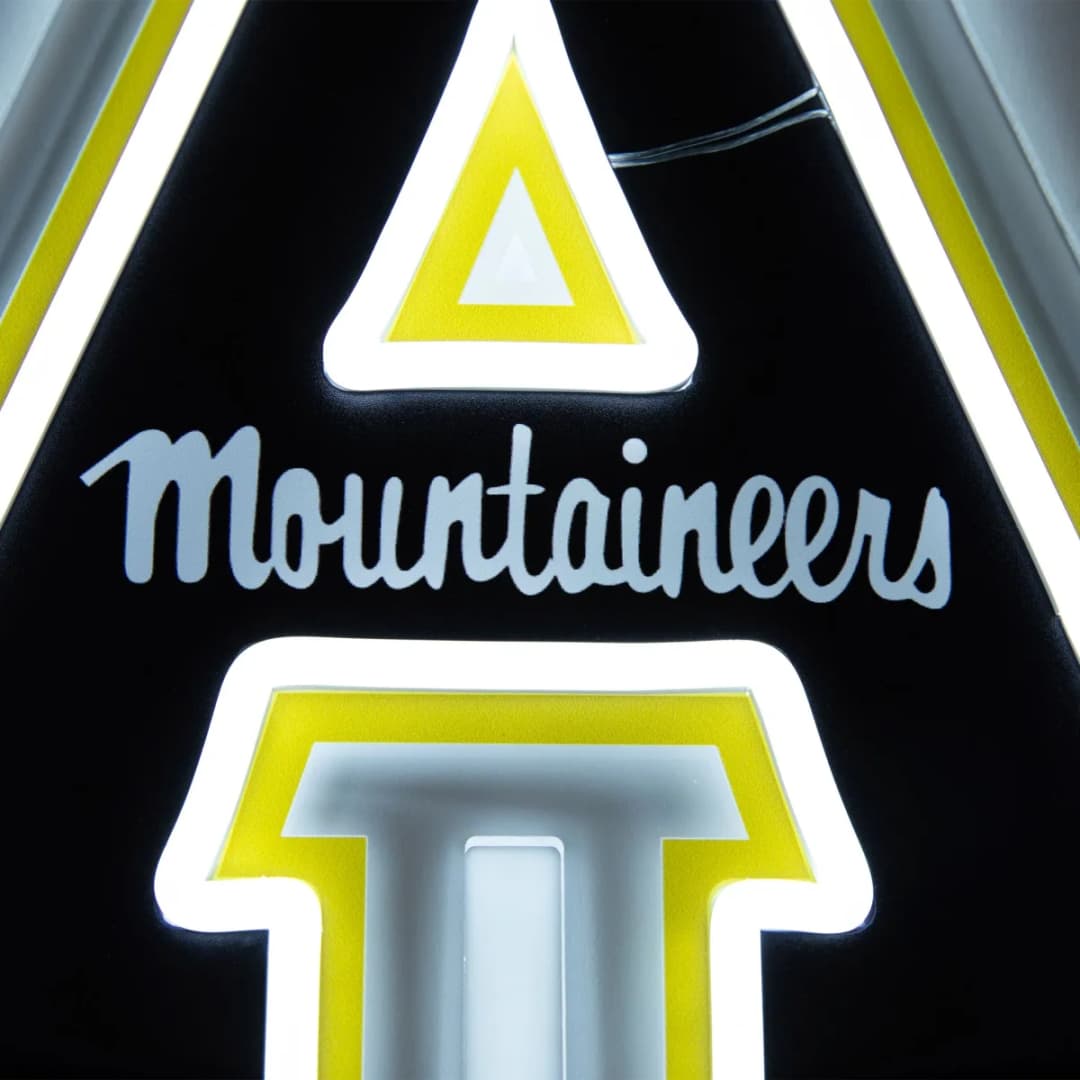
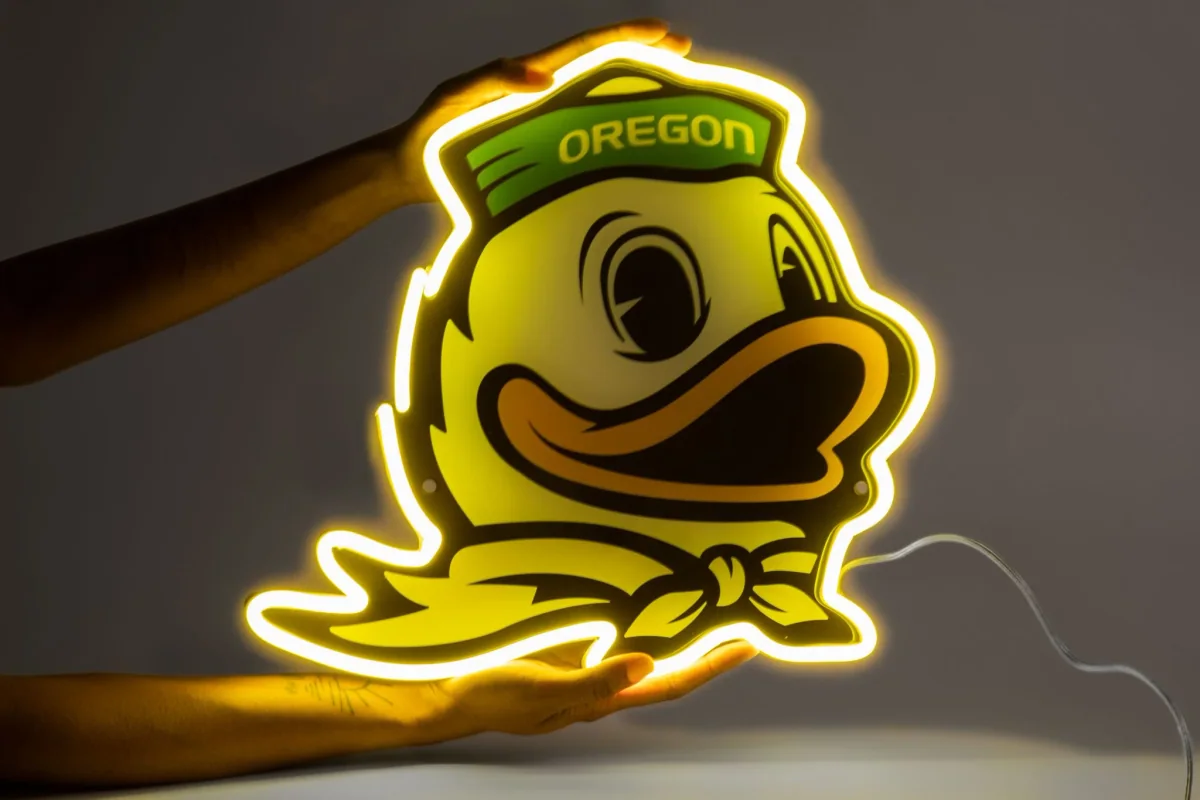
Today, the Denver-based company holds officially licensed deals with the NFL, the NHL, and nearly 100 NCAA programs, plus partnerships with Fortnite and Liquid Death. CU Boulder was their first licensing partner — the school that helped them learn how the collegiate licensing process actually works. Their current NFL bestseller is the Buffalo Bills sign; NHL bestseller is the Colorado Avalanche; NCAA bestseller is the Oregon Ducks "O."
The thing they sell isn't traditional glass neon. It's LED neon — a relatively newer category in which dense LED strips are packed inside a flexible silicone tube that diffuses the light the same way a noble-gas-filled glass tube does, paired with UV printing on a CNC-machined acrylic backer that lets a licensed logo render at full color accuracy instead of the simplified, single-color approximation a glass bender can physically reproduce. It plugs into a wall outlet or a USB-A port, runs on low voltage, weighs almost nothing, and stays lit for years without burning out.
It's also — and this is the part that matters for the room — the brightest thing in a fan cave, by design. Which is why Schaer has unusually specific opinions about what a fan cave should look like, what people get wrong, and what's worth spending on when you're outfitting one.
We sat down with Schaer to talk through the LED-vs-glass-neon question, what it actually takes to land NFL licensing as a startup, why a Bills sign outsells every other team in his catalog, and the unwritten rules for building a sports space that doesn't read like a generic basement with a logo on the wall.
The Home Bar & Fan Cave Rules
BoozeMakers: What's the one thing most people get wrong when they're outfitting a home bar or fan cave?
The biggest miss is treating it like a regular room with sports stuff on the walls. A fan cave should feel like you. The colors, the team, the city, the inside jokes from your tailgates. If a stranger could walk in and not immediately know which team owns your soul, you've underbuilt it.
BM: If someone has a modest budget and wants to build something that feels premium, where do you tell them to spend, and where do you tell them to save?
Spend on lighting and on one or two anchor pieces you actually love. Save on the stuff nobody remembers — the generic bar stools, the trendy wall decals, the gadgety bottle openers. A great sign and warm, layered light will carry a room. A pile of forgettable accessories won't.
BM: What's a trend in this space right now that you think people will regret in five years?
Anything ironic. The dive bar parody. The fake speakeasy with the secret password door. It looks fine on Pinterest, and a year later you realize it was somebody else's idea of cool. Buy what you actually like, not what looked good in a Reel.
BM: What's the one item in your category that's worth splurging on, and why?
A sign of the team you grew up with. That's not a sales pitch, that's the honest answer. The thing your kids and your buddies will point to in ten years is the one that means something. A generic "BAR" sign won't carry that weight.
BM: How do you balance functionality with personality in a space like this?
Function gets you to the room. Personality is why you stay in it. Handle the basics well — a clean ice setup, decent glassware, enough seating — and then go a little wild with the personality layer. The personality is what your guests talk about when they leave.
The LED Neon Question
BM: Walk us through the LED neon vs. traditional glass neon difference — most people don't realize this is even a category. What changed in the technology that made premium LED neon viable?
Glass neon is a beautiful, century-old craft. Real artistry, real heat, real noble gas in a hand-bent tube. It has earned every bit of its history and we have huge respect for it.
LED neon is a separate, newer category. It came out of the optoelectronics industry, the same world that gave us LED screens, indicator lighting, and modern commercial signage. Engineers figured out how to pack dense LED strips inside a flexible silicone tube that diffuses the light evenly along its length. The look is shockingly close to a gas-filled glass tube, which is why the category is called LED neon. The LEDs are doing the job neon used to do.
Honestly, what changed wasn't the LED neon technology itself so much as the realization in the broader market that it has some real, obvious advantages over traditional glass. It runs on low voltage and is safe to the touch. There's no glass and no gas inside. It plugs into a regular wall outlet or USB-A port, weighs almost nothing, and can stay lit for years and years without burning out.
There's also a huge jump in design flexibility once you pair LED neon with UV printing. Glass neon is essentially a single bent tube in one color of gas, so the artwork has to be simplified down to something a glass bender can physically reproduce. With LED neon plus UV printing, the LED neon handles the glowing outlines and accent lines, and the UV-printed backer carries everything else: the fills, the gradients, the drop shadows, the mascot illustration, the helmet stripes, the small type. The end result is true to the original artwork instead of an approximation of it.
For a licensed product, where every color and proportion has to match the team's brand standards exactly, that's a big deal. It's the difference between "neon-style version of the logo" and the actual logo, lit up. Once people saw all of that in one product, the category took off, and it opened the door for us to do licensed work at a level of quality a serious fan expects.
How a Startup Lands the NFL
BM: You're licensed with the NFL, NHL, and nearly 100 NCAA programs. What does that licensing process actually look like, and how does a startup land deals with the major sports leagues?
To even get into the licensing conversation, you need a real company behind you. Liability insurance, a manufacturing operation that can pass quality audits, product samples that meet the league's standards, financial statements that suggest you'll still be around in five years, and a category they actually need filled. Then there are real dollars on the line up front, well before you've sold a single unit, and ongoing financial obligations you have to be able to carry whether the market is strong or soft.
So how a startup actually lands deals with the major leagues is a mix of grit, capital, and a little bit of luck. The grit is years of applications, approvals, and rejections. The capital is real money committed before you've earned anything back. The luck is the league looking at your category at the right moment and deciding you're worth a conversation.
BM: From your side of the desk — what does the buyer of a Saturday Neon sign actually look like? Is it the dad putting one in a basement bar, the dorm room kid, the office decorator? Who's surprised you?
We were confident the product would have mass appeal, but it's even broader than we initially thought. The classic buyer is the dad doing a basement build — that's real. But we also see a lot of moms buying for husbands, college kids decorating dorms, and young professionals buying to represent their alma mater in their office.
What People Get Wrong in a Fan Cave
BM: There's something inherently bar-and-tailgate about a lit-up team logo. What's a fan cave decorating mistake you see most often — overdoing it, underdoing it, mixing the wrong elements?
I think the bigger mistake is underdoing it.
There's a school of thought that says, "don't mix elements, keep it tasteful." I get it for a living room. But a fan cave isn't a living room. Sports are loud. It's chaotic. It's a Saturday or Sunday in the fall where you've got three games on, your buddy is yelling at the TV, somebody spilled a beer, and the dog is wearing a jersey. That's the whole point.
If you're going to commit to a sports space, commit fully. Mix your college team with your pro teams. Throw in a favorite band poster. Stack the helmets. Hang the pennants. The signs are made to be the bright thing in the room, and they only really do that job when the room lets them. A fan cave with one tasteful accent piece and a beige couch is a room with a sign in it. It isn't a fan cave.
BM: You mentioned tailgating in your press materials — for the guy outfitting a real tailgate setup, not a folding-table-and-cooler operation, where does a neon sign fit in?
This one I love because it's literally how we started.
In the early Saturday Neon days, we'd bring at least one CU Buffs sign to every tailgate and just prop it up against the truck, the trailer, or the corner of the tailgating table. That was the whole setup. No rigging, no mount, no production. At a night game you'd come around the corner of the lot and see this glowing team logo lighting up a tailgate from fifty yards out. Everybody walking by stops. It's the best traffic driver in a sea of tents.
So, for the guy with a real tailgate setup, the sign is your beacon. Prop it on the table, lean it on a tire, hang it off the side of the trailer. If you want it up on a panel for a few hours, 3M Command strips will hold them just fine and pull off clean afterward. Plug it into a portable battery pack or into your generator and you're set. It's the cheapest, simplest upgrade you can make, and it's the one your friends will text you about on Monday.
Bestsellers & Personal Favorites
BM: Most popular sign in your catalog right now — and your personal favorite design across the whole lineup. What are they?
The Buffalo Bills has been our number 1 NFL seller for a while now. Our NHL bestseller is the Colorado Avalanche. Our NCAA bestseller is the Oregon Ducks "O."
My co-founder Will and I both went to the University of Colorado Boulder, so we'd be remiss if we didn't say the Colorado Buffaloes sign was our favorite. CU was also our very first licensing partner. They helped us navigate the collegiate licensing process and really supported us early on, so they'll forever have a soft spot in our hearts.
The Long Game
BM: Five years from now — does Saturday Neon stay focused on sports teams, or do you see expansion into other licensed lifestyle areas? Music, breweries, distilleries?
Our mission is to illuminate the fan experience. Whatever you're a fan of — whether that's a sports team, a band, a brewery, a video game, or a brand — our job is to have an illuminated product that lets you celebrate it visually. Sports is where we started because it's the strongest fan culture in the world, but the mission absolutely extends beyond it.
If people have love for something culturally significant, there should be a Saturday Neon sign for it.
About Saturday Neon
Saturday Neon is a Denver, Colorado-based maker of officially licensed LED neon signs founded by two University of Colorado Boulder grads, Marc Schaer and his co-founder Will. The company holds licensing deals with the NFL, the NHL, and nearly 100 NCAA programs, plus partnerships with Fortnite and Liquid Death. Products are CNC-machined acrylic backers paired with UV-printed art and flexible silicone-encased LED neon for color-accurate logo reproduction at low voltage.
Signs range from $80–$200, plug into a standard wall outlet or USB-A port, and are kid- and pet-safe (no glass, no gas, no buzzing transformer). The Tennessee Titans sign is one of the picks in our 2026 Gentlemen's Father's Day Gift Guide.
Web: saturdayneon.com
Instagram: @saturdayneon
The BoozeMakers Interview Series profiles the operators shaping how Americans drink — and the makers in the orbit who shape the rooms we drink in. Know someone we should talk to? Drop us a line.