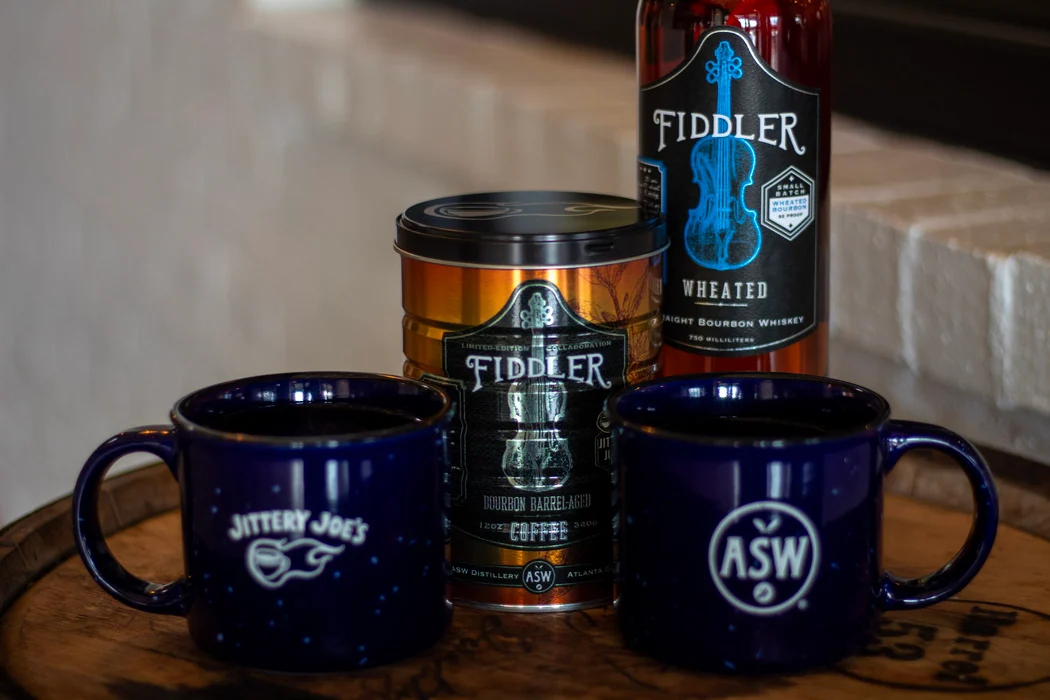
Welcome back to the BoozeMakers Interview Series, where we sit down with the operators reshaping how Americans drink. This time we're following the most natural spirits-adjacent thread there is — coffee + whiskey — and the Athens-Georgia roaster who just sent his second run of beans into spent bourbon barrels and brought them back out as the most talked-about can in college-town coffee.
Meet Bob Googe
Bob Googe was not supposed to own a coffee company. In 2002 he was running a management consulting practice helping executives manage multi-generational workforces and drive bottom-line profits through customer service. He was also working as a campus minister at UGA. Then 9/11 happened, and inside two weeks, ninety percent of his booked consulting income for the year was canceled. Executives stopped flying together. Stopped meeting in person. The consulting income evaporated.
One night at a fundraiser for his oldest daughter's elementary school, he ended up serving coffee next to a guy he didn't really know. That guy turned out to be Charlie Mustard, Jittery Joe's Roastmaster. Mustard mentioned the Five Points café was for sale. Googe — a former CPA — went home, told his wife the conversation was going to change their lives, audited three years of cash-register tapes against the checkbook deposits to verify the business could service debt, then maxed out the credit cards, drained the home equity, and borrowed money from his in-laws. ("Which might've been the hardest thing to do of any of them.") That's how he bought what was then two Jittery Joe's cafés in Athens, Georgia.
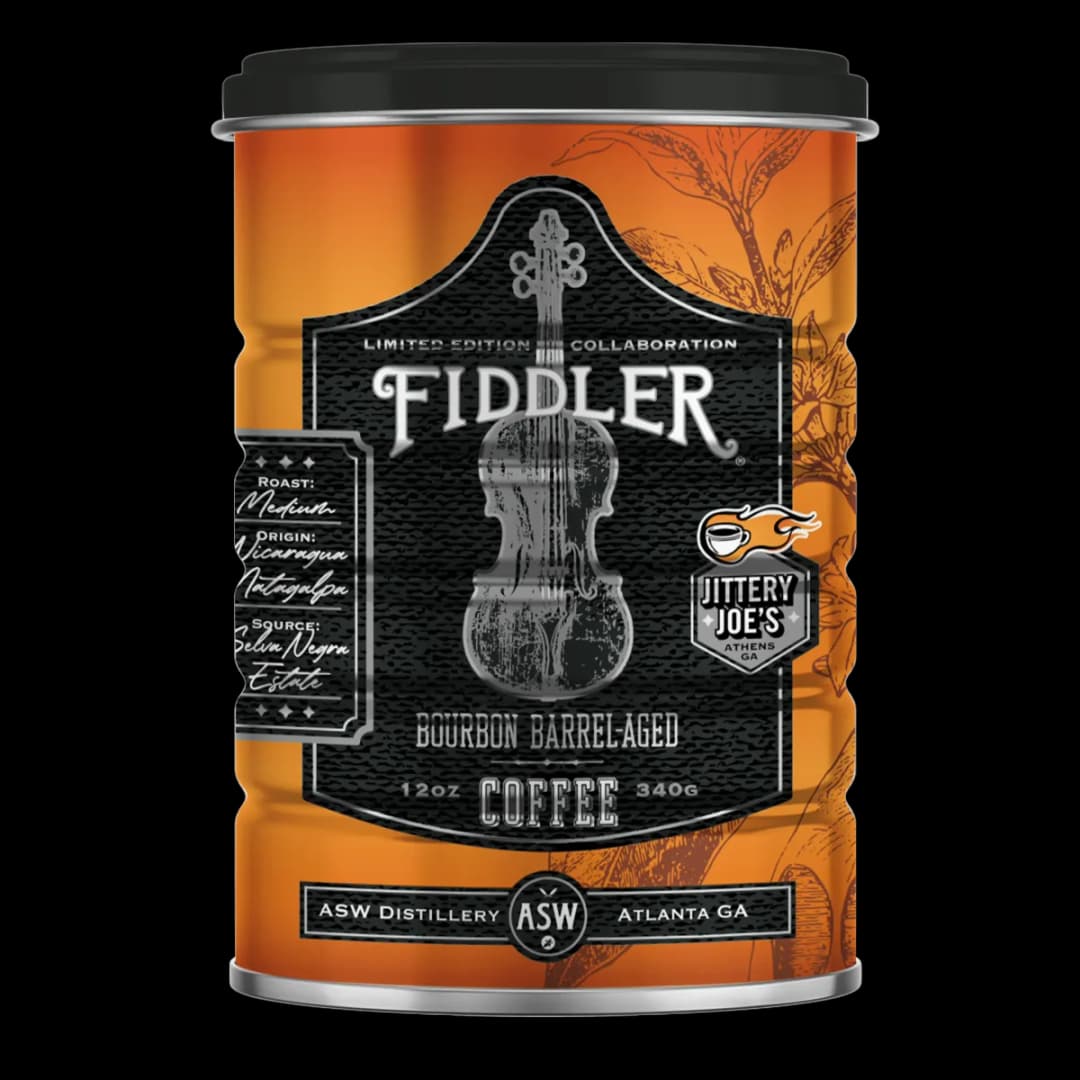
Twenty-three years later, he's sold the café side to focus on the roaster, partnered with Drew French (the founder of Your Pie) on a new drive-thru franchise model, and just shipped a second run of Fiddler Bourbon Barrel-Aged Coffee — a limited-edition collaboration with Atlanta's ASW Distillery in which Nicaraguan green beans from Selva Negra spend two to three weeks inside the freshly emptied barrels that produced ASW's "World's Best" Small Batch Bourbon. The release dropped March 31, 2026; one-night launch event with Last Resort Grill on April 7. Twelve-ounce can, whole bean, $25, while supplies last.
We sat down with Googe to talk about the 2002 bet, the bourbon-barrel process, why the U.S. palate is finally meeting coffee and whiskey halfway, and what 23 years of running a college-town roaster through two once-in-a-generation downturns has taught him about staying calm when the next one shows up.
The 2002 Bet: From Sermons to Cash-Register Tapes
BoozeMakers: You came to Jittery Joe's in 2002 by way of management consulting and ministry — not coffee. What made you bet on a college-town roaster, and what from those earlier chapters actually transferred to running it?
So I used to go to Jittery Joe's to write sermons, meet with students, and work on presentations and speeches for my consulting practice. When 9/11 happened, my consulting practice collapsed practically overnight. I worked with executives, vice presidents, and above on managing generational differences between older and younger employees and on using customer service to drive bottom-line profits.
Within about two weeks of 9/11, ninety percent of my booked income for the year was canceled. I know it's hard to remember, but there was a period of well over a year when executives of companies quit flying together and refused to be in the same room together because there was a cloud of fear: "What if it happens again?" So I basically lost most of my income. Campus ministry was my full-time job, but it was a part-time income. The consulting practice actually supported my family.
One evening, I was at a fundraiser for my oldest daughter's elementary school, and I happened to be serving coffee with another man whom I knew but did not know well. I mentioned to him that I was looking for another business. It turns out I was talking with Charlie Mustard, Jittery Joe's Roastmaster. He told me that the Jittery Joe's café at Five Points was for sale, and he could put me in touch with the owner.
I had always loved coffee and enjoyed being in coffee shops, but it had never even occurred to me to go into food service. But I went home that night and told my wife that I had a conversation that was going to change our lives.
There were two Jittery Joe's cafés back in 2002 when this conversation happened. I used to be a CPA, and the books were a mess, actually non-existent. I audited three years of cash register tapes and compared them to the checkbook for expenses and deposits. After determining that with the right management, the two cafés could make money and pay back the loans I would need to take out, I maxed out our credit cards and our home equity, and we borrowed money from my wife's parents. Which might've been the hardest thing to do of any of them!
So essentially, I bet the farm on a small-town roaster because I was familiar with Jittery Joe's, I've always loved coffee, and as someone who started their first business at age 12, I have always been involved in a business in one way or another. That casual conversation at a PTA event happened at the moment I was looking for a business that I could step into and run or start.
It turns out I was able to transfer many of the skills I had in my consulting practice and in campus ministry to the coffee shop. My consulting practice specifically focused on two issues: how to drive bottom-line profits through excellent customer service, and how to manage multi-generational workforces. Well, if you own coffee shops, you need to have great customer service, and everyone who worked there was significantly younger than me, so it actually transferred very well.
The Athens Question: How Do You Export a Town?
BM: Athens is a music-and-arts town, and Jittery Joe's has done limited releases with Widespread Panic, Drive-By Truckers, and others. How much of the brand is really an Athens identity, and how do you carry that into wholesale accounts in cities that have never set foot in Georgia?
One of the fun benefits of being an Athens-based company is that 32 years of UGA students and the many people who come to Athens for activities in and around the University of Georgia have connected with Jittery Joe's. In many ways, being an Athens-oriented or Athens-based business has been helpful because there are hundreds of thousands of people for whom Jittery Joe's was a core experience of their growing up into adulthood.
As most people can probably relate, those years between high school and college create lifelong, important memories. Our experience is that when these folks go to other cities across the country, they don't give up on their Athens experiences; they embrace them. Of course, part of those memories are the great musical artists who call Athens home. That creates a national base for those sales. UGA graduates are everywhere!
At the same time, while the bands we partner with are based in Athens, they are also nationally and internationally known. When we roll out a new Widespread Panic, Drive-By Truckers, or Jason Isbell coffee, we get people from all over the country who buy that coffee. Many of them never lived in Athens or attended the University of Georgia.
Thinking of the brand outside our music affiliations, the other approach we take to keep our Athens vibe while expanding into other areas is most obvious in our selection criteria for new Jittery Joe's franchise owners. Other than great coffee, the one thing at the core of Jittery Joe's identity is community involvement. As we grow, we are looking for franchises that will steer us in the direction of their local community events, bands, and projects — things that are important to their community so that we can do special coffees and promotions for those as well.
Being really ingrained in a community is in our DNA. So we're not just trying to export Athens, we're trying to export who Jittery Joe's is in Athens as we launch our drive-through franchise locations.
The Boozy Angle: Inside the Fiddler Collab
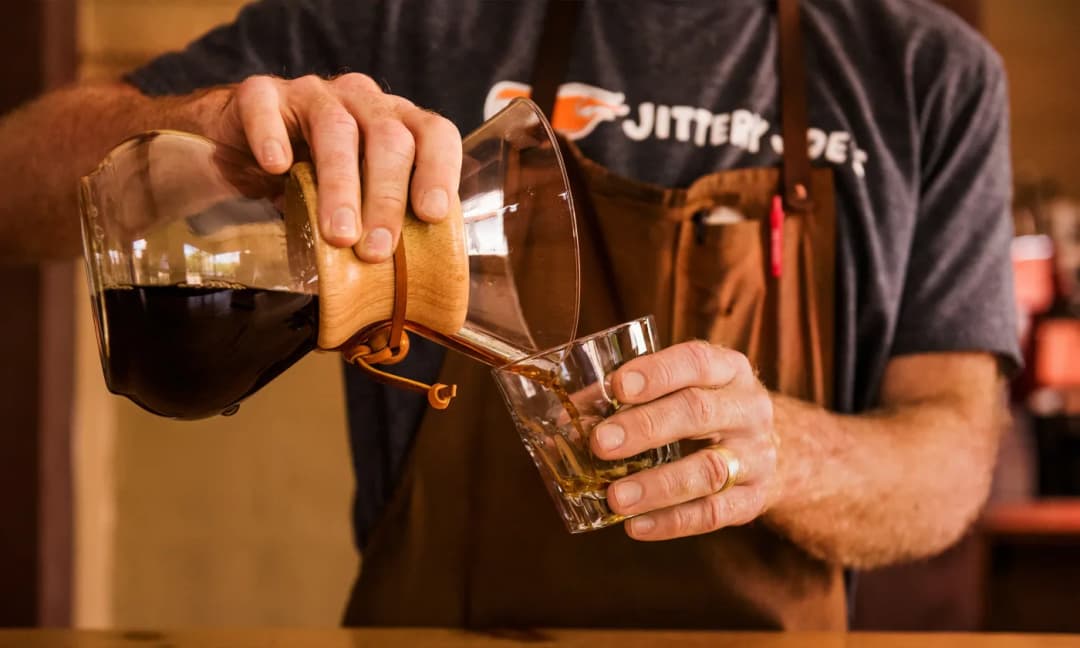
BM: The Fiddler Bourbon Barrel-Aged Coffee collaboration with ASW Distillery is back for a second run after the first sold out fast. Walk us through what actually happens to those Nicaraguan beans inside the spent bourbon barrels — what does the wood and residual whiskey do to the cup that you can't get any other way?
Oh wow, that is a really great question, and those Fiddler bourbon barrels do amazing things to the coffee beans. Here is how the process works:
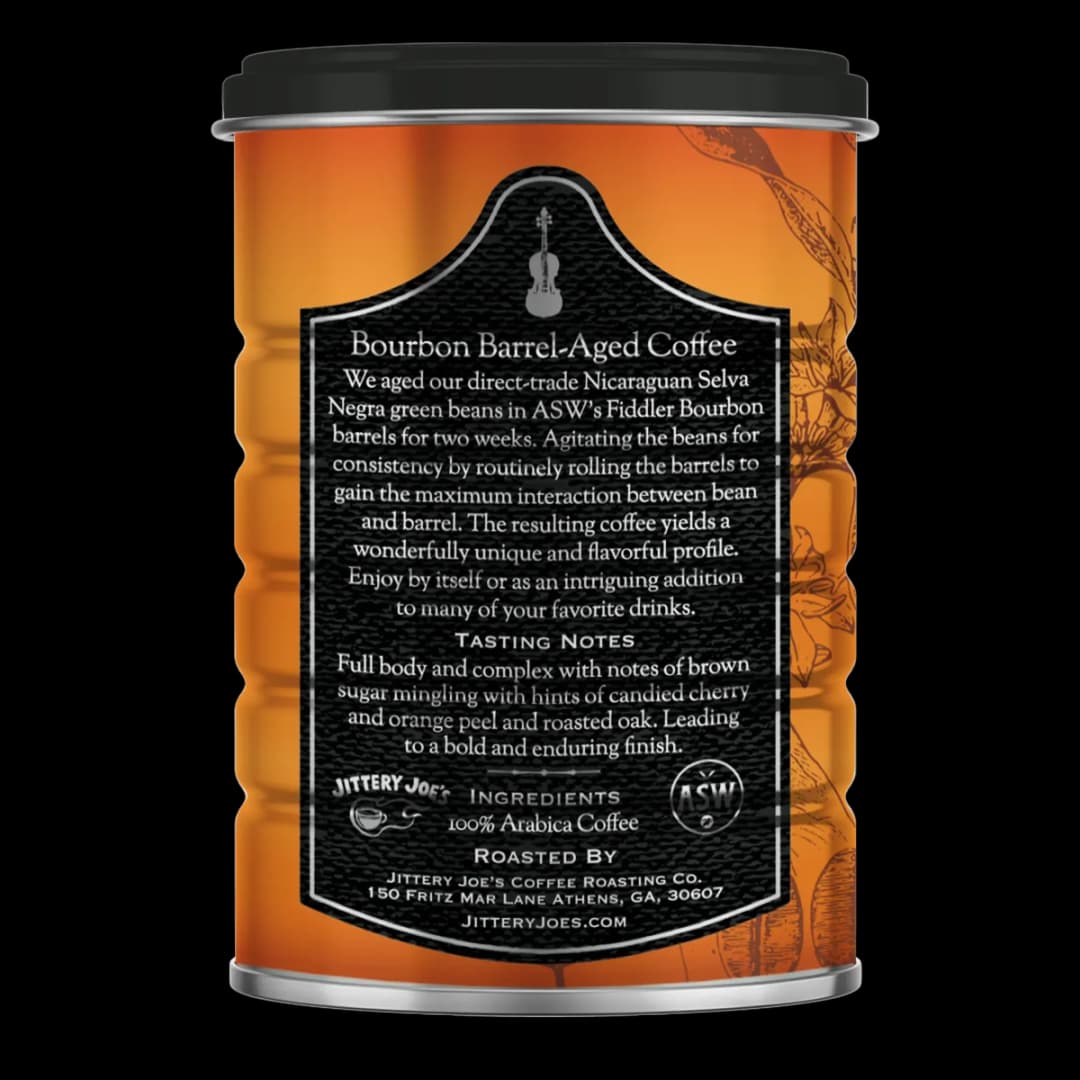
ASW sends us empty Fiddler barrels. We put the green Nicaraguan beans into the empty barrels, which are still actively releasing Fiddler flavors and aromas. We keep those beans in the barrels for 2 weeks. We then pull some beans out of the barrel and test roast a small amount to see if the beans have absorbed enough of the Fiddler characteristics. If they are ready, we roast all the coffee in the barrel. If they still need a little more "distilling," we keep them in the barrel for another week. We roll the barrels every single day to ensure that all the beans come into contact with the barrel. Over the course of 2-3 weeks, the Fiddler aromas and tastes seep into the unroasted coffee beans. When we roast those beans, all the Fiddler characteristics are highlighted.
It's really fascinating to me that when you open a can of Fiddler coffee, there is a very big nose (aroma) of Fiddler bourbon. However, the bourbon flavor in the cup is subtle, intentionally so. The first time we made bourbon barrel coffee, it had an overwhelming bourbon flavor, and didn't work well in the cup. We had to figure out how long to keep it in the barrel so it didn't taste too much like bourbon, but enough like bourbon. It's not just science, it's an art!
I like to tell people that if they pour a little cream into their Fiddler coffee, they'll almost have a cup that tastes like it has Baileys in it, but with no alcohol.
BM: Coffee and spirits are having a real cultural moment together — espresso martinis, barrel-aged everything. From where you sit, is this a lasting overlap between the coffee drinker and the cocktail drinker, or a trend with a shelf life?
We certainly hope it is a long-term trend! One trend we're seeing among our customers, and it's not just in spirits and coffee, is that the US palate is growing more and more adventurous. People are looking for new, interesting taste experiences.
When you pair a really nice spirit with coffee that has been grown, harvested, processed, and roasted with proper care and expertise, you get an experience that is unique and fun. So I do think that it is a long-term trend, and you'll see more and more experimentation.
BM: The Fiddler partnership leans on ASW for the spirits side. Bourbon-barrel coffee is one direction — but is a Jittery Joe's coffee liqueur or a ready-to-drink coffee cocktail something you'd ever put your own name on, or are those crafts better left to a distillery partner? What would have to be true for you to go further than barrel-aging?
Oh, we one hundred percent would love to see a Jittery Joe's coffee liqueur or a ready-to-drink coffee cocktail. If ASW approached us and said they are ready to do something like that, we would jump on it. There's a high level of integration and partnership between our two companies, and if they wanted to produce either or both products, we would love to see our name on it. We would absolutely trust ASW to do that.
That is not something that we would do on our own. That would require a distilling license from both the federal and state governments. ASW has that expertise.
The collaboration would begin when ASW's Master Distiller, Justin Manglitz, and our Roast Master, Charlie Mustard, put their heads together to determine the desired taste profile and how to highlight the best qualities of both products. I have to say I would be super excited to have that at my house. Now that you've asked the question, I sure hope that happens.
BM: When you collaborate with a distillery, two crafts with very strong opinions about "the right way" have to meet in the middle. Where do coffee roasting and whiskey-making genuinely agree on philosophy — and where do they fight?
I don't know that I've ever seen them fight! There are differences, of course. A cup of coffee can be savored over a meal or on a long weekend morning. It can be adapted with cream, sugar, honey, or whatever you'd like to add. It can also be simply a quick pick-me-up on the way to work or on the way out the door.
Whiskey, particularly really good whiskey, is frequently sipped over time on the back porch with a friend. It can be sipped straight, over ice, with a mixer, or even blended.
There are so many similarities, but the biggest is that both are frequently enjoyed with others. Both drinks are bound up in community and friendship.
So really it's more about making sure that we're working with people who agree on what we're both trying to accomplish. When we put two professionals like Master Distiller Justin and Master Roaster Charlie together in the same room, it's actually pretty spectacular to watch. They geek out over all the different flavor profiles they're tasting, and they work out something that's magic in a cup.
Leadership Lessons from Two Crises
BM: You've written or edited several leadership books — The PLUS 10% Game, Trapeze Buddies, SPLAT!. Which idea from those do you actually find yourself using on the café floor, not just on the page?
Interesting question, I haven't really thought about it because it's been so long since those books came out. But I use them all the time.
The +10% Game was the first book. A major lesson from the book, a lesson I relearn all the time, is that we're not trying to improve the company 100% every day. We're not trying to do a fruit-basket turnover to everything we've ever done. If we can simply improve by 10% a month for 10 months, we will see a 120% improvement in our company. It's better to bite off a small morsel and get it right than it is to try to change your entire company overnight. We look for little wins every day — how can we be just a little better every day?
In the Trapeze Buddies and Splat! books we use the analogy of the trapeze artist. One of the most crucial aspects of a trapeze artist's work is communication. Trapeze artists don't just swing out there, hoping someone will catch them. They communicate clearly and often. Then they practice; they go over every move again and again before debuting a new act or routine.
We constantly work on clearly communicating with each other about our goals, expectations, and how we're going to make sure we catch each other so that no one goes SPLAT on the circus floor. In a company our size, where everyone is wearing so many hats, it is, hands down, the hardest thing to get done consistently.
BM: You've described the CEO's job as being "the calm in the storm" — that anger is usually just fear. During the 2008 recession, Athens business reportedly dropped 30–35% overnight and you had to make brutal staffing calls. How did you stay the unafraid presence when you were probably afraid too?
Both the 2008 recession and the 2020–2021 pandemic were extremely difficult times. We had to make decisions about staffing, products, purchasing, salaries, payroll — all kinds of decisions in the face of massive uncertainty. In both the Great Recession and the Pandemic, we were making what felt like, and probably were, life-and-death business decisions with little to no information.
One of the things I have learned over the decades is that when people make decisions based on fear or anger, they usually do not make great decisions. Pulling on my ministry background, the one thing that Jesus says more than anything else in all of the gospels is "fear not," "do not be afraid."
The key is to understand that these situations are a part of life, not all of life. When I remain calm and remember that even if I have to close a store, lay off staff, take a reduction or even zero pay (something we as owners have done more than once during the Great Recession and the Pandemic), even if all of that happens, the world is not going to end.
When I remember that my business is part of my life, not all of it, and that I need to take a deep breath before making a decision, I find I make decisions that are more focused on the situation rather than on fear or anger. When I am calm, I can focus on the situation. When I am afraid or angry, I inevitably make decisions more about taking care of my fear or anger than about the actual situation.
I am a big fan of a couple of books that I have read and reread over the years that help drill this thought process into me, and believe me, it takes practice and reinforcement. I have probably read Viktor Frankl's Man's Search for Meaning fifty times. I have read Michael Singer's Untethered Soul and The Surrender Experiment at least a dozen times. I read Marcus Aurelius's Meditations about every six months. It's something that gets, not easier, but more accessible with practice.
Finally, I have, over time, realized that being the calm in the eye of the storm does not necessarily mean that I'm not afraid. I was petrified in 2008 and 2009. I was petrified in 2020 and 2021. We did not know whether our business would survive either of those crises. But after moments of pure terror, I remembered that being afraid is not useful. Making decisions out of fear is not useful. The question I always ask when I feel my emotions rising up is, "Is this useful? Is this helpful to the situation?"
Re-reading the above makes it sound like I really have it all put together. I do not. I practice, and I practice, and I practice. I fail as often, if not more often, than I succeed. But over time, with practice, being the calm in the middle of the storm has become my guiding leadership philosophy, one I am hopefully getting better at each day.
BM: You've talked about a tradeoff with staff — flexibility for loyalty — and that COVID and the "Great Resignation" flipped that bargain upside down. Have you figured out what your people want now, and what's replaced the old deal?
When people badmouth the younger generation, I'm like, "Are you kidding? These people are spectacular."
As owners and managers, we need to understand that particularly younger workers grew up in a different world than that of those of us with some mileage on us. When I hear people my age complain about younger workers, I remind them that those young folks did not raise themselves. We raised them. If there's something about how they relate to the work world that we don't like, we should look in the mirror. We're the ones who raised them and helped shape the values that they have.
So, have I figured out what people want now? I think the answer is both yes and no.
Yes, in that some things never change. People want to be treated with dignity and respect. They want to know that their contribution is valued. They want flexibility when issues arise in their lives. They want to be paid fairly. Those things have not changed.
At the same time, the answer is no. We have not figured it out. I think one thing we haven't quite figured out yet is what motivates the current group of workers. The younger team members, in particular — and at this point, that is almost everyone under 40 — grew up in a world of the Great Recession, then the Pandemic, then the Great Resignation. So they don't necessarily believe promises of promotions and "put your nose to the grindstone, and it will all work out for you." They watched their parents do those things, and everything around them collapsed. So how do you motivate and work with and manage someone who, at a very basic level, does not believe that the work that they're doing will actually pay off?
It's a tough challenge, so we try to just be relatable. We try to communicate when things are not going well and when they are. So far, there is no silver bullet, no magic pill. I think the bottom line is to treat people with dignity and respect and keep working on being and doing better.
The Future: Roaster, Franchise, and a Brazilian Barbecue
BM: You stepped back from the eight-café side and are now focused on roasting and a new drive-thru franchise model. Why is the future of Jittery Joe's in the bean and the franchise rather than in owning the cafés yourself?
My wife and I did not sell the cafés because they were not a great business for us, or because we didn't enjoy them anymore. We had simply reached the stage where we wanted to simplify our lives a bit. Both of our children are out of the house and on their own, and we wanted to be able to focus more on a particular aspect of the coffee business.
We sold the stores to Grant and Kane Kanavage, who are doing a spectacular job, and we began to focus on the roaster operation with our business partner, Michael Ripps.
We have, for years, had requests for Jittery Joe's to franchise. A couple of years ago, Drew French, the founder of Your Pie, reached out to us, and we formed a company together that Drew is running. He is running the franchise side of the business, while Michael and I focus on the coffee side. The team brings in skills from both areas. We think it has a lot of potential, and we are having a blast.
That is a long way of saying we really did not discard the cafés; it was just a time in our lives when we made a directional change that worked for our family.
BM: You source from Nicaragua, Colombia, Rwanda, Sumatra and beyond. With climate pressure and price volatility hitting growing regions hard, how do you protect both the quality of the cup and the relationships at origin?
That's a really great question, and we've begun to focus on that even more this year than we have in the past. We believe that the best way to protect the quality of the cup is to improve our relationships with the farms at origin. So, beginning in 2026, we have increased the amount of our coffee supply from direct trade from 40% of all coffee purchases to about 90%.
Direct trade means that we're buying coffee from the farmer. There is no person or importer in the middle. We deal with the farm. We negotiate with the farmer. We do use customs brokers to help us get things through customs, but we're dealing with the farmer. The farmer knows our names and our families, and we know their names and their families.
We've been building direct trade relationships for years and have discovered that when things get tough and interesting in the coffee world, those relationships pay off. As climate change accelerates, as politics get in the way, as all the weird things that happen in a business that relies on a product that comes from outside the US pop up, it is knowing people that makes the biggest difference.
For example, we have a great relationship with Veloso Farm in Brazil. Two months ago, I had the farmer, his right-hand person, and the ownership and management team of Jittery Joe's on the back porch at my house with me on the grill, doing my best to replicate a Brazilian barbecue. We sat around for hours getting to know each other and having a good time. We also have a 15-year relationship with Selva Negra Farm out of Nicaragua. We've been in each other's homes, lived through droughts, hurricanes, coffee rust, changes in governments — you name it, we have gone through it together. Those relationships count, particularly in an unstable and rapidly changing environment.
BM: You've said the primary job of a business is to provide decent jobs so people can go be involved in what matters to them. Thirty years in, is that still defensible in a low-margin industry — or is it a philosophy that gets tested every quarter?
You know that gets tested every day, not just every quarter. Especially in a year with tariffed coffee. But it is a core commitment of Jittery Joe's. It is part of who we are.
Nothing makes me prouder than when one of our team members is able to buy their first house, buy a decent vehicle, take a great vacation, or do something that they were never able to do before they came to work here. I wish we could pay people a lot more, and if margins improved, we would do that.
We pride ourselves on people being able to live the lives they want because of the jobs that they have here. Are we perfect? No, we are not. Do we try? Yes, we do every single day. There are years when the owners make less money intentionally so that the people who work for us can make more, because we feel that's the right thing to do. Believe me, those are not easy discussions.
About Jittery Joe's Coffee & the Fiddler Collab
Jittery Joe's Coffee is an Athens, Georgia roaster founded in the 1990s and run since 2002 by Bob Googe alongside business partner Michael Ripps. The company sold its eight-café operation to Grant and Kane Kanavage and is now focused on the roaster, wholesale, and a new drive-thru franchise model led by Drew French (founder of Your Pie).
ASW Distillery Fiddler Bourbon Barrel-Aged Coffee returned March 31, 2026 in a second limited run. Green Nicaraguan beans from Selva Negra are aged 2–3 weeks inside spent Fiddler bourbon barrels — the same barrels that produced ASW's "World's Best" Small Batch Bourbon — then roasted in Athens. Tasting notes: sweet, clove, toffee, with a smooth lingering finish. 12oz can, whole bean, $25, while supplies last.
Web: jitteryjoes.com · Buy the Fiddler can
Franchise info: jitteryjoes.coffee
ASW Distillery: aswdistillery.com
The BoozeMakers Interview Series profiles the operators shaping America's adult-beverage scene — including the makers in the orbit who give us reasons to keep showing up. Know someone we should talk to? Drop us a line.