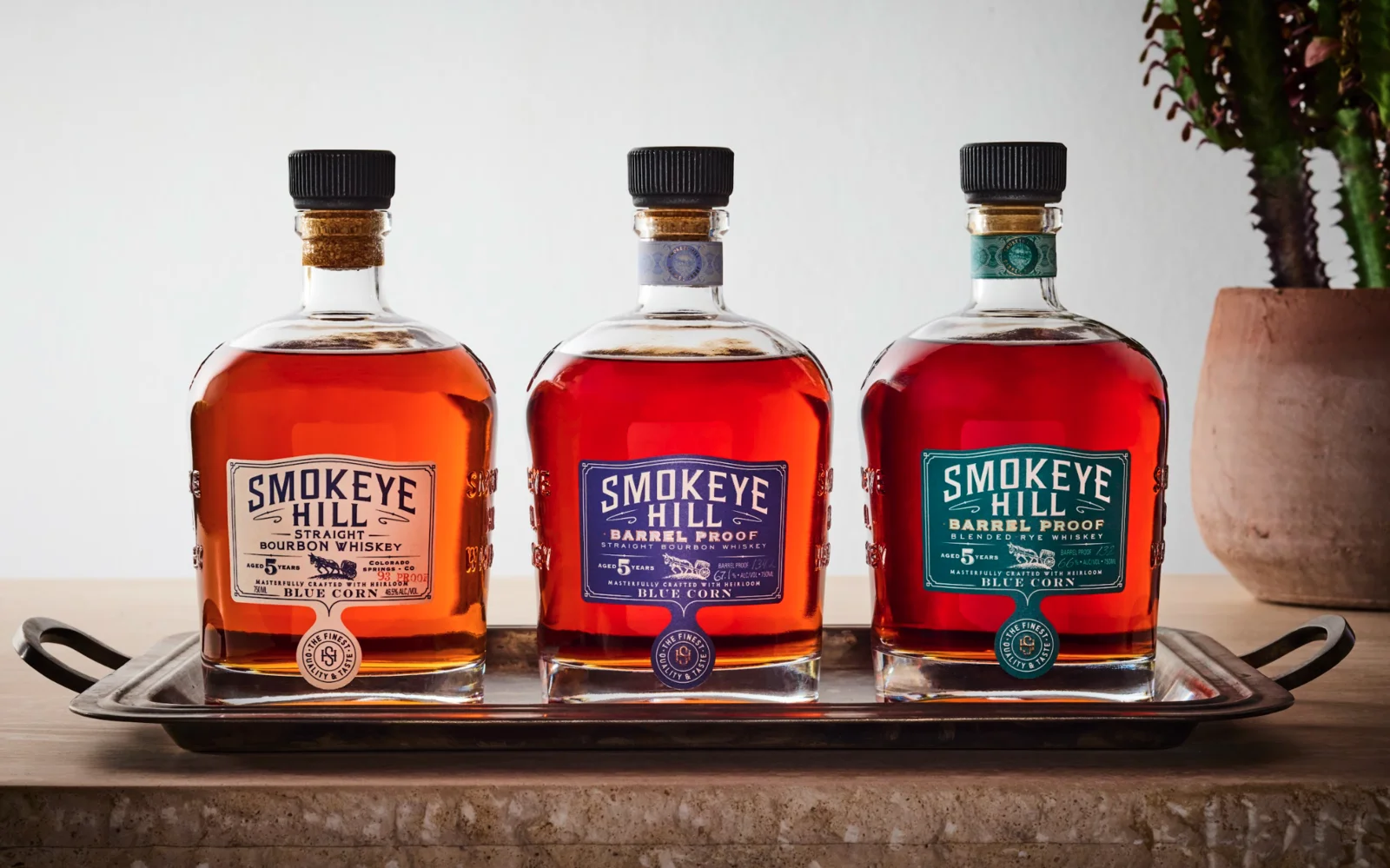
Welcome back to the BoozeMakers Interview Series, where we sit down with the people remaking how America drinks. This time we aimed straight at one of the most argued-about young bourbons in the country: a five-year-old, blue-corn whiskey distilled in Indiana, aged at 6,100 feet in Colorado, and named for a hill on an Arizona ranch — a bottle that walked into a blind panel and walked out "Bourbon of the Year" before its website was even live. We put the uncomfortable questions to founder Blake Johns: the three-state question, the ASCOT skeptics, the price, and the grain. He didn't dodge any of them.
Meet Blake Johns
Blake Johns did not come up through a distillery. He came out of real estate and marketing — the exact background bourbon people are trained to distrust — and he'll tell you so himself. What he had instead was a hill. Smokeye Hill is a real rise on his family's Arizona ranch, land his great-grandfather bought in 1940 at his grandfather's urging, where moonshiners had worked during Prohibition. As a kid in the 1990s, Johns found the remnants of an old still near it. Years later he went looking for the rest of the story and traced the bootlegging provenance back to the land.
The throughline is his grandfather — the man who, Johns says, invented the spout on the milk carton, ran a packaging company and a horse-breeding operation, and served as a past president of the American Quarter Horse Association. The Johns family is multi-generational equine, and Blake's earliest bourbon memory is sitting on his grandfather's lap by the armchair at the end of the day, listening to the stories and catching "the smoky — or should I say smokeye — scent."
That heritage is the brand's story. The whiskey itself is a more complicated, more modern thing: a proprietary blue-corn mashbill (more than half the grain) contract-distilled in Indiana, then barreled and aged in Colorado Springs across a wide spread of char levels and barrel sizes. It won ASCOT "Bourbon of the Year" in a blind tasting — against bottles like George T. Stagg — and later scored 98 points at the San Francisco World Spirits Competition. We sat down with Johns to ask how all of that fits together, and whether the story is doing more work than the liquid.

The Origin & the Name
BoozeMakers: Smokeye Hill is a real hill on your family's Arizona ranch where moonshine was made during Prohibition, and the bell-shaped bottle comes from officers tying warning bells on the cattle. Tell us that story the way it was told to you. How much is documented family history versus legend that got better with each retelling?
Growing up, I was told of finding the remnants of the still around Smokeye Hill. This was in the '90s. Not much else was known about it. My family bought the ranch in 1940, after the end of Prohibition, so we can't take credit for running moonshine. It wasn't until years later, when doing research, that I uncovered the story of the moonshiners in the area during Prohibition and was able to trace some provenance back to the land.

BoozeMakers: You came from real estate and marketing, not distilling. A lot of marketers launch a whiskey and it shows. What did you have to un-learn from marketing to earn credibility with bourbon people, who can smell a brand-first play a mile away?
If you get into this business just thinking that a fancy bottle is all it takes to create a successful brand, you're going to learn the hard way that you're wrong. Whiskey connoisseurs can see through marketing 'BS' a mile away. They're incredibly passionate and knowledgeable — it's what's in the bottle that truly matters.
Although I consider my path into the whiskey industry non-traditional, I was completely obsessed with bourbon and knew enough about the industry to understand you build the brand from inside the bottle out. Producing world-class whiskey was, and always is, the number one priority for Smokeye Hill. Beyond that, I trusted everything else would fall into place. This brand is embedded in my heritage, so it feels natural to share our story in an authentic way.
BoozeMakers: Your earliest bourbon memory is sitting on your grandfather's lap by his armchair — 'the smoky, or should I say smokeye, scent.' How much of this brand is genuinely about him versus a great story you discovered you had?
It's funny because in many ways whiskey was a conduit to reconnect with my roots, leading me down this sort of cosmic path of discovery to create Smokeye Hill. My grandfather is one of my biggest heroes in life, even though he's no longer with us. He was a successful entrepreneur — inventing the spout on the milk carton, running a successful packaging company and horse-breeding operation. My great-grandfather was too; he originally purchased the family ranch at my grandfather's urging in 1940.
We're a multi-generational equine family through and through. My grandfather was a past president of the American Quarter Horse Association, who bred and owned many race and performance horses. He introduced my mom to the lifestyle, and then eventually myself and my brothers. And then, of course, it was sitting in his study while he drank his bourbon at the end of the day, telling us these colorful stories of his life. So in a sense, he was the conduit to putting all the pieces together, which ultimately inspired Smokeye Hill.
Blue Corn & the Liquid

BoozeMakers: Blue corn is the heart of the identity — over half the mashbill — and it's a grain most bourbon drinkers have never knowingly tasted. In plain terms, what does blue corn actually do to the spirit that yellow dent corn doesn't? And be honest: is the difference something a casual drinker tastes, or something they mostly believe because of the story?
I'm a firm believer that heirloom grains influence flavor, texture, and aroma. Blue corn brings a richness and depth that I don't typically find in commodity yellow dent corn. To me, it contributes notes that are nuttier, more floral, and slightly more savory, along with a silkier mouthfeel.
That said, bourbon is a sum of many parts. Grain matters, but so do fermentation, distillation, barrel selection, climate, and blending. A casual drinker may not immediately identify blue corn specifically, but they often recognize that the whiskey tastes a little different. The story may spark curiosity, but ultimately the liquid has to stand on its own.
BoozeMakers: Blue corn is sacred and culturally significant to Indigenous peoples of the Southwest. How do you think about honoring that heritage rather than just borrowing it as a marketing texture?
For starters, we acknowledge and give credit to the people who cultivated and preserved blue corn long before it became interesting to us. Growing up in Arizona, Native American history and culture were part of the fabric of the region and something I always respected and admired.
We don't claim ownership of that story. We simply recognize blue corn's importance to the Southwest and appreciate the role Indigenous communities played in preserving it. Our goal is to approach that heritage with respect, transparency, and gratitude rather than treating it as a marketing device.
BoozeMakers: You contract-distill in Indiana to your own proprietary recipe, then barrel and age in Colorado Springs at 6,100 feet — and the Arizona ranch is the story, not the still. Critics have called that a 'three-state question.' Make the case: why is that the right way to make this whiskey and not just the convenient one?
I understand why people ask the question, but we're unapologetic about our model because it's honest, intentional, and focused on quality. At Smokeye Hill, whiskey comes first. Contract distillation allowed us to work with world-class distillers, create whiskey to our specifications, and invest our resources into barrels and aging rather than expensive infrastructure.
Colorado provides a remarkable aging environment — significant temperature swings, moderate humidity, and elevation that create exceptional barrel interaction. Could we make whiskey on the Arizona ranch? Absolutely. But if I believed it would compromise the quality of the whiskey, I wouldn't do it. I'd rather tell a slightly more complicated story than make a worse bourbon.
BoozeMakers: You use an unusually wide range — 30- and 53-gallon barrels, char levels from #2 all the way to #5. That's a lot of variables for a small brand. What are you chasing with that, and what have you learned barreling in that swinging Colorado climate?
It's born out of the philosophy that the whole is better than the sum of its parts. Every char level truly does impart a different flavor profile, unlocking noticeable differences in the whiskey. Combining them together in a deliberate way creates a fuller, richer taste beyond a single char.
For our current core products, we use predominantly 30-gallon barrels with a few 53-gallons sprinkled in. The increased surface-to-volume ratio of the 30-gallon barrels yields an incredibly developed whiskey for its age of five years. It's expensive, though, since we have to buy almost double the number of barrels for the same volume. The majority of our 53-gallon barrels are being withheld for longer-maturation special releases. The Colorado climate and temperature swings are amazing for aging whiskey — we get incredible natural hot and cold cycles, leading to tremendous interaction with the barrels.
The Awards & the Skeptics
BoozeMakers: Winning ASCOT 'Bourbon of the Year' — beating bottles like George T. Stagg in a blind tasting — is a massive upset for a young brand. What did that night actually change for the business the next morning?
I will never forget that day for the rest of my life. This is a true story: I was out on my very first market 'ride with' our distributors. As an unknown brand, we were hoping to hand-sell a few bottles that day. We met for breakfast before we hit the streets, and I got a call from my partners saying we won Best Small Batch Bourbon first. I was shocked. Then I got a call a few minutes later from them again. My heart sank — I thought there was a mistake and they were going to rescind it. Turns out we won more than just Best Small Batch, but Bourbon of the Year.
My rep immediately got on the phone, and we went from hoping to sell three or four cases that day to 300 or 400 by the day's end. At that point, our website wasn't even live yet, and the day we won the award was the first official day we entered the market. I'll never forget Fred telling me to buckle up and get ready for a wild ride. He was right. It instantly changed our fortunes, and I am forever grateful to Fred and the ASCOT judges.

BoozeMakers: There's been some public debate about the ASCOT judging format itself. You've handled that pretty gracefully. When an award gets questioned, does it help or hurt a small brand to lean into it — and how do you talk about the win without overselling it?
Look, I understood why people were skeptical. We were an unknown brand with a five-year-old, non-traditional bourbon competing against some of the most respected names in American whiskey. Rather than argue about it, we tried to let the whiskey do the talking. We were suddenly being compared side-by-side with bottles I had admired for years. That's an incredible honor.
We never claimed to be better than anyone else. A blind panel of judges recognized our whiskey, and we're grateful for that. Beyond that, consumers can taste it and decide for themselves.
BoozeMakers: You've made a point of holding price — 'Bourbon of the Year' quality for under $100 — while the premium category keeps climbing. Some reviewers still call it pricey for what it is. How do you defend the value when a buyer is choosing between you and a dozen $70 options?
Perceived value is relative. If you compare us to other Bourbons of the Year, I'm confident we're toward the lower end of the spectrum — most of them are hundreds of dollars, if not thousands. It's the same with the wine market. Our process is expensive because heirloom blue corn costs more than commodity corn, and we have to buy about two 30-gallon barrels for every 53-gallon barrel's worth of distillate. Our Bourbon of the Year is barrel proof, meaning the liquid isn't proofed down with water, and it costs more per bottle because it's unadulterated. In general, the barrel-proof market tends to be much more expensive than lower-proofed options.
In blind spirits competitions, our five-year-old whiskey was compared to and preferred over whiskies many years older. We even scored 98 points at the San Francisco World Spirits Competition. So if you take the age statement off the table — which hangs up a lot of folks — what you get is a phenomenal barrel-proof bourbon at under $100. All things considered, I do consider it a good value for what it is. Age doesn't always mean better.
The Gift Angle

BoozeMakers: This was included in our Father's Day guide, and your own pitch leans on it being 'a conversation-starting gift with a story dads will actually want to tell.' What's the story you most want a guy to repeat at his own table when someone asks about the bell-shaped bottle?
First, it's an honor to be included in your Father's Day guide. More than any specific detail about moonshiners or cattle bells, I hope the story people tell is simple: 'I brought out the good stuff because you're important to me.' The older I get, the more I realize time is our most valuable asset. If Smokeye Hill becomes part of a meaningful conversation between a father and son, or between family and friends, that's far more important to me than any story printed on a label.
BoozeMakers: Bourbon is one of the most clichéd dad gifts there is. What makes Smokeye Hill the bottle that doesn't end up unopened on a shelf next to three other gift bourbons?
Clichéd for good reason! Being a good father is hard work, and every father deserves a nice glass of bourbon at the end of a long day. So it's the perfect gift in a way. What makes Smokeye Hill different is that it's genuinely distinctive — the heirloom blue corn, the story behind the brand, the awards, and the unique flavor profile all give people something to talk about. But ultimately, the reason it won't sit unopened on a shelf is simple: people open it, taste it, and want another pour.
BoozeMakers: For a reader buying their first bottle as a gift — bourbon-curious dad, not a collector — do you point them to the 93-proof flagship or the barrel proof, and how should they actually drink it the first time?
You know, our barrel proof currently gets all the love, but I'll tell you, our 93-proof is made with the same award-winning whiskey as our barrel-proof bourbon and is absolutely delicious. I'd recommend starting there if you're new to bourbon.
At home, I'd recommend taking a sip neat in order to actually taste the whiskey before dilution from ice impacts the flavor. Once you get an appreciation for it, go ahead and throw some ice in there or make a nice cocktail. Typically an Old Fashioned is a great, easy way to start. We have some great cocktails on our website if anyone wants more recommendations.
The Future

BoozeMakers: You've launched the first-ever blue-corn rye and you're still laying liquid down for releases years out — not flipping barrels. Where does Smokeye Hill realistically sit in five years: a beloved cult brand, or something bigger, and which do you actually want?
First, I'm incredibly grateful that anyone chooses to spend their hard-earned money on our whiskey. If people are still supporting Smokeye Hill five years from now, I'll consider that a tremendous success. That said, I don't think we're anywhere near our ceiling. We're just beginning to see what this whiskey can become as it matures.
My goal has never been to follow the status quo. Whether Smokeye Hill becomes a cult favorite or something much larger, I want it to remain known for exceptional whiskey, authentic storytelling, and doing things a little differently than everyone else.
BoozeMakers: You started this in a brutally crowded category with a story and a grain. If you were starting today, knowing what you know, would the story still be enough — or has the bar moved?
In today's market, a story alone isn't enough. It might get someone to pick up a bottle once, but only the whiskey gets them to come back. The bar is higher than ever, and that's a good thing. Consumers are more informed, more discerning, and have more choices than ever before, so it's vital to have some sort of differentiation from the competition.
If I were starting today, I'd still build Smokeye Hill the same way. At the end of the day, a great story may earn you a chance, but only a great whiskey earns a place on someone's shelf. That's the part that never changes.
Smokeye Hill's barrel-proof blue-corn bourbon is the bottle that won ASCOT "Bourbon of the Year" — we put it through a full blind tasting in our Smokeye Hill review, where it earned its score against the field. For where the category's headed and why young, well-made bottles like this are suddenly worth a look, see The Great Bourbon Correction. And if you're shopping for the holiday, it's one of our picks in the 2026 Father's Day gift guide. Find a bottle near you through Smokeye Hill's official store locator.