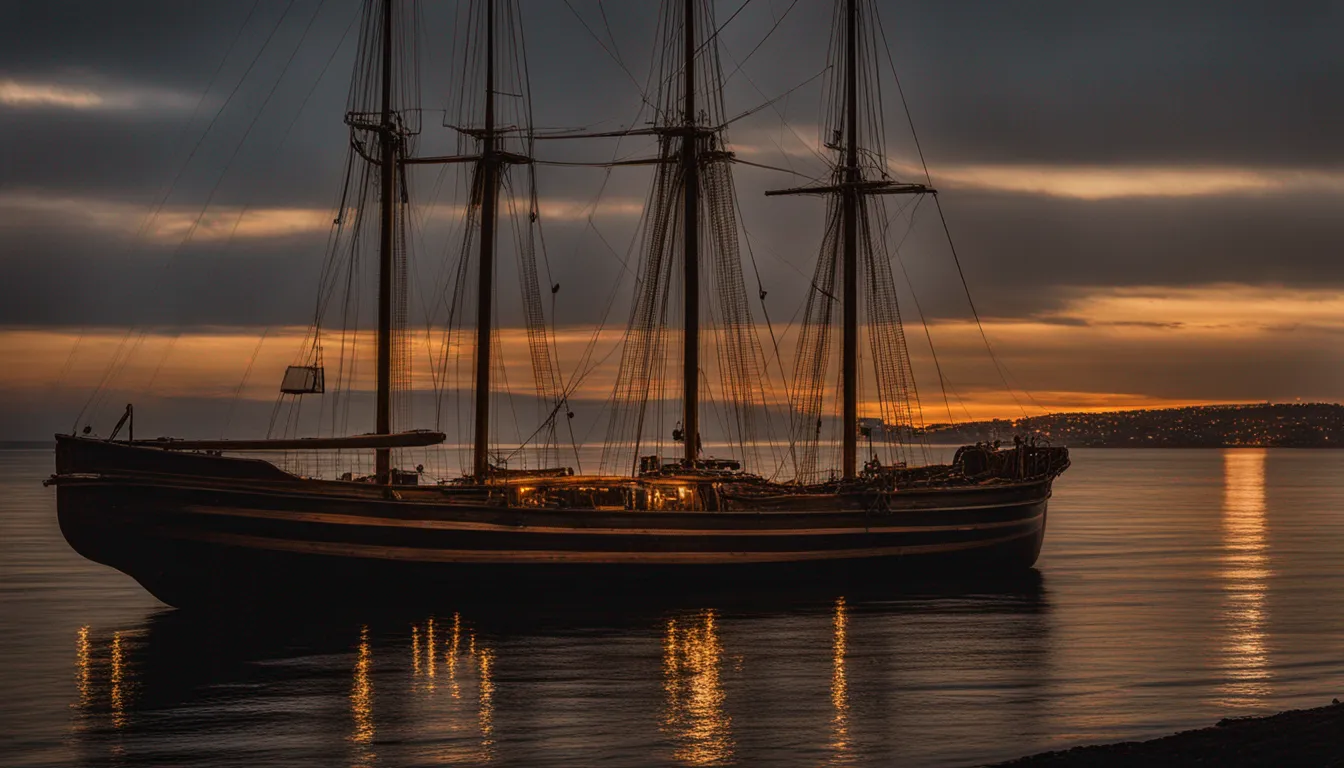
Every day, millions of English speakers use the phrase "the real McCoy" without knowing — or caring — that it probably traces back to a Florida boat builder who looked at the Eighteenth Amendment and saw a business plan. William Frederick McCoy didn't set out to become the most famous rum runner in American history. He set out to avoid bankruptcy. The rum running was just the part that worked.
McCoy's story is the rare Prohibition tale that doesn't end in a hail of bullets, a dramatic courtroom breakdown, or a body dumped in the Chicago River. He smuggled booze, made a fortune, got caught, did his time, went home, and died quietly at 71 on a boat in Stuart, Florida. In an era of Tommy guns and theatrical violence, McCoy committed perhaps the most radical act of all: he was reasonable. This is Article #4 in the Spirits & Outlaws series — following the stories of America's moonshine history, George Remus, and Popcorn Sutton.
The Man Before the Legend: Boats, Not Booze
William Frederick McCoy was born on August 17, 1877, in Syracuse, New York, to a Scottish-American family whose most notable characteristic was a complete absence of criminal ambition. His father, also William, was a brick mason who had served in the Union Navy during the Civil War, running blockade duty — which, in hindsight, feels like foreshadowing that the family chose to ignore.
Young Bill grew up in Philadelphia, spending his formative years haunting the Delaware River docks the way other teenagers haunted dance halls. By the time most kids were figuring out what they wanted to be, McCoy had already decided: he wanted to build boats and sail them. He graduated from the Pennsylvania Nautical School in 1895 at eighteen, which in the 1890s qualified as a focused career plan rather than a gap year.
Around 1900, the McCoy family relocated to Holly Hill, Florida — a small town just north of Daytona Beach that today has a population of roughly 12,000 and a rum runner heritage it did not ask for. Bill and his older brother Ben (five years his senior) established a motor boat service and boatyard that operated between Holly Hill and Jacksonville. They were good at it. Better than good. By 1918, their client list included Andrew Carnegie and the Vanderbilts — the kind of people who didn't buy boats so much as commission floating monuments to their own wealth. The McCoy brothers built yachts for millionaires, and for nearly two decades, this was the whole story. Two brothers in Florida, building boats, making an honest living.
Then came highways. Then came buses. Then came the slow strangulation of the coastal freight and excursion trade. And then, on January 17, 1920, came the Eighteenth Amendment. The McCoys' legitimate business was dying. America's thirst was about to become illegal. Bill McCoy connected these two facts with the same cool-eyed pragmatism that had made him a good boat builder, and he arrived at a conclusion that would define his legacy: if the country wanted liquor and the law said no, someone was going to fill that gap. It might as well be someone who knew how to sail.
The Business Model: A Floating Drive-Through on the Atlantic
McCoy looked at Prohibition the way a startup founder looks at a gap in the market — with dollar signs and a complete absence of moral conflict. But unlike the mob-connected bootleggers who were already setting up networks of bribes, violence, and territorial warfare on the mainland, McCoy had a different idea. A cleaner one. An almost elegant one.
Step one: buy a boat that could carry a lot of liquor. In 1921, McCoy and Ben sold off the remnants of their boatyard business, traveled to Gloucester, Massachusetts, and bought the schooner Henry L. Marshall — a vessel they refitted to carry 1,500 cases of alcohol. Step two: sail to Nassau in the Bahamas, which was a British territory and therefore a place where buying liquor was perfectly legal. Step three: load up. Step four — and this was the genius — sail back to the East Coast and anchor just outside the three-mile U.S. territorial limit.
Three miles offshore, McCoy was technically in international waters. He wasn't smuggling anything. He was parking a boat full of booze in a place where no law applied and letting other people come to him. Small, fast boats — "contact boats" — would motor out from shore, buy cases of whiskey and rum at wholesale prices, and race back to the beaches to distribute the goods on land. McCoy never set foot on American soil with a single bottle. He was, in the strictest legal sense, just a man sitting on a boat. With several thousand cases of Canadian whiskey.
His first run, on August 1, 1921, sailed into Savannah, Georgia, where he sold all 1,500 cases and cleared $15,000 in profit. In 1921 dollars, that was enough to buy a comfortable house outright. He'd made it in a single trip. McCoy looked at those numbers and did what any rational person would do: he went back for more.
The beauty of the model was its simplicity. No bribes to police. No payments to organized crime. No territory disputes with rival gangs. No violence. McCoy operated with the radical transparency of a man who had found a loophole and intended to drive a schooner through it. He even registered his vessels under the British flag to further insulate himself from U.S. maritime law — a move that was less patriotic than practical, and McCoy was nothing if not practical.
Why They Called It "The Real McCoy"
The phrase "the real McCoy" — meaning the genuine article, the authentic thing — is widely attributed to rum runner Bill McCoy, who during Prohibition refused to dilute or adulterate his liquor. While his competitors cut their product with everything from wood alcohol to embalming fluid, McCoy delivered exactly what he promised: unadulterated, properly sourced spirits that wouldn't blind or kill the customer.
To appreciate why this mattered, you need to understand what drinking looked like in early 1920s America. The moment Prohibition created an illegal liquor market, that market attracted people whose quality-control philosophy could charitably be described as "nonexistent." Bootleggers routinely cut spirits with industrial alcohol, wood alcohol (methanol), kerosene, and substances that belong nowhere near a human mouth. In New York alone in 1926, roughly 750 people died from drinking wood alcohol-laced bootleg liquor. On New Year's Day 1927, 41 people died at Bellevue Hospital, with hundreds more following that year. The federal government had ordered manufacturers to add poisons to industrial alcohol to discourage consumption; bootleggers stole the industrial alcohol and tried to remove the poisons, usually with incomplete success. "Tried" is doing a lot of work in that sentence.
McCoy's competitors cut their product with everything from rubbing alcohol to embalming fluid. McCoy's radical business strategy was to sell... actual liquor. Revolutionary. He shipped genuine Scotch whisky, Canadian rye, and Caribbean rum — exactly as it came from the distillery or the bonded warehouse, with no additives, no dilution, and no risk of going blind. His buyers knew that if they bought from McCoy, they were getting what the label said. In a market where a bottle of "Scotch" might contain any liquid from turpentine to floor polish, this was a selling proposition that essentially marketed itself.
The phrase stuck. "The real McCoy" became shorthand among buyers, bartenders, and speakeasy operators for liquor that was safe, authentic, and worth the price. McCoy had accidentally created one of the most enduring brand identities in American culture — an idiom that outlived Prohibition by a century and counting.
There is, however, a complication. (There is always a complication with etymology.)
The phrase "the real McCoy" may not come from Bill McCoy at all. The earliest recorded version appears in an 1856 Scottish poem as "a drappie o' the real MacKay" — a reference to a fine whisky, published in Glasgow decades before McCoy was even born. By 1870, a Scotch whisky brand was advertising under the slogan "the real McKay." The phrase crossed the Atlantic, and the Scottish "MacKay" became the American "McCoy" through the natural process of people hearing a foreign name and replacing it with a familiar one.
Other claimants exist. Kid McCoy, a welterweight boxing champion born Norman Selby, allegedly inspired the phrase when a drunk in a bar questioned his identity and got punched for it — the drunk reportedly confirming from the floor that yes, this was "the real McCoy." Elijah McCoy, an African American inventor whose lubrication devices were so superior that railroad engineers reportedly asked for "the real McCoy" by name, is another candidate. Each theory has advocates. None has conclusive proof.
What is indisputable is that Bill McCoy popularized the phrase in its modern usage during Prohibition, even if he didn't invent it. He gave an existing expression a new, specific, and extremely marketable meaning. Whether or not he coined it, he earned it.
Outlaw File: Bill McCoy
- Full Name: William Frederick McCoy
- Born: August 17, 1877, Syracuse, New York
- Died: December 30, 1948, Stuart, Florida (age 71)
- Alias: "The King of Rum Row," "The Gentleman Bootlegger"
- Era: 1921–1923
- Territory: Atlantic Coast — Nassau to New Jersey
- Specialty: Offshore rum running via Rum Row (3-mile limit)
- Key Vessels: Henry L. Marshall, Tomoka (formerly Arethusa)
- Cargo Capacity: 1,500–5,000+ cases per voyage
- First Run Profit: $15,000 (approx. $250,000 today)
- Legal Trouble: Captured November 1923; 9 months in New Jersey jail
- Personal Habits: Teetotaler — never drank the product he sold
- Legacy: Popularized "the real McCoy"; namesake of The Real McCoy Rum brand
- Signature Trait: Never bribed officials, never cut his liquor, never worked with organized crime
Rum Row: The Greatest Floating Market in American History
McCoy didn't just pioneer offshore rum running. He created an entire industry. By 1922, the stretch of Atlantic Ocean just beyond the three-mile limit — particularly off the coast of New Jersey, from Sandy Hook to Atlantic City — had become a permanent fixture visible from shore. Locals called it "Rum Row," and the name was generous in its simplicity. This wasn't a row. It was a regatta.
At its peak, up to 100 vessels sat anchored in a loose line off the Jersey Shore, their holds packed with every variety of spirit the world produced. Scottish traders brought Scotch. French vessels brought champagne and cognac. Caribbean ships brought rum. Canadian schooners brought rye whiskey. It was essentially an offshore duty-free mall, except instead of perfume and chocolate, the merchandise was several hundred thousand gallons of illegal alcohol. The only thing missing was a food court.
The atmosphere on Rum Row developed its own culture. Jazz bands played on some of the larger vessels. Tourists — actual tourists — would motor out on pleasure boats just to look at the spectacle, the way modern tourists rubberneck at anything vaguely forbidden. Contact boats darted back and forth like water taxis, loading up with cases of whiskey and sprinting back to shore. The whole scene had the chaotic energy of a farmers' market, if the farmers were smugglers and the produce was felonious.
McCoy was Rum Row's undisputed king. After outgrowing the Henry L. Marshall, he purchased a larger vessel — a cargo schooner called the Arethusa, capable of carrying more than 5,000 cases. He registered it under the British flag, renamed it the Tomoka (after the river running through his hometown of Holly Hill), and began making regular runs from Nassau to the waters off New Jersey. Each trip could carry cargo worth tens of thousands of dollars. McCoy was reportedly clearing profits that, in today's currency, would make venture capitalists jealous.
The U.S. Coast Guard watched all of this with the institutional frustration of an organization that knew exactly what was happening and could do almost nothing about it. The three-mile limit was a hard line. International waters meant international waters, and boarding a British-flagged vessel beyond that line was an act that had diplomatic consequences. The Coast Guard could patrol, observe, and attempt to intercept the smaller contact boats making runs to shore — but the mother ships sat offshore like floating middle fingers, perfectly legal, staggeringly profitable, and absolutely infuriating to law enforcement.
McCoy described this period with a directness that bordered on brazenness. At his eventual court hearing, he offered what may be the most concise defense statement in American legal history:
"I have no tale of woe to tell you. I was outside the three-mile limit, selling whisky, and good whisky, to anyone and everyone who wanted to buy."
That's not a defense. That's a Yelp review of his own business. Five stars. Would smuggle again.
The Fall: When Three Miles Became Twelve
The problem with a loophole is that eventually, someone seals it. The three-mile territorial limit had been a legal fixture for over a century, but by 1924, the spectacle of Rum Row — visible from American beaches, reported on by American newspapers, patronized by American drinkers — had embarrassed the federal government into action. On April 21, 1924, Congress extended U.S. territorial waters from three miles to twelve, citing a treaty negotiated with Britain and Canada. The treaty defined the enforceable zone as "one hour's distance" from shore — which, given the speed of most large vessels at the time, worked out to roughly twelve nautical miles.
But McCoy didn't make it to 1924. His run ended on November 23, 1923, a few months before the expanded limit would have complicated his life anyway. The Coast Guard cutter Seneca had orders — specific orders — to capture Bill McCoy and the Tomoka, even if that meant bending the rules about international waters. The fact that McCoy was flying a British flag and sitting outside U.S. jurisdiction was, on this particular day, a technicality the Coast Guard had been authorized to ignore.
What followed was, by Prohibition standards, almost polite. Lieutenant Commander Perkins of the Seneca sent a whaleboat to examine McCoy's papers. McCoy, who had 4,200 cases of whiskey aboard (of which 400 remained after a busy sales period), recognized the situation for what it was. When the boarding party came alongside, McCoy initially tried to run — turning the Tomoka's bow out to sea and making sail. The Seneca fired a shot across the bow. McCoy's crew responded with a machine gun mounted on the forward deck, which sounds more dramatic than it was — they abandoned the gun the moment the Seneca's four-inch shells started landing close enough to throw spray across the deck. Bravery has limits, and those limits are defined by the caliber of the guns pointed at you.
McCoy later described the capture with characteristic dryness: "I immediately set sail and ran away with the boarding party — one lieutenant, one bos'n and thirteen seamen — and only upon their pleas did I heave to and put them back on the Seneca. The damned radio was too severe a handicap for me. I surrendered."
He was brought ashore and charged with violation of the Volstead Act. His response to the legal process was as pragmatic as everything else he'd ever done: he pleaded guilty. No dramatic trial. No insanity defense. No attempt to bribe his way out. McCoy looked at the situation, calculated the odds, and took the deal. He was sentenced to nine months in a New Jersey jail — and by most accounts, the warden let him spend a good portion of that time in a hotel where he could come and go as he pleased. Even in incarceration, McCoy managed to get a better deal than most people get at an Airbnb.
Compare this exit to the other great bootleggers of the era. George Remus murdered his wife in a Cincinnati park. Al Capone died of syphilis in a Miami mansion, his mind destroyed. Dutch Schultz was shot in a Newark chophouse. Bill McCoy pleaded guilty, served nine months, and went home. The man even made jail look sensible.
After the Party: A Quiet Retirement in Florida
Most Prohibition stories end badly. McCoy's ended with real estate.
After his release, McCoy assessed the situation with the same clear-eyed pragmatism that had defined his career. The game had changed. The twelve-mile limit made offshore operations exponentially harder. More importantly, organized crime had moved into rum running with the kind of capital and violence that a lone-wolf boat builder from Holly Hill couldn't compete with. The syndicates had muscle, political connections, and a willingness to resolve business disputes with murder. McCoy had a schooner and a reputation. He chose retirement.
He claimed that legal fees ate up most of his earnings — a claim that should be taken with roughly the same grain of salt you'd apply to any wealthy person claiming poverty. McCoy purchased a comfortable Florida residence, never had to work again, and spent his remaining years doing essentially what he'd done before Prohibition: sailing boats up and down the coast, living quietly, and minding his own business. He and Ben continued building boats. He invested in Florida real estate, which in the 1920s and 1930s was either a brilliant move or a terrible one depending on the year.
There's something almost aggressively undramatic about McCoy's post-Prohibition life. No comeback attempt. No memoir-fueled celebrity tour. No association with organized crime. No bitter interviews about the system. He simply folded his hand and walked away from the table — a skill that approximately zero percent of other famous bootleggers ever mastered. If you're looking for the best bourbon under $50 to raise a glass to an outlaw who knew when to quit, McCoy would probably approve — though he'd also probably not drink it, since the man was a lifelong teetotaler. The king of Rum Row never touched a drop of his own product. The irony writes itself.
William Frederick McCoy died on December 30, 1948, of a heart attack complicated by food poisoning, aboard his boat Blue Lagoon in Stuart, Florida. He was 71. The cause of death — food, not booze — feels like a final, unintentional punchline from a man who spent his most famous years surrounded by alcohol and never drank any of it.
The Legacy: Gentleman, Outlaw, Brand
McCoy occupies a peculiar space in the Prohibition canon. He wasn't the wealthiest bootlegger — Remus had him beat by orders of magnitude. He wasn't the most violent — he barely qualifies as violent at all. He wasn't the most flamboyant — the man's idea of a dramatic gesture was selling quality merchandise at fair prices, which is less "outlaw" and more "functioning retail operation." But McCoy is the Prohibition figure that Americans seem to like the most, and the reason is simple: he was honest.
That sounds absurd. He was a criminal. He broke federal law for three years with enthusiastic consistency. But within the framework of his illegal enterprise, McCoy operated with a code of conduct that would shame most legal businesses. He never cut his product. He never bribed officials. He never worked with organized crime. He never used violence except in self-defense. He paid his debts. He delivered what he promised. He was, in the parlance of a later era, a disruptive entrepreneur who just happened to be disrupting the Volstead Act.
The teetotaler detail is the one that seems to fascinate people most, and it should. Bill McCoy built an empire on selling alcohol he personally had zero interest in consuming. He wasn't a drinker who saw an opportunity. He was a businessman who saw a margin. The product was incidental. It could have been silk stockings or Swiss watches — McCoy would have applied the same principles of quality, reliability, and geographic loophole exploitation. The fact that it was booze was a function of market demand, not personal taste.
Today, the phrase "the real McCoy" has been so thoroughly absorbed into English that most people who use it have no idea they're referencing a Florida rum runner, a Scottish whisky, a boxer, an inventor, or any specific McCoy at all. It has achieved the linguistic equivalent of escape velocity — traveling so far from its origin that the origin itself has become trivia. A rum brand called The Real McCoy, launched in 2013, has tried to bring the story back into focus, selling Caribbean rum with explicit reference to Bill McCoy's legacy and his commitment to unadulterated spirits. Bill would probably appreciate the quality control. He would probably not drink any.
If you're planning a trip along the Kentucky Bourbon Trail, you're following in the footsteps of a different kind of American spirits tradition — one where the product is legal, the tourism is encouraged, and nobody has to anchor three miles offshore. But McCoy would recognize the core appeal. Good spirits, honestly made, sold to people who care about what they're drinking. That was his whole pitch. He just had to do it from international waters.
In the end, Bill McCoy's greatest achievement wasn't the fortune he made or the phrase he popularized. It was the demonstration that you could break the law and still have standards. That you could be a criminal and still be principled. That the real McCoy — whatever its origin — was a concept worth living by, even if the life in question was technically a felony. He was the gentleman bootlegger, the honest smuggler, the outlaw with a quality guarantee. And he never touched a drop.
Frequently Asked Questions
Where does the phrase "the real McCoy" come from?
The most popular American explanation attributes it to rum runner Bill McCoy, who during Prohibition (1920-1933) refused to adulterate his liquor, unlike competitors who cut their product with dangerous chemicals. However, the phrase may predate McCoy — a Scottish poem from 1856 references "the real MacKay," and a Scotch whisky used "the real McKay" as a slogan in 1870. Other candidates include boxer Kid McCoy and inventor Elijah McCoy. McCoy almost certainly popularized the phrase in its modern American usage, even if he didn't coin it.
Was Bill McCoy really a teetotaler?
Yes. Multiple historical sources confirm that William Frederick McCoy never drank alcohol despite spending his most profitable years selling thousands of cases of whiskey, rum, and other spirits from ships anchored off the Atlantic coast. He viewed rum running as a business opportunity, not a lifestyle. The king of Rum Row's personal beverage preferences remain one of the great ironies of Prohibition history.
What was Rum Row during Prohibition?
Rum Row was the name given to a line of ships anchored just beyond the three-mile U.S. territorial limit (later extended to twelve miles in 1924), particularly off the coast of New Jersey from Sandy Hook to Atlantic City. These vessels, flying foreign flags, operated as floating liquor stores — selling alcohol to smaller "contact boats" that would transport the cargo to shore for distribution. At its peak, up to 100 ships sat anchored on Rum Row at any given time. Bill McCoy is credited with pioneering this method in 1921.
How was Bill McCoy caught?
On November 23, 1923, the U.S. Coast Guard cutter Seneca intercepted McCoy's schooner Tomoka off the coast of Sea Bright, New Jersey. Although McCoy was technically in international waters, the Coast Guard had specific orders to capture him. After a brief exchange of fire — McCoy's crew fired a machine gun, the Seneca responded with four-inch shells — McCoy surrendered. He was found with approximately 400 cases of whiskey remaining from a 4,200-case shipment. He pleaded guilty and served nine months in a New Jersey jail.
What happened to Bill McCoy after Prohibition?
After serving nine months in jail, McCoy returned to Florida and retired from rum running. He invested in real estate, continued boat building with his brother Ben, and lived quietly in Florida for the remaining 24 years of his life. He died on December 30, 1948, at age 71, aboard his boat Blue Lagoon in Stuart, Florida. Unlike most famous Prohibition figures, McCoy's story ended without violence, tragedy, or a dramatic downfall — he simply recognized when the game was over and stopped playing.
Did Bill McCoy work with organized crime?
No. One of McCoy's defining characteristics was his refusal to work with organized crime syndicates, bribe law enforcement or government officials, or engage in the violence that characterized other bootlegging operations. He operated independently, relying on the legal loophole of international waters rather than on corruption or intimidation. This independence was both his brand and, ultimately, his limitation — when the syndicates moved into rum running with greater capital and muscle, McCoy couldn't compete and chose to retire rather than partner with them.