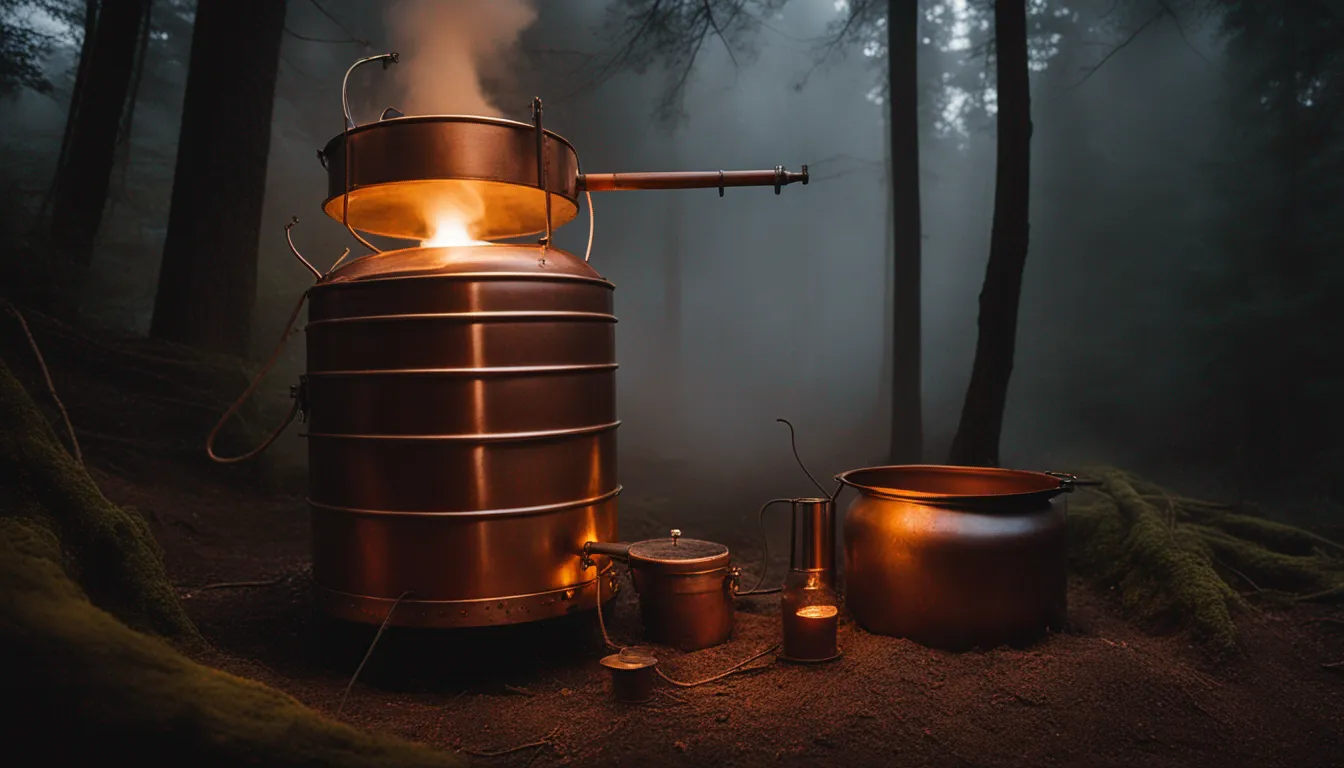
On March 3, 1791, a man named Robert Johnson rode into the hills of western Pennsylvania to deliver tax notices. Farmers chased him out at gunpoint, stripped him, tarred and feathered him, and sent him stumbling back to Pittsburgh covered in pine pitch and shame. Johnson's crime? Asking moonshiners to pay six cents per gallon on the corn whiskey they'd been making since before the Constitution existed. That whiskey — raw, unaged, cooked in copper pots over open flame — was moonshine. And Americans have been fighting over it for 235 years.
The history of moonshine isn't a quaint folk tale. Moonshine built NASCAR, fueled a shooting war against the federal government, poisoned thousands during Prohibition, and spawned a $3.2 billion legal craft spirits industry. It's the most American spirit ever distilled — born from immigrant know-how, frontier stubbornness, and an enduring national conviction that the government has no business telling you what to do with your own corn.
Pour something strong. This is the full, uncut moonshine history — from the first copper stills to the Mason jars at your local liquor store.
So What Is Moonshine, Actually?
Moonshine is unaged corn whiskey, typically distilled to 80 proof or higher, produced without government authorization. That last part is what separates it from, say, the white whiskey you can buy at Total Wine. Same basic liquid. Very different legal status.
The name comes from "moonshining" — distilling by the light of the moon to avoid detection. The term first appeared in British English around 1785 to describe any illicit activity conducted at night, but American moonshiners made it their own. By the early 1800s, "moonshine" referred specifically to illegally distilled spirits in the United States.
The recipe is disarmingly simple. Corn (at least 80% of the grain bill), water, yeast, and sometimes malted barley or sugar. The mash ferments for 4-7 days, then gets heated in a pot still until the alcohol vaporizes, travels through a condenser (traditionally a copper coil called a "worm"), and drips out as clear, high-proof spirit. Our breakdown of bourbon mash bills explained covers the science behind corn-to-whiskey ratios.
Is moonshine stronger than vodka? It can be. Commercial vodka is standardized at 40% ABV (80 proof). Moonshine ranges wildly — anywhere from 40% to 75% ABV depending on who made it and how many times they ran it through the still. Some legendary Appalachian distillers reportedly produced runs above 90% ABV, though drinking that is roughly as advisable as gargling lighter fluid.
Who Invented Moonshine? The Scots-Irish Planted the Seeds (and the Corn)
Nobody "invented" moonshine the way nobody "invented" bread. But ask "who invented moonshine?" and you get a specific answer: Scots-Irish immigrants who settled in Appalachia during the 1700s. The American moonshine tradition starts on the other side of the Atlantic.
Between 1717 and 1775, an estimated 250,000 Scots-Irish immigrants settled in the backcountry of Pennsylvania, Virginia, and the Carolinas. These were people from the borderlands of Scotland and northern Ireland — communities where home distilling was a cultural institution. They brought copper pot stills, generations of distilling knowledge, and a bone-deep suspicion of centralized authority. When they found Appalachia's hollows thick with cold spring water and corn that grew waist-high by July, they did what came naturally.
Corn was the critical variable. In Scotland and Ireland, they'd distilled barley and rye. In Appalachia, corn dominated because it produced more grain per acre and grew in poor mountain soil. A bushel of corn that might fetch 25 cents at market could yield two and a half gallons of whiskey worth $1.25. On rutted mountain roads where a wagon might not survive the journey to town, whiskey was the only commodity that made economic sense. It was currency. Farmers paid debts in whiskey. Churches accepted tithes in whiskey. Doctors prescribed it. Babies were baptized in it. (That last one might be apocryphal. Might.)
George Washington — yes, that one — operated what was, by 1799, the largest distillery in America at Mount Vernon. His Scottish farm manager, James Anderson, convinced him to build a stillhouse that produced 11,000 gallons of rye whiskey in its peak year. Washington wasn't making moonshine (he had a license), but his operation proved what Appalachian farmers already knew: distilling grain was the most profitable thing you could do with it.
America's First Tax Revolt (Spoiler: It Was About Whiskey)
The Whiskey Rebellion of 1794 wasn't just a skirmish. It was the first armed challenge to federal authority under the new Constitution, and it set the template for every moonshine bust that followed.
Here's the setup. Alexander Hamilton needed to pay off $54 million in Revolutionary War debt. His solution: an excise tax on distilled spirits, signed into law by President Washington in March 1791. Eastern distillers who sold in cash markets could absorb the tax. Frontier farmers who used whiskey as currency couldn't. A farmer in western Pennsylvania might never see enough paper money in a year to pay the tax on his annual production.
Resistance escalated fast. Tax collectors were threatened, beaten, and tarred and feathered. In July 1794, 500 armed men attacked the home of federal tax inspector John Neville near Pittsburgh and burned it to the ground. Two weeks later, 7,000 rebels gathered at Braddock's Field to debate marching on Pittsburgh itself.
Washington's response was staggering. He assembled a militia force of 12,950 soldiers — larger than any army he'd commanded during the Revolution — and personally rode west to suppress the rebellion. It was, and remains, the only time a sitting U.S. president led troops in the field. The rebels scattered without a major battle. Twenty were arrested; two were convicted of treason; Washington pardoned both.
The tax stayed on the books until Thomas Jefferson repealed it in 1802. But the precedent was permanent: the federal government could tax your whiskey, and if you refused to pay, the army would show up. Many western Pennsylvania distillers migrated south and west — into Kentucky, Tennessee, and deeper Appalachia — carrying their stills and their resentment into mountains where federal reach was thinnest. If you've ever driven the Whiskey Rebellion Trail guide route through western Pennsylvania, you've passed the exact hills where farmers decided that dying was preferable to paying six cents a gallon.
Why Is Moonshine Illegal?
Moonshine is illegal because the federal government requires a permit to distill spirits and charges an excise tax of $13.50 per proof gallon on all distilled alcohol. Producing spirits without a federal Distilled Spirits Permit is a felony under 26 U.S.C. § 5601, punishable by up to 5 years in prison and a $10,000 fine.
The Alcohol and Tobacco Tax and Trade Bureau (TTB) — the successor to the "revenuers" — oversees distilled spirits production in the United States. Unlike home brewing of beer and wine, which Congress legalized for personal consumption in 1978, home distillation remains a federal crime regardless of quantity or intent. You can brew 200 gallons of beer per household per year. You cannot legally distill a single drop of whiskey without a federal permit.
The real reason isn't safety — it's revenue. The federal excise tax on distilled spirits generates approximately $9.5 billion annually. The government has a massive financial incentive to maintain its monopoly on permitting and zero incentive to create a homebrewing-style exemption for distillers.
Can You Go to Jail for Making Moonshine?
Yes. Federal law treats unlicensed distillation as a felony, not a misdemeanor. First-time offenders face up to 5 years in federal prison and fines up to $10,000 per offense. State penalties vary and can stack on top of federal charges. In practice, the TTB prosecutes commercial-scale operations more aggressively than hobbyists with 5-gallon stills, but "probably won't get caught" is not a legal defense. Our comprehensive guide to home distilling laws by state breaks down the patchwork of state regulations that layer onto the federal ban.
Is It Legal to Own a Still?
Federal law does not prohibit owning a still — they're sold on Amazon. But you must use it for legal purposes only: distilling water, essential oils, or fuel alcohol (which requires a separate federal permit). The moment you run a fermented mash through it for consumable spirits without a DSP, you've committed a federal crime. A few states — Florida and Georgia among them — require still registration regardless of intended use.
What States Allow Moonshine?
The moonshine legal states question is complicated because no state can override the federal ban. Missouri is the most permissive, allowing up to 200 gallons per year for personal consumption — though this technically conflicts with federal law. Alaska has historically been lenient in enforcement. Most states default to the federal ban, and a handful (Alabama, Indiana, Kansas) impose their own criminal penalties on top. The history of the Hobby Distillers Association tracks the ongoing fight to change these laws.
The Golden Age: When Mountains Ran White
If you grew up watching "Dukes of Hazzard" reruns and assumed moonshining was a quaint hillbilly pastime — a couple of good old boys running a still in the woods for drinking money — the actual history will recalibrate your assumptions considerably.
By the mid-1800s, moonshining was an industry. Not a cottage industry. An industry. Appalachian communities from western Virginia to northern Georgia operated networks of stills producing tens of thousands of gallons annually. The operators weren't stereotypical backwoods hermits; they were farmers, businessmen, and the most technically skilled members of their communities. Running a copper pot still required metalworking, chemistry, temperature management, and — most importantly — the ability to keep your mouth shut.
The federal government responded by deploying revenue agents — "revenuers" — into moonshine country. The job was exactly as dangerous as it sounds. Between 1870 and 1900, at least 34 federal revenue agents were killed in the line of duty in Appalachian states. The moonshiners weren't playing.
Mountain communities protected their distillers. Warnings traveled faster than agents could ride. Stills were hidden in caves, behind waterfalls, and deep in hollows accessible only by footpath. When revenuers found a still, they'd chop it apart with axes — the origin of the term "busted" — but another would appear within weeks, built from salvaged copper and stubborn principle.
Outlaw File: Marvin "Popcorn" Sutton
The most famous moonshiner of the modern era wasn't from the 1800s — he died in 2009. Marvin "Popcorn" Sutton was a Tennessee mountain man who distilled moonshine openly, starred in documentaries about his craft, and published a hand-typed autobiography titled Me and My Likker. He was convicted of federal distilling charges in 2007 after agents found three working stills and 850 gallons of moonshine on his property. Rather than report to prison, Sutton took his own life at age 62. He's buried in Maggie Valley, North Carolina, and his legacy inspired a legal moonshine brand (Popcorn Sutton's Tennessee White Whiskey) now owned by Sazerac.
Notable stat: Sutton claimed his family had been making moonshine continuously since the 1700s — roughly 10 generations.
Then Came Prohibition, and Everything Got Worse
On January 17, 1920, the Eighteenth Amendment went into effect and the United States banned the production, sale, and transportation of alcoholic beverages. For moonshine country, this was both catastrophe and opportunity.
Catastrophe because Prohibition militarized enforcement. The Bureau of Prohibition deployed federal agents with badges, guns, and — eventually — the legal authority to shoot on sight. The violence escalated from rural skirmishes to something resembling a low-grade civil war in parts of Appalachia.
Opportunity because suddenly everyone in America wanted what moonshiners had been making for 150 years. Demand exploded. Urban bootleggers needed supply. Moonshine runners became the critical link between mountain stills and thirsty cities. The price of corn whiskey tripled overnight.
Prohibition also democratized moonshining. Before 1920, the craft was concentrated in Appalachian communities with multi-generational traditions. After 1920, operations sprang up in Chicago basements, Brooklyn bathrooms, Kansas wheat fields, and Louisiana sugarcane plantations. Quality ranged from excellent to lethal — city operators who cut corners ran mash through stills made from car radiators, poisoning their customers with lead.
When Prohibition ended on December 5, 1933, legal distilleries reopened and casual moonshiners disappeared. In Appalachia, the old-timers kept cooking. They'd been illegal before Prohibition, illegal during Prohibition, and they saw no reason to change. Federal agents would spend the next 60 years hunting them.
"I've been making whiskey since I was 6 years old, and I ain't never stopped. What's the government gonna tell me I can't do — breathe?"
— Attributed to Amos Owens, "Cherry Bounce King of Rutherford County," North Carolina, circa 1890
Thunder Road: How Moonshine Built NASCAR
Here's a sentence you don't read every day: America's most popular motorsport was invented by federal criminals.
During and after Prohibition, moonshine runners in the southeastern United States faced a logistics problem. They needed to move hundreds of gallons of untaxed whiskey from remote mountain stills to distribution points in piedmont cities — typically a 50- to 100-mile drive through winding mountain roads, past county sheriffs and federal agents. Getting caught meant prison. Getting away meant money. The solution was speed.
Runners modified their cars obsessively. They dropped V8 engines into Ford coupes, stiffened suspensions to handle 100-gallon payloads, stripped interiors to save weight, and learned to drive mountain roads at 100 mph with their lights off. The cars looked stock from the outside — a crucial detail, since a '40 Ford with visible modifications attracted the wrong kind of attention.
On days off, runners raced each other. They cleared fields, set up improvised tracks, and bet on who was fastest. In 1948, Bill France Sr. organized 35 drivers for the first "Strictly Stock" race at Charlotte Speedway — at least a third had moonshine records.
Junior Johnson is the name everyone remembers. Born in Wilkes County, North Carolina — the moonshine capital of the eastern United States — Johnson ran his first load of whiskey at age 14 and served 11 months in federal prison after a 1956 bust at his father's still. He channeled his driving skills into stock car racing and won 50 NASCAR races, including the 1960 Daytona 500, where he pioneered the drafting technique. Robert Mitchum's 1958 film Thunder Road drew partly from Johnson's story and became the highest-grossing drive-in movie of its era.
President Ronald Reagan pardoned Johnson in 1986. When asked about his moonshine days, he was characteristically blunt: "If it hadn't been for whiskey, NASCAR wouldn't have no cars to race." Wilkes County, population 69,000, has produced more NASCAR drivers per capita than any county in America. The mechanical knowledge that runners developed — engine tuning, suspension geometry, weight distribution — transferred directly to stock car engineering. NASCAR's founding generation didn't just share geography with moonshiners. They were moonshiners.
Will It Kill You? Moonshine Facts, Myths, and Reality
The question "is moonshine dangerous?" carries a lot of folklore and not much nuance. Here are the moonshine facts that separate genuine risk from campfire legend.
The 7 Myths
- "Moonshine will make you go blind." Mostly wrong. Methanol exists in all fermented beverages in tiny quantities. A competent distiller discards the "foreshots" (the first trickle from the still, richest in methanol), and the remaining spirit contains methanol levels comparable to commercial whiskey. The blindness epidemic came from Prohibition-era criminals who added industrial methanol to stretch their product.
- "Moonshine is always dangerously strong." It can be, but many traditional Appalachian distillers aimed for 100-120 proof (50-60% ABV) — strong, but not dramatically more than cask-strength bourbon or Navy-strength gin.
- "Real moonshine tastes terrible." Badly made moonshine tastes terrible. Well-made corn whiskey from a clean copper still is smooth, sweet, and genuinely pleasant. There's a reason people risked prison to make it.
- "Moonshine is always made from corn." Traditionally, yes. But moonshiners have used rye, wheat, barley, sugar, fruit, and whatever else ferments. "Moonshine" describes the legal status, not the recipe.
- "One sip can kill you." No. The danger comes from sustained consumption of contaminated product or acute alcohol poisoning from drinking too much too fast — the same risk as any high-proof spirit.
- "It's only made in the South." Moonshining has been documented in every U.S. state. During Prohibition, Detroit and Chicago were as productive as the Appalachian hollows.
- "Modern moonshine is illegal." The stuff labeled "moonshine" at your liquor store? Completely legal. It's commercially produced, federally permitted, and fully taxed. It's called "moonshine" for marketing purposes. You're buying nostalgia.
The 3 Truths
- Lead poisoning was the real killer. Moonshiners who used car radiators as condensers (instead of proper copper coils) leached lead into the distillate. Chronic consumption caused nerve damage, kidney failure, cognitive decline, and death. Some Appalachian counties had lead poisoning rates far above the national average well into the 1970s, directly attributable to locally distilled whiskey.
- Bad stills produce bad spirits. A still built from galvanized steel, soldered with lead, or cleaned with industrial chemicals will produce spirits contaminated with heavy metals. This is why legitimate distillers use food-grade copper and stainless steel — the "danger" of moonshine was always about the equipment, not the recipe. For the proper process, how bourbon is made covers the equipment that separates craft distilling from guesswork.
- Proof matters. Spirit off a pot still at 160+ proof is not meant to be consumed neat. Traditional moonshiners "proofed" their whiskey down — diluting with clean water, often using the "bead test" (shaking the jar and watching the bubbles) to estimate ABV. Skipping that step turned drinkable whiskey into a dangerous product.
The bottom line: properly made moonshine from a clean copper still, with foreshots discarded and the spirit proofed down to reasonable strength, is no more dangerous than any other whiskey. The danger was never the recipe. It was the shortcuts.
From Outlaw to Artisan: Moonshine's Legal Redemption
Walk into any well-stocked liquor store in America and you'll find an entire shelf of "moonshine" — clear corn whiskey in Mason jars, flavored with everything from apple pie to jalapeño, priced between $15 and $35. This is not what Popcorn Sutton had in mind.
The legal moonshine boom started in 2010 when Ole Smoky Distillery opened in Gatlinburg, Tennessee, as the state's first legal distillery in over a century. They leaned hard into the moonshine aesthetic: Mason jar packaging, Appalachian branding, and flavored expressions that tasted more like alcoholic Jolly Ranchers than traditional corn whiskey. It worked. Ole Smoky became the most visited distillery in the United States, drawing over 4 million visitors annually to its Gatlinburg location. By 2023, they were producing over 1 million cases per year.
Other brands followed. Midnight Moon (founded by Junior Johnson himself) offered authentic pedigree. Kings County Distillery in Brooklyn made moonshine that landed on "best spirits in America" lists. The category grew from essentially zero in 2008 to $3.2 billion in annual retail sales by 2024.
The irony is thick enough to bottle. You can buy moonshine at Dollywood. There are moonshine tasting tours in Pigeon Forge with selfie stations. The descendants of men who shot at revenuers now hold federal distilling permits and file quarterly tax returns.
But something genuine lives underneath the commercialism. The craft distilling movement — now exceeding 2,700 craft distilleries nationwide — owes its philosophical DNA to moonshiners. Small batch, handmade, locally sourced, independent. When a craft distiller in Portland talks about "pushing back against industrial spirits," they're channeling the same impulse that drove a Scots-Irish farmer in 1790 to build a still in a creek hollow and tell the federal government to go to hell.
If you want to explore where that tradition leads when it gets a federal permit and a tasting room, start with the Kentucky Bourbon Trail guide or browse our picks for the best bourbon under $30 — spirits that carry the moonshiner's craft ethos at prices that won't start a rebellion.
What Moonshine Made
Strip away the Mason jars and the mythology, and what moonshiners actually gave America is this: a template for how independent producers fight industrial monopolies.
The "craft" ethos that drives today's small-batch bourbon, artisanal gin, and farm-to-bottle whiskey isn't a marketing invention. It's a direct inheritance from distillers who chose quality, independence, and personal risk over compliance with a system they considered unjust. Every craft distiller who sources local grain and sells direct to consumers is working from the moonshiner's playbook — with a permit and better plumbing.
NASCAR remains the most visible legacy, a $12 billion industry built on bootlegger ingenuity. But the cultural impact runs deeper. The American mythology of the self-reliant rebel — the individual who makes his own product, by his own rules, and answers to nobody — didn't start in Silicon Valley garages. It started in Appalachian hollows, next to a copper still, under a full moon.
And then there's the whiskey itself. The unaged corn spirit that moonshiners produced is the ancestor of bourbon. When those Scots-Irish distillers migrated to Kentucky, they brought their recipes and their copper stills. They started aging corn whiskey in charred oak barrels — perhaps by necessity, perhaps by genius. The result was bourbon. Our top 10 bourbons list includes bottles that owe their existence directly to the moonshine tradition.
Even the phrase "The Real McCoy" — meaning genuine, uncut, authentic — likely comes from Bill McCoy, a Prohibition-era rum runner who never diluted his cargo. (McCoy ran rum, not moonshine, but the spirit world claimed him.)
Consider this: in 1794, Americans went to war with their own government over the right to distill whiskey. Today, the Hobby Distillers Association lobbies Congress for the same right, using legal briefs instead of muskets. The technology changed. The argument didn't.
Moonshine history isn't a relic — it's the reason American whiskey culture exists at all. Every bottle of bourbon, every craft distillery tasting room, every late-night argument about how to make bourbon at home connects back to a Scots-Irish farmer who decided the corn in his field would be worth more as liquid than as grain.
He was right. He's still right. And somewhere in the mountains, someone's probably proving it tonight.
Moonshine FAQ
Why is moonshine called moonshine?
The term comes from "moonshining," meaning to do something covertly by the light of the moon. Illicit distillers worked at night to avoid detection by revenue agents. The word first appeared in English around 1785 and was applied specifically to illegal American spirits by the early 1800s.
Where did moonshine originate?
American moonshine traces to Scots-Irish immigrants who settled in Appalachia during the 1700s, bringing pot-still distilling traditions from Scotland and northern Ireland and adapting them to local corn.
What is moonshine made from?
Traditional moonshine uses a mash of at least 80% corn, combined with water, yeast, and sometimes malted barley or sugar. The mash ferments for 4-7 days, then is distilled in a pot still. For the full grain science, see bourbon mash bills explained.
Is moonshine stronger than vodka?
Moonshine can be significantly stronger than vodka. Standard vodka is 40% ABV (80 proof). Moonshine typically ranges from 40-75% ABV, with some batches exceeding 90% ABV. Traditional moonshiners usually proofed their whiskey down to 50-60% ABV for drinking.
Can you go to jail for making moonshine?
Yes — it's a federal felony under 26 U.S.C. § 5601, carrying up to 5 years in prison and $10,000 in fines. Check our guide to home distilling laws by state for jurisdiction-specific details.
Is it legal to own a still?
Owning a still is legal under federal law if used for non-alcohol purposes. Using one to produce consumable spirits without a permit is a federal crime. The freeze distillation method avoids the still question entirely but occupies its own legal gray area.
What states allow moonshine?
No state can override the federal ban. Missouri permits up to 200 gallons per year for personal use (in technical conflict with federal law). Alaska has historically light enforcement. For a complete breakdown, see home distilling laws by state.