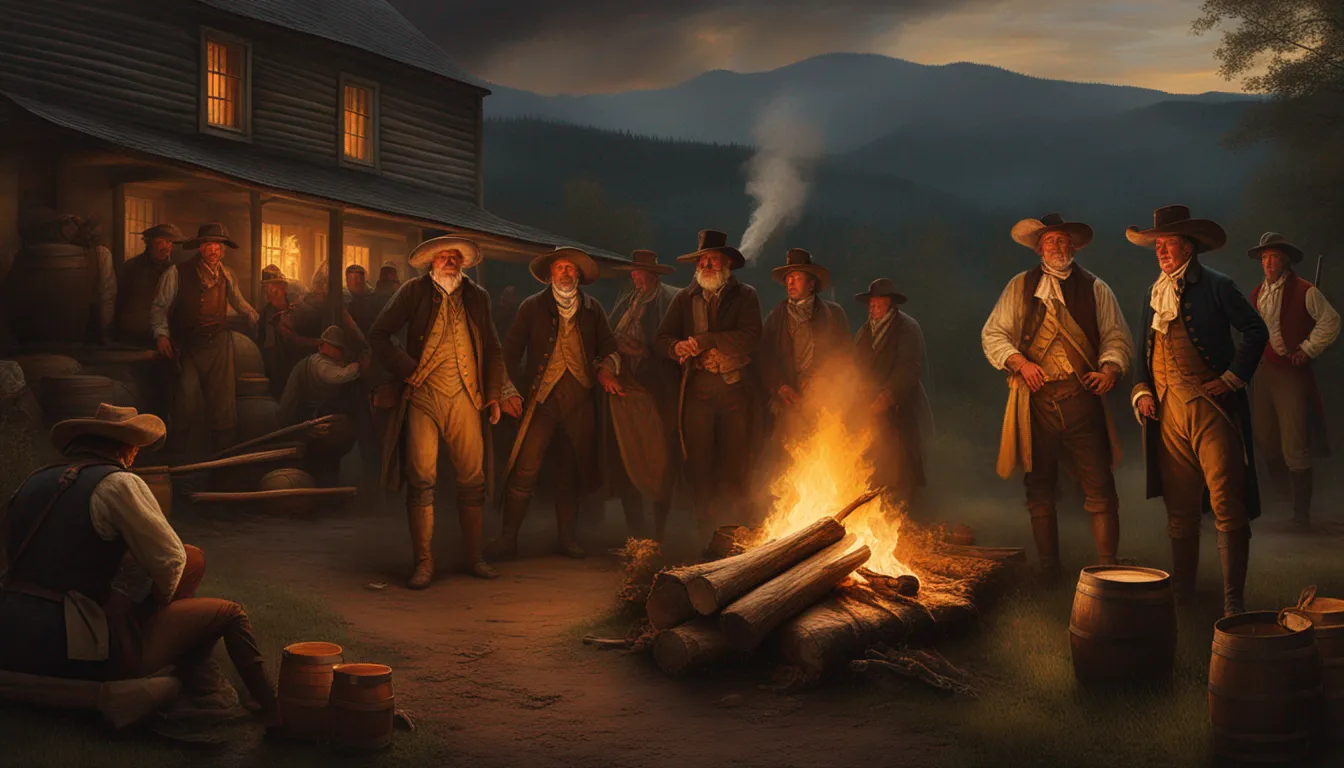
The Whiskey Rebellion was a violent uprising in western Pennsylvania from 1791 to 1794, sparked when Alexander Hamilton imposed the first federal tax on domestic whiskey to pay Revolutionary War debts. Frontier farmers—who used whiskey as currency—tarred and feathered tax collectors, burned a federal inspector's mansion, and assembled a 7,000-strong militia before President George Washington personally marched 13,000 troops into the region to crush the revolt.
The Night They Burned the Tax Man's House
On July 17, 1794, roughly 600 armed men surrounded a mansion called Bower Hill in Allegheny County, Pennsylvania. They were not there for the architecture. They had come for General John Neville, the federal revenue inspector who’d been collecting Alexander Hamilton's new whiskey tax, and the place was about to become the most expensive bonfire in early American history.
The day before, about 40 rebels had already tried to capture a U.S. marshal serving writs at Neville's estate. That attempt ended when Neville fired from a window and killed Oliver Miller, a local farmer. So the rebels came back the next morning with reinforcements. After an exchange of gunfire, their leader—a Revolutionary War veteran named James McFarlane—stepped into the open during what he believed was a ceasefire. A shot from the house dropped him dead. The enraged mob burned Bower Hill to the ground, including the slave quarters and every outbuilding on the property.
This was not, to be clear, a minor policy disagreement. This was the fledgling United States of America tearing itself apart over a tax on booze, barely a decade after winning independence from Britain over... taxes. The irony was not lost on anyone at the time, and it shouldn't be lost on us now.
Welcome to the Whiskey Rebellion. The story of how America's complicated relationship with untaxed spirits nearly derailed the republic before it got out of second gear.
Liquid Currency: Why the Frontier Ran on Whiskey
To understand why Pennsylvanian farmers were willing to commit treason over grain alcohol, you need to understand what whiskey actually was in the 1790s. It wasn't a luxury. It wasn't a vice. It was money.
Western Pennsylvania in the early republic was not exactly Wall Street. Hard currency—gold and silver coins, known as specie—barely existed west of the Appalachian Mountains. Each state printed its own paper money, most of it worth less than the paper it was printed on. So frontier communities developed a barter economy, and the most reliable unit of exchange was whiskey.
Farmers paid their doctors in whiskey. They bought tools, cloth, and salt with whiskey. They settled debts in whiskey. A gallon of rye whiskey was as close to a universal currency as western Pennsylvania had. Think of it as a kind of grain-based Bitcoin, except it actually had intrinsic value because you could drink it.
There was also a practical math problem that made distilling not just convenient but essential. Grain is heavy and bulky. Hauling bushels of rye or corn over the Alleghenies to eastern markets was brutal, expensive work that destroyed roads, wagons, and the backs of the men doing the hauling. But distill that same grain into whiskey, and you reduced the volume by roughly a factor of ten while preserving—or increasing—the value. A horse could carry four bushels of grain or the equivalent of twenty-four bushels in whiskey. The math was not complicated.
By 1790, southwestern Pennsylvania alone held roughly one-quarter of all the stills in the entire United States. Allegheny, Fayette, Washington, and Westmoreland counties were the distilling capital of the new nation. The grain mash bill of choice was rye, and nearly every farm with surplus grain had a still. Distilling wasn't a side hustle. It was the economy.
So when Alexander Hamilton came for the whiskey, he wasn't proposing a minor inconvenience. He was proposing a tax on the frontier's primary currency, payable only in the hard currency that frontier communities didn't have. He might as well have demanded payment in moon rocks.
Hamilton's Bright Idea: The Excise Act of 1791
Alexander Hamilton had a problem. The Revolutionary War had left the federal government drowning in approximately $54 million of debt, and Hamilton, as Secretary of the Treasury, had convinced Congress to assume the states' war debts too. Noble in theory. Expensive in practice.
Hamilton's solution was a federal excise tax on domestically produced spirits, signed into law on March 3, 1791. The tax ranged from six to eighteen cents per gallon, depending on the proof and type of spirit. On paper, it looked straightforward. In practice, it was designed in a way that would make a modern lobbyist blush with admiration at its naked favoritism.
Large distillers—the kind operating in eastern cities with access to cash markets—could pay an annual flat rate that worked out to roughly six cents per gallon. The more they produced, the lower the effective rate. Small frontier distillers, meanwhile, got stuck paying nine cents per gallon, assessed per batch. If you were a farmer running a small copper still a few months a year, you were paying nearly 50 percent more per gallon than the big operators in Philadelphia.
Hamilton knew this would be unpopular. He didn't particularly care. He viewed the whiskey tax as a way to accomplish two goals simultaneously: raise revenue and assert federal authority over the states. In Hamilton's vision of America, the central government needed to demonstrate that it could levy and collect taxes. The Articles of Confederation had failed precisely because the federal government couldn't fund itself. If the new Constitution was going to mean anything, someone had to actually pay for it.
The frontier farmers saw it differently. They had just fought a war against a distant government that taxed them without adequate representation. Now a new distant government was doing the same thing. Their representatives in Congress had voted against the excise. The tax collectors were easterners who didn't understand frontier life. The tax had to be paid in specie they didn't possess. And the whole scheme transparently favored large producers over small ones.
This went over about as well as you'd expect.
Tar, Feathers, and Escalation
The resistance started before the ink on the Excise Act was dry. In September 1791, a recently appointed tax collector named Robert Johnson was making his rounds in Washington County, Pennsylvania, when eleven men disguised in women's clothing surrounded him on the road. They stripped him naked, tarred and feathered him, stole his horse, and left him to walk home through the woods. Johnson, understandably, resigned.
A federal official sent to serve arrest warrants on Johnson's attackers received the same treatment. He was whipped, tarred, feathered, and abandoned in the forest. The warrants were not served.
Over the next three years, violence against tax collectors became routine in western Pennsylvania. Revenue officers were beaten, threatened, and had their property destroyed. Anyone who agreed to rent their property as a tax collection office found their buildings vandalized or burned. One distiller who complied with the tax had his still shot full of holes. The message was clear: cooperate with the excise, and you'd regret it.
The rebels employed what amounted to frontier community policing. They erected liberty poles—tall wooden poles with signs declaring opposition to the tax, borrowed from Revolutionary War protests against the British. They organized conventions to draft formal petitions. And when those petitions failed, they turned to what they knew: the same tactics their fathers had used against the Stamp Act. Tar, feathers, and selective arson.
Hamilton, for his part, saw the resistance as proof that his tax was working exactly as intended. Not the revenue part—collections were abysmal—but the authority part. If frontier farmers could simply refuse to pay a federal tax, the Constitution was just a piece of paper. Hamilton began pushing Washington to use military force.
Washington hesitated. He was a politician as well as a general, and he understood that sending an army against citizens who had just fought for independence was not a great look. So he tried negotiation first. He issued proclamations. He sent commissioners. He waited.
The frontier didn't get the message.
The Summer of 1794: Things Fall Apart
The powder keg finally exploded in July 1794. On July 15, a U.S. marshal named David Lenox arrived in western Pennsylvania to serve writs on distillers who hadn't registered their stills or paid the excise. He was accompanied by General John Neville, the regional tax inspector. Their first few stops went fine. Then they arrived at the farm of William Miller in Allegheny County.
Miller was not home. His neighbors were, and they were not happy to see a federal marshal. Word spread through the hollows faster than anyone in Philadelphia could have predicted. The next day, a group of roughly 40 armed men showed up at Neville's Bower Hill estate to demand Lenox's writs. Neville opened fire. Oliver Miller, no relation to William, was killed. The rebels retreated.
The following day, July 17, they returned with ten times the numbers. The battle at Bower Hill lasted an hour before James McFarlane was shot dead during what he believed was a truce. The rebels torched the estate. Neville's family and the marshal escaped, but the symbolism was done: an angry mob had burned a federal officer's home to the ground.
McFarlane's funeral, held on July 18, drew hundreds. He was a Revolutionary War veteran, and the frontier viewed his death as murder by a corrupt government. The funeral became a recruiting rally.
And then David Bradford entered the picture.
Outlaw File: David Bradford
Known As: "Whiskey Dave" (which, frankly, is an underrated nickname)
Occupation: Lawyer, deputy attorney general for Washington County, PA. Yes, the man leading an insurrection against federal law was literally a lawyer.
Born: 1762, Maryland
The Rebellion: In early August 1794, Bradford led a march of 5,000–7,000 armed men to Braddock’s Field near Pittsburgh, threatening to burn the city. Pittsburgh wisely offered the marchers free whiskey, and they moved on. Diplomacy at its finest.
The Escape: On October 25, 1794, Bradford was at home when cavalry arrived to arrest him. He leaped from a rear window onto his horse and galloped into the night. Fled to Spanish Louisiana.
What He Did Next: Built The Myrtles Plantation in St. Francisville, Louisiana—now known as "the most haunted house in America." Because apparently fleeing treason charges and settling in a swamp invites ghosts.
Pardoned: 1799, by President John Adams. Brought his wife and five children to Louisiana. Never returned to Pennsylvania.
Died: 1808, at The Myrtles. He was 46.
Bradford was a well-connected Washington County lawyer who threw himself into the rebellion with the enthusiasm of a man who had apparently forgotten that he was, in fact, an officer of the court. On August 1, 1794, he led a march of between 5,000 and 7,000 men to Braddock's Field, just outside Pittsburgh, in what amounted to a show of force against the federal government.
The citizens of Pittsburgh, outnumbered and outgunned, responded with one of history's more creative acts of de-escalation: they sent out barrels of free whiskey and told the mob they were welcome to drink as long as they didn't burn the city down. It worked. The marchers drank, grumbled, and dispersed without torching Pittsburgh. Someone should write a conflict resolution textbook about this.
Bradford also intercepted the U.S. mail—a federal crime then and now—and read letters from Pittsburgh residents who had written to the government asking for protection from the rebels. He publicly read these letters at a rally, essentially doxxing loyalists in 1794. The man had flair, if not legal judgment.
Washington Saddles Up
By August 1794, George Washington had run out of patience, commissioners, and diplomatic options. On August 7, he issued a proclamation demanding the rebels disperse by September 1. Nobody dispersed.
So Washington did something no American president had done before and none has done since: he personally mounted his horse and led an army into the field. On September 30, 1794, he rode out of Philadelphia at the head of a militia force drawn from Virginia, Pennsylvania, Maryland, and New Jersey.
The army numbered approximately 12,950 troops. For context, that's more soldiers than Washington commanded at most major battles during the Revolutionary War, including the initial stages of the Yorktown campaign that won American independence. Let that sink in for a moment. Unpaid whiskey taxes warranted a bigger army than the British Empire.
“If the laws are to be so trampled upon with impunity, and a minority is to dictate to the majority, there is an end put, at one stroke, to republican government.”
Washington personally led the troops as far west as Bedford, Pennsylvania, making him the only sitting president in American history to take the field as commander-in-chief in a literal, on-a-horse, wearing-his-old-uniform sense. He then turned operational command over to Henry "Light Horse Harry" Lee—the governor of Virginia and father of the future Robert E. Lee—and returned to Philadelphia.
The army pressed on into western Pennsylvania in late October. And here's where the story takes its most anticlimactic turn.
Nobody was there.
Well, not nobody. There were people. They were just going about their business, tending farms, looking innocent, and absolutely not committing treason. The rebellion had evaporated the moment 13,000 federal troops crested the Alleghenies. David Bradford had already leaped out his window and was riding hard for the Spanish border. The other leaders had scattered like bourbon at a college tailgate.
The army arrested around 150 men. Most were released quickly. Twenty-four were marched back to Philadelphia for trial, which was itself a punishment—imagine walking 300 miles in chains in November because your neighbor told a federal officer you'd once cheered at a liberty pole. Of those twenty-four, only two were convicted of treason: John Mitchell and Philip Vigol (sometimes spelled Weigel). They were the first Americans ever convicted of federal treason.
Washington pardoned them both. He reportedly found one to be a "simpleton" and the other "insane." These were the first two presidential pardons in American history. The republic's inaugural act of executive clemency was for two guys whose primary defense was that they were too dumb to have committed treason on purpose.
What It All Meant
The Whiskey Rebellion was simultaneously the most and least important crisis of the early republic. Militarily, it was a farce—a massive army mobilized against a rebellion that collapsed at the sight of uniforms. Politically, it was foundational.
For Hamilton, the rebellion vindicated everything he believed about federal power. The government had levied a tax, faced resistance, and enforced compliance through military force. The Constitution worked. The precedent was set: the federal government could tax domestic goods, and if you didn't pay, the president could send an army to your farm. Hamilton considered this a feature, not a bug.
For the rebels and their sympathizers, the lesson was different. The Whiskey Rebellion became a rallying point for the nascent Democratic-Republican Party, led by Thomas Jefferson and James Madison. They argued that Hamilton's financial system—the excise, the national bank, the assumption of state debts—served eastern merchants at the expense of western farmers. When Jefferson won the presidency in 1800, one of his first acts was repealing the whiskey excise in 1802. The frontier celebrated. Hamilton, by then a private citizen, did not.
The rebellion also accelerated westward migration. Farmers who had been distilling in Pennsylvania looked south and west for territory where the federal government's reach was weaker. Many headed to Kentucky, where corn replaced rye as the primary grain, limestone-filtered water provided a natural advantage, and the whiskey that emerged from charred oak barrels would eventually become bourbon. The Kentucky bourbon industry owes a quiet debt to the Pennsylvanian farmers who decided that fighting the federal government was less appealing than outrunning it.
There's a satisfying irony in that. The tax that nearly broke the republic pushed distillers into the territory where they'd create America's most iconic spirit. Hamilton's excise didn't kill whiskey. It just moved it.
The Ghost of Hamilton's Tax
Here's the thing about the whiskey excise: it never really went away. Jefferson repealed it in 1802, but it came back during the War of 1812 and again during the Civil War. By the late 1800s, excise taxes on spirits were the federal government's single largest source of revenue. Let that settle for a moment. The tax that frontier farmers died over became the tax that funded the government.
Today, distilled spirits in the United States face a three-tier federal excise tax. Small distillers pay $2.70 per proof gallon on the first 100,000 proof gallons. After that, the rate jumps to $13.34 per proof gallon, and above 22.13 million proof gallons, it's $13.50. The federal excise tax on spirits is roughly three times the rate on wine and more than double the rate on beer. In 2024 alone, distillers paid $6.7 billion in federal excise taxes. Hamilton would weep with joy.
The reduced rate for small producers—that $2.70 tier—only became permanent in December 2020, after a decade of lobbying by the American Craft Spirits Association. For years, small distillers had been fighting essentially the same battle that frontier farmers fought in 1794: a tax system that disproportionately burdened small producers while giving breaks to large ones. The main difference is that modern craft distillers lobby Congress with PowerPoint presentations instead of muskets. Progress, arguably.
The tension between American spirits and American taxation is woven into the nation's DNA. Prohibition, the 18th Amendment, bootleggers, moonshiners—every chapter of that story traces back to the fundamental disagreement that erupted in western Pennsylvania in 1791. How much authority does the government have over what you distill, and how much of the proceeds does it get to take?
We're still arguing about it. The venue has just moved from Braddock's Field to Capitol Hill, and the weapons have shifted from tar and feathers to campaign contributions. The underlying dispute hasn't changed one drop.
Why This Matters If You Drink Bourbon
Every time you buy a bottle of bourbon, a meaningful chunk of the price goes to federal and state excise taxes. On a $30 bottle—say, one of the reliable bourbons we recommend at that price point—roughly $2.14 goes to federal excise tax alone, before state taxes, sales tax, and distributor markups. You are, in a very literal sense, paying Alexander Hamilton's tax every time you pour a glass.
The Whiskey Rebellion also established the template for every subsequent conflict between American distillers and American regulators. The moonshine tradition—distilling in secret to avoid taxation—is a direct descendant of the frontier resistance. When Appalachian moonshiners like the legendary figures of American bootlegging history ran their stills deep in mountain hollows, they were continuing a tradition that started with Robert Johnson getting tarred and feathered on a Pennsylvania road in 1791.
And the rebellion's most lasting legacy might be its most overlooked one. The Whiskey Rebellion proved that in America, you can disagree with a tax, resist it violently, lose the fight, and then vote the other party into power and get the tax repealed. The system worked, just not the way either side expected. The rebels lost the battle and won the policy argument. Hamilton won the battle and established the precedent. Both outcomes exist simultaneously, and both still shape how Americans think about taxation, federal power, and whiskey.
Two hundred and thirty years later, we're still a country that loves its bourbon and resents its taxes. Some things about America are genuinely permanent.
Frequently Asked Questions
What was the Whiskey Rebellion?
The Whiskey Rebellion (1791–1794) was a violent tax protest in western Pennsylvania against Alexander Hamilton's federal excise tax on domestically produced whiskey. Frontier farmers who used whiskey as currency tarred and feathered tax collectors, burned a federal inspector's home, and assembled thousands of armed men before President George Washington personally led 12,950 militia troops to suppress the uprising. It was the first major test of federal authority under the U.S. Constitution.
Why did the Whiskey Rebellion happen?
The rebellion was triggered by the Excise Act of March 3, 1791, which imposed a tax of six to eighteen cents per gallon on distilled spirits. Western Pennsylvania farmers relied on whiskey as their primary medium of exchange because hard currency was scarce on the frontier. The tax disproportionately burdened small producers—who paid up to nine cents per gallon—while large eastern distillers paid as little as six cents. The tax also had to be paid in gold or silver coin, which frontier communities barely had. Farmers saw it as the same kind of unjust taxation they had fought the Revolution to escape.
How did the Whiskey Rebellion end?
President Washington issued a proclamation on August 7, 1794, demanding the rebels disperse. When they didn't, he assembled a militia of nearly 13,000 troops from four states and personally led them west from Philadelphia. By the time the army reached western Pennsylvania in late October, the rebellion had collapsed. Rebel leaders like David Bradford fled to Spanish Louisiana. About 150 men were arrested, but only two—John Mitchell and Philip Vigol—were convicted of treason. Washington pardoned both, making them the first recipients of a presidential pardon in American history.
Did George Washington really lead troops during the Whiskey Rebellion?
Yes. Washington rode out of Philadelphia on September 30, 1794, at the head of the militia force, making him the first and only sitting U.S. president to personally command troops in the field. He accompanied the army as far west as Bedford, Pennsylvania, before handing operational command to Virginia Governor Henry "Light Horse Harry" Lee (the father of Robert E. Lee). Washington then returned to Philadelphia to attend to presidential duties, including an upcoming session of Congress.
What happened to the leaders of the Whiskey Rebellion?
David Bradford, the rebellion's most prominent leader, escaped capture on October 25, 1794, by jumping through a rear window of his home and riding to Spanish Louisiana. He eventually built The Myrtles Plantation in St. Francisville, Louisiana—now famous as one of America's "most haunted" houses. President John Adams pardoned him in 1799. Other leaders scattered or went into hiding before the federal army arrived. Of 150 arrests, only two men were convicted, and both were pardoned by Washington.
Is there still a federal excise tax on whiskey?
Absolutely. The federal excise tax on distilled spirits has existed in some form since 1791, with a brief repeal from 1802 to 1813. Today, distillers pay $2.70 per proof gallon on the first 100,000 proof gallons produced, $13.34 on the next 22.13 million proof gallons, and $13.50 per proof gallon above that. The reduced rate for small producers was made permanent in 2020 after years of lobbying by craft distillers. In 2024, the spirits industry paid $6.7 billion in federal excise taxes—meaning Hamilton's tax is alive, well, and extremely profitable for the U.S. Treasury.