Somewhere in the boardrooms of Daytona Beach, Florida, men in suits negotiate television deals worth billions of dollars for the right to broadcast stock car racing. Somewhere in a luxury suite at Charlotte Motor Speedway, a corporate sponsor hands over a check large enough to buy a small country. And somewhere in the afterlife, a barefoot teenager from Wilkes County, North Carolina, who learned to drive by hauling illegal whiskey through the mountains at 100 miles per hour with his headlights off, is laughing himself sick. Because NASCAR — the second-most-watched professional sport in America, a machine that generates billions in annual revenue — exists because a bunch of Appalachian teenagers needed to outrun the police while delivering untaxed corn whiskey. Junior Johnson was the best of them. And his life story is so improbable that if you pitched it as a screenplay, Hollywood would tell you to dial it back.
NASCAR originated from moonshine running in the 1930s and 1940s, when bootleggers in the American South modified ordinary cars with powerful engines to outrun law enforcement while transporting illegal whiskey. These drivers began racing each other for bragging rights, which stock car promoter Bill France Sr. organized into NASCAR in 1948. Junior Johnson, a former moonshine runner from Wilkes County, North Carolina, became one of the sport's first superstars.
Junior Johnson's career arc reads like a piece of absurdist fiction: illegal whiskey delivery driver, federal inmate, NASCAR champion, presidential pardon recipient, legal whiskey brand owner. He went from running from the government to being honored by it, from cooking moonshine in the woods to selling it in liquor stores. If that's not the American Dream, it's at least the American Punchline.
Born Into the Family Business (The Illegal One)
Robert Glenn Johnson Jr. was born on June 28, 1931, in Ronda, North Carolina, a small community in Wilkes County. For those unfamiliar with Wilkes County's primary export during the mid-20th century, it wasn't tobacco, timber, or textiles. It was corn whiskey. Untaxed corn whiskey. Wilkes County earned the title "Moonshine Capital of the World," which is not the kind of thing the chamber of commerce puts on a welcome sign but probably should have.
His father, Robert Glenn Johnson Sr., was the kingpin of Wilkes County moonshine production for most of his adult life — specifically, the portions of his adult life not spent in federal prison. The elder Johnson operated what authorities considered the largest copper stills in North Carolina. In a spectacular 1935 raid, IRS Alcohol Tax Unit agents seized 1,113 cases and 6,678 jars of whiskey from the Johnson property — one of the largest inland seizures of illegal whiskey in American history. Robert Sr. received four years in federal prison. He would ultimately spend 20 of his 65 years on earth behind bars, all on moonshine-related charges. The man was, by any reasonable measure, committed to his craft.
Junior grew up in this environment the way other kids grew up around their parents' hardware stores or dental practices. By eight, he was driving. By fourteen, he was running loads. The family operation wasn't some romantic one-jug affair — it was an industrial-scale enterprise that supplied demand across the Southeast, with moonshine going as far as Detroit, New Jersey, and South Florida. Young Junior's job was the delivery side of the business: getting the product from the hollows of Wilkes County to customers in distant cities without getting caught.
He was, in the most literal sense, a teenager working a part-time delivery job. The fact that the product was a federal crime and the delivery vehicle was a modified 1940 Ford doing triple digits on mountain roads is just an Appalachian detail.
The Art of Not Getting Caught
Moonshine running was not a job for the careful or the anxious. The operational requirements were straightforward: take a car, load it with 120 or more gallons of untaxed whiskey (roughly 800 to 1,000 pounds of liquid felony), and drive it from point A to point B without being intercepted by federal revenue agents, state police, or local sheriffs. The routes were mountain roads — narrow, unpaved, frequently clinging to the sides of ridges with nothing between you and a thousand-foot drop but optimism and tire rubber. The schedule was nighttime. The headlights were optional. Many runners, including Johnson, drove with them off.
Let that settle in: a teenager, in the dark, on a dirt road carved into the side of a mountain, driving a car weighted down with half a ton of illegal whiskey, at speeds that would make a modern highway patrol officer weep, with no lights on. The deer alone should have killed everyone involved.
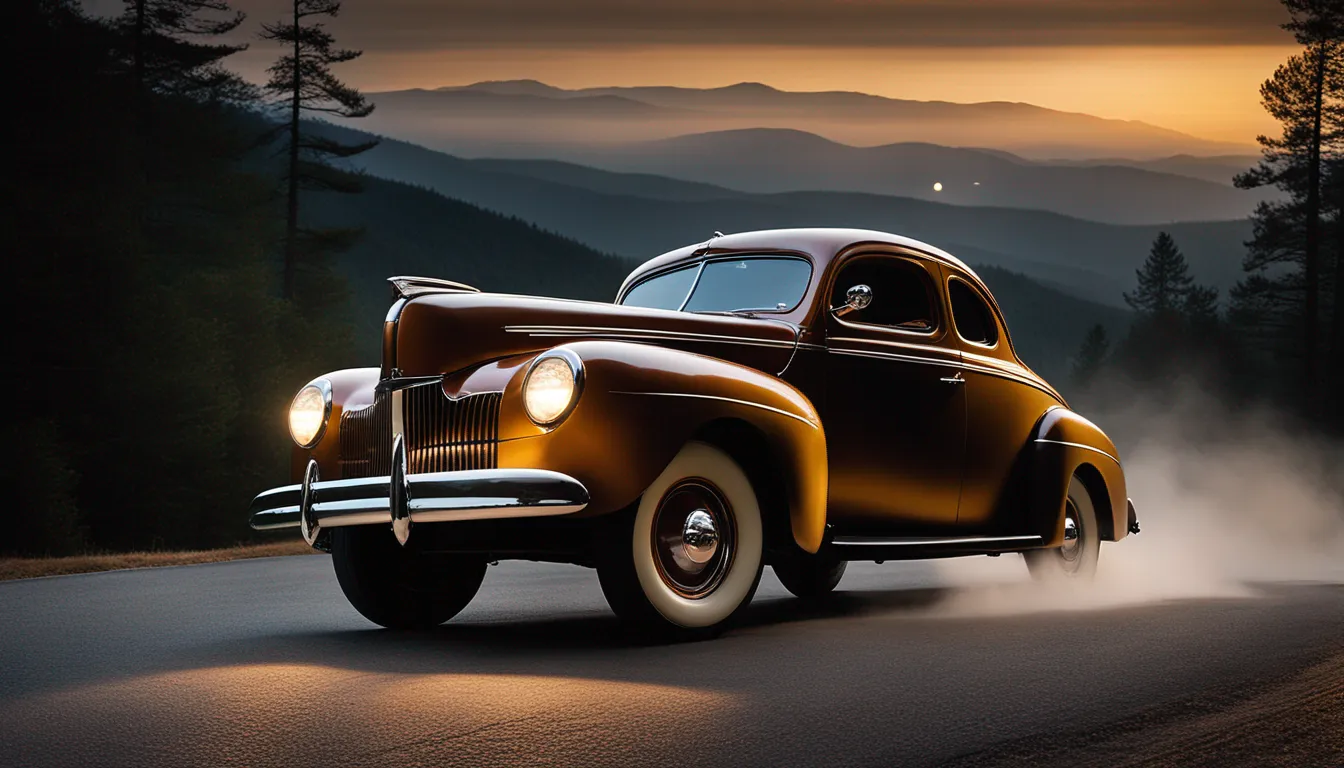
The car of choice was the 1940 Ford coupe. Stock, it had a flathead V-8 engine producing about 85 horsepower — adequate for church on Sunday, insufficient for outrunning law enforcement on Tuesday. So the runners modified everything. Bigger engines, sometimes Cadillac V-8s swapped in from ambulances (a detail too good to be invented). Additional carburetors. Stiffened suspension to handle the extra weight without the rear end sagging and announcing to every passing deputy that the trunk was full of something heavy and illegal. Switches to kill the taillights and brake lights. Dark paint. No chrome. Nothing memorable. The goal was a car that looked like every other car on the road but could do things no other car on the road could do.
And then there was the bootleg turn. If a runner hit a dead end or a roadblock, he needed to reverse direction instantly. The technique: throw the car into second gear, crank the steering wheel, stomp the accelerator, and whip the rear end around in a full 180-degree arc. You'd be facing the opposite direction and accelerating before the pursuing vehicle even registered what happened. It was developed not as a racing maneuver but as a "the cops are right behind me and this road ends at a cliff" maneuver. NASCAR later adopted it as legitimate strategy, which is the motorsport equivalent of a bank deciding to hire safecrackers.
Junior Johnson never got caught running moonshine. Not once. He was eventually arrested at his father's still in 1956, but on the road, behind the wheel, loaded with whiskey and pursued by the law, nobody ever caught him. He would later say, with characteristic understatement, that he "just liked to drive fast." The cops who chased him presumably described the experience less charitably.
Outlaw File: Junior Johnson
- Full Name: Robert Glenn Johnson Jr.
- Born: June 28, 1931 — Ronda, Wilkes County, North Carolina
- Died: December 20, 2019 — Charlotte, North Carolina (age 88)
- Moonshine Era: Mid-1940s through mid-1950s
- Territory: Wilkes County, NC ("Moonshine Capital of the World")
- Racing Career: 1953–1966 (driver), 1966–1995 (team owner)
- Driver Stats: 313 races, 50 wins, 47 poles, 121 top fives
- Owner Stats: 132 victories, 6 Cup Series championships
- Criminal Record: 1956 federal conviction — manufacturing non-tax-paid whiskey
- Presidential Pardon: December 26, 1986 — granted by Ronald Reagan
- Brand: Midnight Moon Moonshine (with Piedmont Distillers, 2007)
- Hall of Fame: NASCAR Hall of Fame, inaugural class of 2010
From the Hollows to the Oval
The origin of stock car racing is one of those stories so perfectly American it sounds like propaganda. In the 1940s, moonshine runners in the Southeast had two things: highly modified cars and an excess of competitive ego. On weeknights, they outran the law. On weekends, they raced each other. Not for money, at least not at first — for bragging rights. Who had the fastest car. Who was the best driver. Who could take a 1940 Ford with a Cadillac engine and a trunk full of ghosts and make it do things that violated basic physics.
These informal races happened on dirt tracks, cow pastures, and occasionally actual roads. Crowds showed up. Then bigger crowds. Then promoters noticed the crowds and smelled something other than moonshine: money. William Henry Getty "Bill" France Sr., a mechanic and part-time race promoter from Washington, D.C. (by way of Daytona Beach), saw an opportunity to organize the chaos into a legitimate sport. On December 14, 1947, France called a meeting at the Streamline Hotel in Daytona Beach, Florida. Thirty-five men showed up — many of them with personal connections to the moonshine trade that they chose not to discuss in formal settings. On February 21, 1948, NASCAR was officially incorporated.
The sport's first race was held on February 15, 1948, and won by Red Byron, a former moonshine runner. This is like learning that the first Olympic swimmer was actually just a guy who got really good at escaping alligators. The entire founding mythology of NASCAR is that a group of criminals invented a professional sport as a side effect of their criminal enterprise. No amount of corporate sponsorship from Fortune 500 companies can fully erase this, which is part of its charm.
Wilkes County, North Carolina, produced more moonshine per capita than any other place in America during this era. It also produced a disproportionate number of NASCAR drivers. Coincidence is not the word.
Junior Johnson, Racing Driver
Johnson made his NASCAR debut in 1953 at the Southern 500 in Darlington, South Carolina. He was 22 years old and had been driving modified cars at illegal speeds for nearly a decade — he just hadn't been doing it in front of spectators and timekeepers before. His first win came in 1955 at Hickory Motor Speedway, and by that point, anyone paying attention could see that something unusual was happening. This wasn't just a fast driver. This was a driver who approached corners the way a moonshine runner approaches a roadblock: with total aggression and a plan B that involved physics most people hadn't considered.
Over a 14-year driving career spanning 1953 to 1966, Johnson compiled 50 wins, 47 poles, 121 top-five finishes, and 148 top-ten finishes in 313 starts. He won 50 races at NASCAR's top level — the most of any driver who never won a championship, a distinction that sounds like a backhanded compliment but was actually just bad luck. The points system wasn't kind to him, and he missed chunks of seasons for reasons we'll get to shortly (they involved the federal government and a copper still).
But the race that defined his legend was the 1960 Daytona 500. Johnson's Chevrolet, prepared by legendary mechanic Ray Fox, was fast — but not fast enough. In practice, his car was running about 22 miles per hour slower than the top Pontiacs. That's not a gap you close with motivation and positive thinking. That's a gap that means you finish somewhere between mediocre and humiliating.
Then Junior Johnson discovered drafting. Or, more accurately, stumbled into it. During a practice session, a faster car passed him, and Johnson noticed that tucking in directly behind it caused his own speed to increase dramatically. The lead car punched a hole in the air; the trailing car rode in the pocket of reduced wind resistance. Johnson experimented with it: he could keep pace with cars 20 miles per hour faster by sitting in their slipstream, then slingshot around them when the moment was right.
Nobody in stock car racing had ever deliberately used this technique. Cyclists knew about it. So did geese. But stock car drivers hadn't worked out the aerodynamics yet because most of them came from a background where the primary driving concern was "don't hit a tree while hauling whiskey in the dark."
Johnson won the 1960 Daytona 500 in a car that had no business winning. He drafted behind faster cars for 199 laps and then used the slingshot to take the lead when it counted. He essentially invented the dominant strategy of superspeedway racing through a combination of desperation, observation, and the kind of improvisational problem-solving you develop when your formative driving experiences involved federal agents with guns.
"He is a coon hunter, a rich man, an ex-whiskey runner, a good old boy who hard-charges stock cars 175 m.p.h. ... Junior Johnson is one of the last of those sports stars who is not shy about his origins and the life he has led. He is anything but sheepish about it."
— Tom Wolfe, Esquire, March 1965
The Bust: Wrong Place, Right Time (for the Feds)
In 1956, Junior Johnson's parallel career tracks collided. He was in his second season as a NASCAR driver, had already won five races the previous year, and had just signed a contract with Ford Motor Company. Things were going well in the legal column of his life. The illegal column, unfortunately, was still open for business.
On a day in 1956, federal agents raided the Johnson family's moonshine operation in Wilkes County. They found what they always found at the Johnson place: copper stills, mash, and enough evidence to prosecute a medium-sized distillery. They also found Junior. Not running moonshine — he was at the still site, reportedly there to fire up the operation. The distinction matters: Johnson was never once caught transporting moonshine. He was caught manufacturing it. There's a certain irony in a man whose entire legend is built on being uncatchable behind the wheel getting busted while standing still.
Johnson was convicted of manufacturing non-tax-paid whiskey in November 1956. The sentence was 20 months in the federal penitentiary at Chillicothe, Ohio. With good behavior, he served 11 months and three days. During that time, he lost his Ford contract, missed most of the 1956 racing season, and gained a federal record that would follow him for the next three decades.
He came back to racing in 1958 and picked up exactly where he left off — winning races and terrifying competitors with a driving style that had been forged not on practice tracks but on midnight mountain roads with the law in his mirror. The prison stint, if anything, added to his mythology. Among stock car drivers in the 1950s, a moonshine conviction wasn't a scandal. It was a credential.
The Last American Hero (According to Tom Wolfe)
In March 1965, Esquire magazine published "The Last American Hero Is Junior Johnson. Yes!" — a long-form profile by Tom Wolfe that became one of the most celebrated pieces of American sports journalism ever written. Wolfe, then pioneering what would become known as New Journalism, traveled to Wilkes County and found a story so rich with contradiction and cultural significance that it practically wrote itself.
Wolfe's article didn't just profile a race car driver. It profiled a world. The moonshine hollows of Wilkes County. The Sunday afternoon dirt track races. The relationship between outlaw culture and American identity. Wolfe understood something that NASCAR's corporate handlers would spend decades trying to paper over: the sport's authenticity came directly from its illegality. The drivers were exciting because they'd learned to drive while committing crimes. The culture was compelling because it existed in opposition to federal authority. Remove the moonshine, and you just have guys driving in circles.
The profile described Johnson's bootleg turn in loving detail: "You threw the car into second gear, cocked the wheel, stepped on the accelerator and made the car's rear end skid around in a complete 180-degree arc." Wolfe also coined the term "good old boy" in the piece — or at least gave it national circulation. Before Wolfe's article, the phrase was regional. After it, the phrase belonged to America.
The article was adapted into a 1973 film, The Last American Hero, starring Jeff Bridges. The movie was decent. The article was brilliant. And Junior Johnson, who had been famous in racing circles, became famous everywhere.
Reagan's Christmas Gift
For 30 years after his 1956 conviction, Junior Johnson was a convicted felon. He couldn't vote. He couldn't hold certain licenses. The record followed him like a bad smell through every business deal, every public appearance, every award ceremony. Here was a man inducted into every racing hall of fame that existed, celebrated by Esquire and Tom Wolfe, beloved by millions of fans — who technically couldn't cast a ballot because he'd been caught making whiskey at his daddy's still when Eisenhower was president.
Johnson applied for a presidential pardon in the early 1980s. The process ground along at the speed of federal bureaucracy. Then, on December 26, 1986 — the day after Christmas — President Ronald Reagan granted Junior Johnson a full and unconditional presidential pardon, retroactive to the completion of his sentence.
Johnson called it "the best Christmas gift I ever got." He also said, "I could not have imagined anything better." The pardon restored his right to vote and removed the felony from his record. It was, by any measure, the right call. It was also deeply, structurally hilarious: the President of the United States formally forgiving a man for the crime that created the career that made him famous enough to be pardoned by the President of the United States. The snake ate its own tail and somehow everyone felt good about it.
Reagan, for his part, had a pattern of pardoning sports figures. He would later grant one to George Steinbrenner, the Yankees owner, for campaign finance violations. But the Johnson pardon was the poetic one. You don't often get to pardon a man for the crime that built an industry.
The Owner Years and Beyond
Johnson retired from driving after the 1966 season — 313 races, 50 wins, 47 poles — and did what many great drivers do: he became a team owner. What many great drivers don't do is become one of the most successful team owners in the sport's history. Under Johnson's ownership, his teams won 132 races and six Cup Series championships. He won three titles with Cale Yarborough (1976, 1977, 1978) and three more with Darrell Waltrip (1981, 1982, 1985), becoming the first owner to win multiple championships with multiple drivers.
He retired from team ownership in 1995. And then came the part of the story that makes the whole thing feel like a novel written by someone who doesn't care about plausibility.
In 2007, Junior Johnson partnered with Piedmont Distillers in Madison, North Carolina — the state's first legal distillery since Prohibition — to produce Midnight Moon Moonshine. The brand was based on Johnson's family recipe: 100% American corn, small-batch production, the same basic formula the Johnsons had been making (illegally) since before anyone was keeping records. When Piedmont gave him a taste of the first batch, Johnson reportedly declared, "That's the best damn 'shine I ever tasted."
Think about the arc here. A man who went to federal prison for making illegal whiskey used his family's illegal whiskey recipe to create a legal whiskey brand, sold it in the same state where his father's still was raided, and toured the country signing bottles for fans. He went from outlaw to entrepreneur using the exact same product. The only thing that changed was the paperwork. If Popcorn Sutton was the moonshiner who refused to go legitimate, Junior Johnson was the one who figured out that the real bootleg turn was getting the government to let you make whiskey.
Legacy: What Moonshine Built
Junior Johnson died on December 20, 2019, at the age of 88, at his home in Charlotte, North Carolina. He had been in declining health. The obits ran in every major outlet, and every single one of them had to explain that one of NASCAR's founding legends was a convicted moonshiner. This is because that fact is both the most interesting thing about him and the most interesting thing about NASCAR.
The sport has tried various approaches to its moonshine origins over the decades. In the 1970s and 1980s, when corporate sponsors started writing large checks, NASCAR downplayed the bootlegging connection. By the 2000s, it had reversed course and leaned into it — the NASCAR Hall of Fame in Charlotte includes a moonshine exhibit. Marketing departments eventually realized that "our sport was invented by criminals" is not a liability; it's a brand identity. No other major American sport can claim outlaw origins with a straight face. Baseball was invented by guys in boater hats. Football evolved from rugby at Ivy League schools. NASCAR was invented because moonshiners needed something to do on their day off from committing federal crimes.
Johnson's specific contributions are embedded in the sport's DNA. Drafting — the technique he stumbled onto at Daytona in 1960 — is now the fundamental strategy of superspeedway racing. Every pack of cars you see at Daytona or Talladega, slipstreaming in tight formation at 190 mph, is running Junior Johnson's playbook. A moonshine runner who couldn't outgun the competition outthought them instead, and the entire sport changed.
He was inducted into the NASCAR Hall of Fame in its inaugural class of 2010, alongside Bill France Sr., Bill France Jr., Richard Petty, and Dale Earnhardt. It's worth noting that the man who founded the sport and the man who ran moonshine for it were honored in the same breath. Because in NASCAR, those aren't contradictions. They're the same story.
If you're exploring the spirits world that shaped American racing culture, our guides to how bourbon is made and the best bourbons under $30 are worth a detour. And if you want to walk the trails where some of this history was made, our Kentucky Bourbon Trail guide covers the modern, fully legal side of American whiskey.
Junior Johnson took the skills he learned breaking the law, used them to build a career, went to prison for the law he broke, got pardoned by a president for the crime that made him famous, and then turned the whole thing into a legal liquor brand. Somewhere between the copper stills of Wilkes County and the boardrooms of Daytona Beach, America decided that was not just acceptable but heroic. And honestly, it kind of is.
Frequently Asked Questions
How did NASCAR start from moonshine?
NASCAR originated from moonshine culture in the American South during the 1930s and 1940s. Bootleggers modified stock cars with powerful engines to outrun law enforcement while transporting illegal whiskey. On weekends, these drivers began racing each other on dirt tracks for bragging rights, drawing large crowds. Stock car promoter Bill France Sr. recognized the commercial potential and organized these informal races into the National Association for Stock Car Auto Racing (NASCAR), officially incorporated on February 21, 1948. Many early NASCAR drivers, mechanics, and team owners — including Junior Johnson — had direct ties to the moonshine trade.
Did Junior Johnson really run moonshine?
Yes. Junior Johnson ran moonshine for his family's operation in Wilkes County, North Carolina, starting in his mid-teens during the 1940s. He drove modified 1940 Ford coupes loaded with 120+ gallons of untaxed corn whiskey on mountain roads at night, often with headlights off to avoid detection. Remarkably, he was never caught while actually transporting moonshine. His 1956 arrest occurred at his father's still site, where he was convicted of manufacturing — not transporting — non-tax-paid whiskey.
What was Junior Johnson's moonshine brand?
In 2007, Junior Johnson partnered with Piedmont Distillers in Madison, North Carolina, to create Midnight Moon Moonshine. The product is based on the Johnson family's traditional corn whiskey recipe — the same one they'd been making illegally for generations. Midnight Moon is made from 100% American corn in small batches and is legally produced with full state and federal permits. The brand became one of the most recognized legal moonshine products in America.
Why was Junior Johnson pardoned by Reagan?
President Ronald Reagan granted Junior Johnson a full and unconditional presidential pardon on December 26, 1986, for his 1956 federal conviction of manufacturing non-tax-paid whiskey. Johnson had applied for the pardon in the early 1980s. By 1986, he was one of the most celebrated figures in American motorsports, a successful team owner, and the subject of Tom Wolfe's famous Esquire profile. The pardon restored his civil rights, including his right to vote, which had been lost due to the felony conviction. Johnson called it "the best Christmas gift I ever got."
What did Junior Johnson invent in NASCAR?
Junior Johnson is credited with discovering — or at least being the first to deliberately exploit — the technique of drafting in stock car racing. During practice for the 1960 Daytona 500, Johnson noticed that tucking his slower car directly behind a faster car dramatically increased his speed due to reduced aerodynamic drag. He used this slipstream technique throughout the race to keep pace with faster Pontiacs and slingshot past them for the win. Drafting became the dominant strategy at superspeedways and remains fundamental to NASCAR racing today.
How many races did Junior Johnson win?
Junior Johnson won 50 races in 313 starts as a NASCAR Cup Series driver between 1953 and 1966, along with 47 pole positions, 121 top-five finishes, and 148 top-ten finishes. He holds the distinction of having the most wins of any driver who never won a Cup Series championship. As a team owner from the mid-1960s through 1995, his teams won an additional 132 races and six Cup Series championships with drivers Cale Yarborough and Darrell Waltrip.
What was Tom Wolfe's article about Junior Johnson?
"The Last American Hero Is Junior Johnson. Yes!" was published in Esquire magazine in March 1965 by journalist Tom Wolfe. The long-form profile explored Johnson's moonshine-running past, his racing career, and the culture of Wilkes County, North Carolina. The article became one of the most celebrated pieces of American sports journalism and a landmark of the New Journalism movement. It was adapted into a 1973 film, The Last American Hero, starring Jeff Bridges. Wolfe is also credited with popularizing the term "good old boy" through the piece.