On the morning of October 6, 1927, a taxi carrying Imogene Remus and her daughter wound through Eden Park in Cincinnati, heading toward a divorce hearing that would finalize the dissolution of one of the most spectacular marriages in American criminal history. A black sedan swung out of a parking spot and gave chase. The driver forced the taxi to the curb near the Spring House Gazebo. George Remus — pharmacist, attorney, bootlegger, self-described king of everything — leapt out, caught Imogene as she tried to run, pressed a revolver against her abdomen, and fired. She died two hours later at Bethesda Hospital. Remus surrendered immediately. He didn't flee. He didn't hide. He had things to say, and George Remus always had an audience.
This is the story of the man widely believed to have inspired Jay Gatsby — except the real version is wilder than anything F. Scott Fitzgerald put on the page. Gatsby threw parties. Remus threw parties and murdered his wife in a public park. The Great American Novel borrowed from a Great American Criminal, and the criminal's story makes the novel look restrained. This is Article #2 in the Spirits & Outlaws series. (Start with the history of moonshine if you missed Article #1.)
From Pharmacy Counter to Courtroom: The Education of George Remus
George Remus was born on November 13, 1876, in Landsberg, Germany. His family emigrated when he was five, passing through Maryland and Wisconsin before settling in Chicago. His father couldn't work, which meant young George was supporting the family by 14 — running his uncle's pharmacy and developing the obsessive work ethic that would later fuel both a bourbon empire and a murder.
He graduated from the Chicago College of Pharmacy at 19, bought his first pharmacy at 21, then taught himself law, passed the Illinois bar exam, and pivoted to criminal defense. By his mid-thirties, Remus was one of Chicago's most successful defense attorneys. Then he made the observation that changed everything: his clients — bootleggers, mostly — were making ten times what he was. The math was simple. The moral calculation was simpler. In 1920, the year Prohibition took effect, George Remus quit the practice of law and went into the whiskey business.
He memorized the entire Volstead Act — all 25 sections, every clause, every exception — and found the loophole that would make him the wealthiest bootlegger in American history.
The Loophole That Built an Empire
The Volstead Act banned the manufacture, sale, and transportation of alcoholic beverages — but it exempted "medicinal whiskey" distributed through licensed pharmacies with a physician's prescription. Remus, who was both a licensed pharmacist and a lawyer who had memorized the act's every comma, understood what this meant before almost anyone else: whoever controlled the distilleries and the pharmacies controlled the whiskey. Legally.
He moved to Cincinnati in 1920 for one reason: 80% of America's bonded whiskey was stored within a 300-mile radius of the city. Kentucky's bourbon distilleries — shuttered by Prohibition but still holding millions of gallons of aging inventory in bonded warehouses — were sitting there like unlocked vaults. Remus started buying them.
He acquired the Fleischmann Distillery in October 1921 for $197,000. Then Edgewood, for a $10,000 down payment. Then Squibb. Then Pogue. Then Rugby, Birch Springs, Old Lexington Club, and half of Clifton Springs. Individual acquisitions ranged from $50,000 to $325,000. Within two years, Remus controlled an estimated 35% of all the bonded whiskey in the United States.
The scheme was elegant in its audacity. Remus's distilleries received government permits to withdraw whiskey for "medicinal purposes." The whiskey went onto trucks bound for his pharmacies. Somewhere en route, the trucks were "hijacked" — by Remus's own men. The whiskey vanished into the black market. The paperwork showed a robbery. Remus filed an insurance claim. He was stealing from himself, selling the stolen goods, and getting reimbursed for the theft. Three revenue streams from a single barrel.
At its peak, the operation employed roughly 3,000 people. Remus's personal fortune reached an estimated $40 million — somewhere between $300 million and $700 million today, depending on the inflation metric. Some historians push it past $1 billion. A German immigrant pharmacist from Chicago became, in 30 months, one of the wealthiest men in America by exploiting a hole in the law he'd memorized like scripture.
Understanding how bourbon is made explains why Remus targeted Kentucky. Those bonded warehouses held aged, barreled bourbon — already finished, already valuable. Remus wasn't making whiskey. He was redirecting it.
The Marble Palace and the Diamond Parties
What do you do with $40 million in bootleg bourbon money in 1922? If you're George Remus, you throw the most outrageous parties Cincinnati has ever seen, because George Remus does not do anything quietly, and George Remus always refers to George Remus in the third person.
That third-person habit was real. Documented in court transcripts, newspaper interviews, and the accounts of everyone who knew him. "Remus was in the whiskey business and Remus was the biggest man in the whiskey business," he told a jury. "This is going to be a hell of a Christmas for Remus," he reportedly told associates. It wasn't an affectation. It was a worldview. George Remus had invented a character called George Remus, and he inhabited that character fully — years before Fitzgerald created Gatsby, a man who did exactly the same thing.
The mansion was at 825 Hermosa Avenue in the Price Hill neighborhood of Cincinnati. Remus called it the "Marble Palace," and the name wasn't hyperbole. He filled it with expensive artwork, Grecian sculptures, and a $100,000 indoor swimming pool — in 1921 dollars, that's roughly $1.7 million for a pool. The estate sat on a hill overlooking the Ohio River, visible for miles, which was precisely the point.
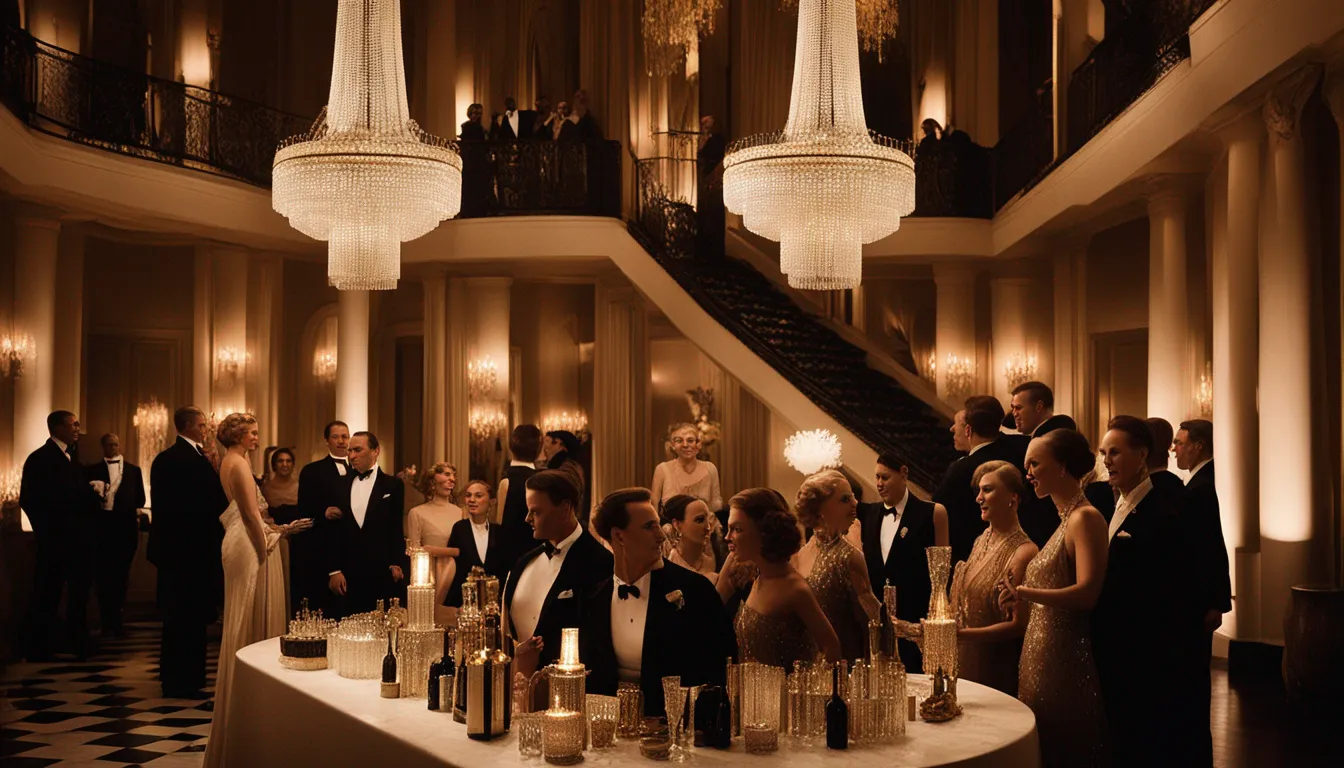
The parties became legend. On New Year's Eve 1921, Remus hosted over 100 guests to christen the swimming pool. Young women dressed entirely in white served gourmet dinners while a full orchestra played. Champagne and bonded whiskey flowed — both technically illegal, both in unlimited supply, because the host owned more whiskey than anyone in America.
The parting gifts sealed Remus's reputation. At one gathering, every male guest received a diamond-studded tie pin. At another, every female guest received a brand-new automobile. At a 1923 birthday party for Imogene, aquatic dancers performed in the pool while a fifteen-piece orchestra serenaded from the terrace. The man was running a criminal enterprise, a network of distilleries and pharmacies — and also personally curating party favors that cost more than most Americans earned in a decade.
Was Jay Gatsby Based on George Remus?
Jay Gatsby was almost certainly a composite character, but George Remus is the strongest single candidate for primary inspiration — and the parallels are so specific that dismissing the connection requires more effort than accepting it.
F. Scott Fitzgerald was stationed at Camp Taylor in Louisville in 1918, where he frequented the Seelbach Hotel — the same hotel that appears thinly disguised in The Great Gatsby as the setting for the Buchanans' wedding. The timeline creates a wrinkle: Prohibition didn't begin until 1920, and Remus didn't arrive in Cincinnati until that year, so their paths couldn't have crossed during Fitzgerald's military service. But Remus's reputation spread explosively between 1920 and 1922 — the exact period Fitzgerald was writing the novel, published in April 1925.
The parallels are almost absurd in their specificity:
- Self-invention: Both Gatsby and Remus were men who created entirely new identities. James Gatz became Jay Gatsby. A German immigrant pharmacist became "The King of the Bootleggers." Both spoke about themselves as if describing a character in a story.
- Lavish parties as performance: Gatsby's parties are attended by hundreds of people who don't know the host. Remus's parties were attended by Cincinnati society elites who knew exactly who the host was and what he did for a living — and came anyway, because the champagne was real and the diamond pins were free.
- A mansion on a hill, overlooking water: Gatsby's mansion on West Egg faces the green light across the bay. Remus's Marble Palace sat on a hill in Price Hill, overlooking the Ohio River. Both men positioned themselves above the world they wanted to conquer.
- Bootleg wealth: Gatsby's fortune comes from "drugstores" — a thinly veiled reference to the medicinal whiskey loophole that Remus exploited more successfully than anyone in the country.
- A doomed love story: Gatsby is destroyed by his obsession with Daisy. Remus was destroyed by Imogene — though Remus, characteristically, took a more direct approach to the tragedy.
- The nickname: Remus called himself "The Great Remus." Fitzgerald titled his novel "The Great Gatsby." Coincidences stack up until they stop being coincidences.
The other major candidate is Max Gerlach, a Long Island bootlegger and Fitzgerald neighbor who used the phrase "old sport" and cultivated elaborate myths about himself. Zelda Fitzgerald and Edmund Wilson both confirmed Gerlach as an inspiration. The academic consensus: Gatsby draws from Gerlach's mannerisms but from Remus's scale — the empire, the fortune, the self-destruction. Gerlach gave Fitzgerald the voice. Remus gave him the story.
Bob Batchelor, whose 2019 biography The Bourbon King is the definitive Remus account, argues that Fitzgerald couldn't have missed him. By 1922, Remus was front-page news in every major American newspaper — the most famous criminal in the country, operating in a region Fitzgerald knew well.
Outlaw File: George Remus
- Full Name: George Remus
- Alias: "The King of the Bootleggers," "The Great Remus"
- Born: November 13, 1876, Landsberg, Germany
- Died: January 20, 1952, Covington, Kentucky (age 75)
- Era: 1920–1927
- Territory: Cincinnati, Ohio / Northern Kentucky
- Specialty: Bonded whiskey diversion via medicinal permit loophole
- Peak Fortune: ~$40 million ($300M–$700M+ adjusted)
- Employees: ~3,000
- Distilleries Owned: 10+ (including Fleischmann, Squibb, Pogue, Edgewood, Rugby)
- Legal Trouble: 2 years federal prison (bootlegging) + murder trial (acquitted in 19 minutes)
- Legacy: Primary inspiration for Jay Gatsby; namesake bourbon brand (Ross & Squibb Distillery)
- Signature Trait: Referred to himself exclusively in the third person
The Fall: Prison, Betrayal, and a Prohibition Agent Named Dodge
Empires built on loopholes tend to collapse when the people who enforce the rules stop looking the other way. On May 16, 1922, Remus was indicted on thousands of Volstead Act violations. The jury convicted him in under two hours. Judge John Peck of the U.S. Circuit Court sentenced him to the maximum: two years in Atlanta Federal Penitentiary.
Two years doesn't sound catastrophic. Al Capone did seven. But what happened during those two years was worse than any prison sentence.
While at Atlanta, Remus encountered a man named Franklin Dodge. Dodge was a Bureau of Prohibition agent — an undercover operative who had been assigned to gather intelligence on Remus's operation. In prison, Dodge befriended Remus. Remus, apparently trusting the man he believed to be a fellow inmate, confided details about his fortune and told Dodge that his wife, Imogene Holmes, held power of attorney over his assets.
Dodge took this information and did something breathtaking even by Prohibition standards. He resigned from the Bureau, traveled to Cincinnati, began an affair with Imogene, and together they systematically looted Remus's empire. They sold the Fleischmann Distillery. They liquidated properties, accounts, and holdings. Of the approximately $40 million Remus had accumulated, they left him with roughly $100.
Then they tried to have him deported. When that failed, they reportedly paid a hitman $15,000 to kill him. The hitman failed — or never tried. By the time Remus walked out of Atlanta on November 2, 1925, he was broke, betrayed, and possessed of the kind of rage that doesn't dissipate with time. It calcifies. Imogene filed for divorce. The proceedings dragged for two years. Remus spiraled — litigating, threatening, obsessing. Everything he'd built was gone, and the two people who'd taken it were beyond his legal reach.
So he reached for something else.
Murder in Eden Park: October 6, 1927
Imogene and her daughter Ruth left the Alms Hotel in a taxi, heading to the courthouse where the divorce would be finalized. Remus was waiting. His driver followed the taxi into Eden Park — a hilly green space above the Ohio River — and forced it to the curb near the Spring House Gazebo.
Imogene leapt out and ran. Remus caught her within yards. The taxi driver, park bystanders, and Imogene's own daughter watched him press a revolver to her abdomen and fire.
"She who dances down the primrose path must die," Remus reportedly said afterward. The line sounds invented, but multiple sources attributed it to him — suggesting a man who had already drafted his own mythology of the moment, who understood that this was the scene that would define him.
Imogene died two hours later at Bethesda Hospital. Remus turned himself in without resistance.
The Trial That Shocked America (and Lasted Only 19 Minutes)
George Remus did what George Remus always did: he took center stage. Despite having no active law license and being the defendant in a murder case that could end in the electric chair, Remus announced he would represent himself. The court assigned attorney Charles Elston to assist, but Remus ran the show.
His defense was "transitory maniacal insanity" — a legal theory Remus himself had pioneered as a defense attorney in Chicago. The argument: the cumulative betrayal by Imogene and Dodge produced a temporary psychotic break at the moment of the shooting. Remus wasn't permanently mad. He was driven to a single act of madness by circumstances so extreme that any reasonable person might have cracked.
The trial lasted five weeks. Remus spoke for an hour and a half during testimony, veering between legal argument, emotional appeals, and long digressions about the injustice of Prohibition itself. He made Imogene and Dodge the villains. He painted himself as a man robbed not just of money, but of identity, dignity, and sanity. The prosecution's case — straightforward, given that he shot her in front of witnesses — couldn't compete with the narrative Remus constructed.
The jury deliberated for 19 minutes. Not guilty by reason of insanity. Nineteen minutes, for a man who shot his wife in broad daylight in a public park. It remains one of the shortest deliberations in Ohio murder trial history. Gatsby convinced people he was old money. Remus convinced twelve citizens he was temporarily insane. Same skill. Higher stakes.
The State of Ohio, caught in a logical trap (the prosecution had argued Remus was sane enough to stand trial; the jury found him insane at the time of the murder), committed him to the Lima State Hospital for the Criminally Insane. His attorneys argued that since the insanity was "transitory," he was no longer insane. After seven months, the state agreed. George Remus walked free on June 20, 1928.
The Quiet End: Covington, Kentucky, and a Small Contracting Firm
Here's the part that doesn't make it into most retellings: George Remus lived for another 24 years and did absolutely nothing remarkable.
He moved across the Ohio River to Covington, Kentucky. Married his longtime secretary, Blanche Watson. Ran a small contracting firm. Filed occasional lawsuits to recover fragments of his empire, but the distilleries were gone, the fortune was gone, and the Marble Palace had been demolished in 1934 (the swimming pool bulldozed in 1940 for public housing).
Remus suffered a stroke in 1950 and spent his final two years in a Covington boarding house. He died on January 20, 1952, at 75. He's buried beside Blanche at Riverside Cemetery in Falmouth, Kentucky — a modest grave for a man who once controlled a third of America's whiskey.
The quiet ending is the most Gatsby-like detail of all. Fitzgerald's novel ends with Gatsby dead and forgotten, his mansion empty. Remus believed in Remus — and when the empire disappeared, the man underneath was just an aging immigrant with a contracting business and a rented room.
George Remus Bourbon: The King's Name on a Modern Bottle
Nearly a century after Remus bought the Squibb Distillery in Lawrenceburg, Indiana, his name sits on bottles of bourbon produced at that same site. The distillery is now called Ross & Squibb Distillery — a subsidiary of MGP Ingredients (Nasdaq: MGPI), one of the largest whiskey producers in the United States. And their flagship bourbon brand? George Remus.
The irony is rich enough to sip. The man who exploited a legal loophole to divert millions of gallons of bonded whiskey now lends his name to whiskey that is entirely legal, federally permitted, and fully taxed. Remus would have found this hilarious — or infuriating, depending on his mood.
The lineup includes George Remus Straight Bourbon Whiskey — a high-rye blend aged five years — the Remus Repeal Reserve annual limited edition (now in its ninth series), and the Remus Gatsby Reserve: a cask-strength, 15-year bourbon released in 2025 for the 100th anniversary of The Great Gatsby's publication. It retails for $199.99, which Remus would have considered a reasonable bar tab for a single guest.
The connection is more than branding. Remus actually owned that distillery — he purchased W.P. Squibb & Co. in 1921. When the Feds seized his assets, it passed through various hands before becoming part of MGP. The bourbon produced there today uses the same water source and the same Lawrenceburg location. The ghosts are real, and they're bottled at 94 proof. Our top 10 bourbons list covers where Remus fits in the broader landscape, and bourbon mash bills explained covers the grain science behind high-rye bourbons like the Remus lineup.
What George Remus Means to American Spirits
Strip away the murder, the parties, the Gatsby connection, and the third-person speeches, and George Remus represents something fundamental about bourbon's place in American culture: the spirit has always attracted outsiders who see opportunity where others see restriction.
Remus was an immigrant, self-taught in three professions, who looked at Prohibition and saw the biggest business opportunity in the country. His scheme anticipated the structure of modern spirits conglomerates: control the supply chain from distillery to point of sale, and the margins become astronomical. The Kentucky Bourbon Trail guide will take you through the region he once dominated — the same distilleries Remus bought, looted, and lost.
In the history of moonshine, the outlaws are anonymous — mountain distillers whose names vanished into the hollows. Remus is the opposite. He wanted to be "the biggest man in the whiskey business." He achieved that, lost everything, killed the woman who helped destroy him, talked his way out of the electric chair, and faded into a Kentucky boarding house.
Fitzgerald understood something Remus never did: the green light at the end of the dock isn't a destination. It's a receding illusion. Gatsby reached for it and drowned. Remus reached for it, grabbed it, had it stolen, committed murder over its loss, and spent 24 years wondering where it went.
The bourbon endures. You can walk into a liquor store, pick up a bottle of George Remus Straight Bourbon, and drink whiskey carrying the name of a man who once controlled 35% of America's supply. The bottle costs about $35 — check our list of the best bourbon under $50. Remus would have spent that on a single diamond tie pin. But the whiskey is real, the label is legal, and the story is completely true.
George Remus FAQ
Who was George Remus?
George Remus (1876–1952) was a German-born American pharmacist, attorney, and bootlegger who became known as "The King of the Bootleggers" during Prohibition. He exploited a loophole in the Volstead Act to acquire distilleries and divert bonded whiskey through a network of pharmacies, amassing a fortune estimated at $40 million (over $300 million in today's dollars) and controlling roughly 35% of the nation's bonded whiskey supply.
Was Jay Gatsby based on a real person?
Jay Gatsby is widely considered a composite character, but George Remus is the strongest single inspiration. The parallels — self-made wealth, lavish parties, a mansion overlooking water, bootleg liquor fortune, and a doomed love story — align more closely with Remus than with any other historical figure. Max Gerlach, a Long Island bootlegger and Fitzgerald's neighbor, contributed Gatsby's mannerisms and the phrase "old sport." Most scholars believe Fitzgerald drew from both men, along with elements of his own personality.
How did George Remus die?
George Remus died of natural causes on January 20, 1952, in Covington, Kentucky, at the age of 75. He had suffered a stroke in 1950 and spent his final two years in a boarding house. He is buried at Riverside Cemetery in Falmouth, Kentucky. Despite his violent history — including the murder of his wife Imogene in 1927, for which he was acquitted — Remus lived his final decades in quiet obscurity.
Is George Remus bourbon named after the bootlegger?
Yes. George Remus Straight Bourbon Whiskey is produced at Ross & Squibb Distillery (formerly MGP) in Lawrenceburg, Indiana — the same site where Remus purchased the W.P. Squibb & Co. distillery in 1921 as part of his bootlegging empire. The brand explicitly honors its namesake, and the Remus Gatsby Reserve limited edition acknowledges the Fitzgerald connection. The full lineup includes the standard Straight Bourbon, the annual Repeal Reserve series, a Single Barrel expression, and the premium Gatsby Reserve.
How much was George Remus worth?
At his peak around 1922–1923, Remus had accumulated approximately $40 million — equivalent to $300 million to $700 million today. Some historians push the adjusted figure past $1 billion. By the time he left prison in 1925, his wife and Franklin Dodge had liquidated nearly everything, leaving him functionally broke.
What happened to George Remus's mansion?
The "Marble Palace" at 825 Hermosa Avenue in Cincinnati's Price Hill neighborhood was demolished in 1934. The $100,000 indoor swimming pool was bulldozed in 1940 to make way for Delehanty Court, a public housing development. Nothing of the original estate remains.