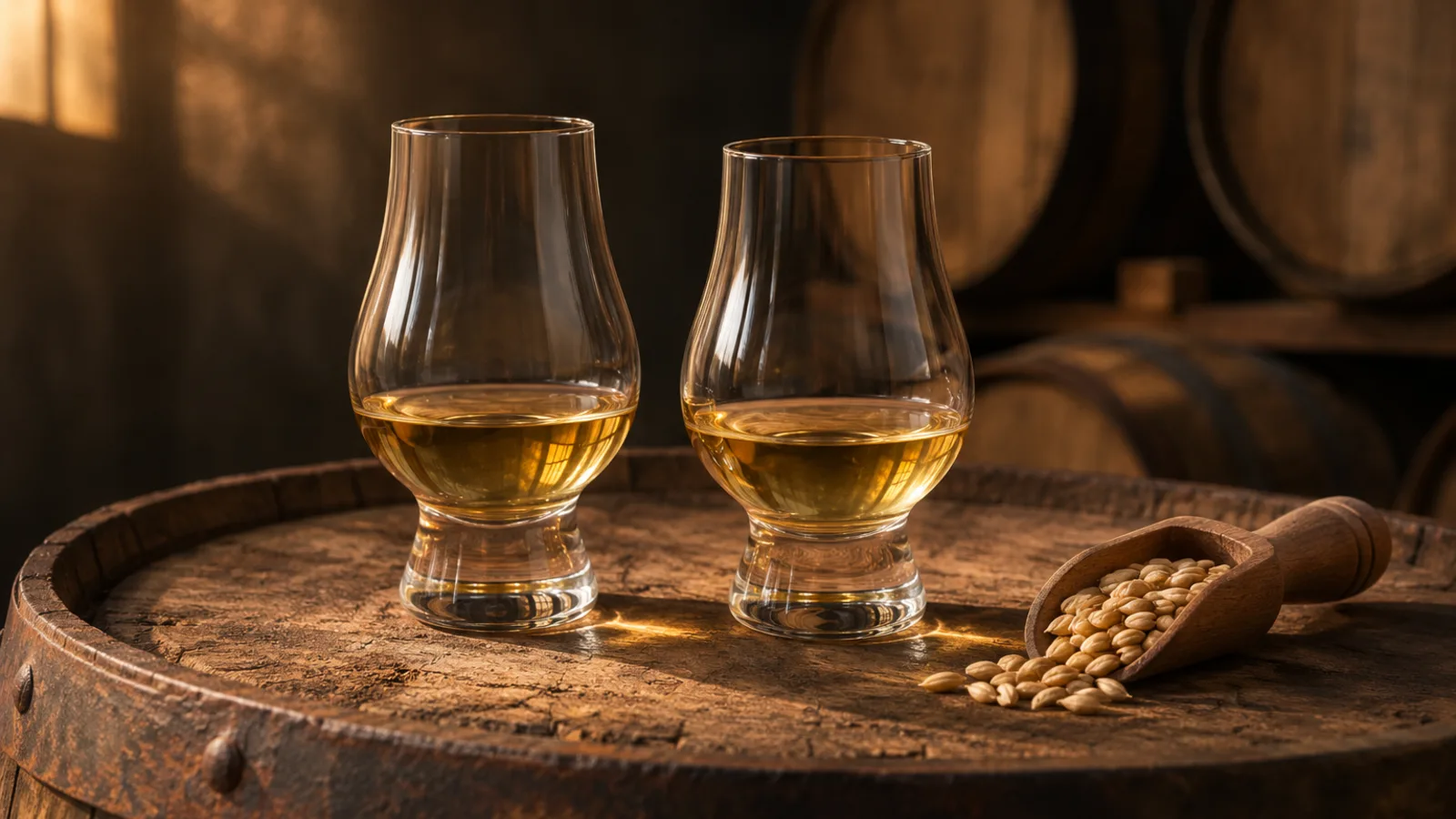
We visited Oak & Grist as part of a hosted trip coordinated by One For The Books, which also reimbursed our travel costs. Our opinions are our own.
An American single malt whisky can be bottled with no minimum age at all. Federal rules require 100% malted barley, one American distillery and oak barrels no bigger than 700 liters. They set no aging floor. A single malt Scotch must spend at least three years in oak, and even a "straight" American single malt only needs two.
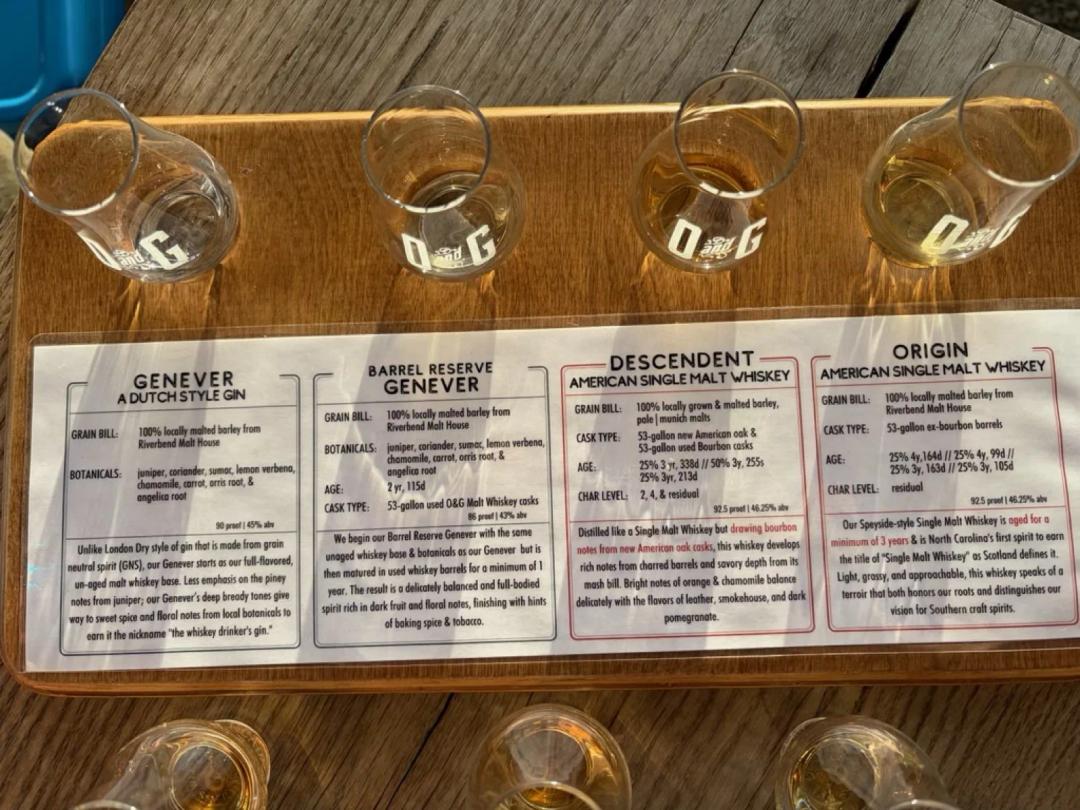
We saw how much that gap matters on November 5, 2026, at Oak & Grist Distilling in Black Mountain, North Carolina. The card on our tasting board said the distillery's Origin single malt meets the definition of single malt "as Scotland defines it." So we checked. Here is what each label actually guarantees, and how to tell which rules the bottle in your hand follows.
What is American single malt whiskey?
American single malt whisky is whisky made from a mash of 100% malted barley produced in the United States, distilled at a single US distillery to 160 proof or less, and stored only in the US in oak barrels of 700 liters or less. Those barrels can be new charred, new uncharred or used. It has to be bottled at 80 proof or more. The Alcohol and Tobacco Tax and Trade Bureau (TTB) added the category to the federal standards of identity in a rule that took effect on January 19, 2025.
Bottles made under the older label rules can still carry the name if they were bottled before January 19, 2030, under a five-year transition period.
American single malt vs Scotch: what's the difference?
The age floor and the still. Single malt Scotch must be matured for at least three years in Scotland, and it must be distilled in pot stills. The American rule has no minimum age and says nothing about the type of still. The rest lines up closely: both require malted barley only, a single distillery and oak casks of 700 liters or less.
| Rule | American single malt | Single malt Scotch | Bourbon |
|---|---|---|---|
| Grain | 100% malted barley, produced in the US | Water and malted barley only | At least 51% corn |
| Where it's distilled | One US distillery | One Scottish distillery | No single-distillery rule |
| Still type | Not specified | Pot stills | Not specified |
| Barrels | New charred, new uncharred or used oak, 700 liters max | Oak casks, 700 liters max | Charred new oak |
| Minimum age | None (2 years to be called "straight") | 3 years | None (2 years to be called "straight") |
| Distillation proof | 160 or less | Under 94.8% ABV (189.6 proof) | 160 or less, into the barrel at 125 or less |
| Bottling strength | 80 proof or more | 40% ABV (80 proof) or more | 80 proof or more |
| Caramel coloring | Allowed if the label says so | Plain caramel allowed | Not allowed |
Sources: 27 CFR 5.143 (US whisky standards, including the December 18, 2024 American single malt rule) and The Scotch Whisky Regulations 2009, regulation 3.
Does American single malt have a minimum age?
No. TTB chose not to set one, noting in the final rule that no other whisky type has a minimum age apart from the "straight" designation. A bottle labeled "straight American single malt whisky" has spent at least two years in oak. A bottle labeled only "American single malt whisky" could be younger. The same two-year line applies to bourbon, as our guide to bourbon age statements explained covers.
That is the one thing to check before you pay single malt prices. Look for "straight" or an age statement on the label. Without either, the federal rules give you no minimum.
How does Oak & Grist's Origin measure up?
It clears both bars, going by the card on our board. Origin is 100% malted barley from Riverbend Malt House in Asheville, double-distilled in pot stills at Oak & Grist's own distillery, and aged in 53-gallon ex-bourbon barrels. That's about 200 liters, well under the 700-liter cap. Its four component batches were aged 3 years 105 days, 3 years 163 days, 4 years 99 days and 4 years 164 days, so the youngest whiskey in the bottle has passed the three-year Scotch minimum by 105 days. The distillery calls it North Carolina's first spirit to earn the title of single malt as Scotland defines it.
Founder and head distiller William Goldberg built the distillery around that standard. "For the classic Speyside style we were chasing there really wasn't an option besides time," he wrote to us. Our interview with Oak & Grist's William Goldberg has the full story.
American single malt vs bourbon: what changes in the glass?
The barrel does most of the work. Bourbon has to go into charred new oak. American single malt can use new or used barrels, and that choice shows up in the glass. We tasted it side by side at Oak & Grist:
- Origin, aged entirely in used bourbon barrels, tasted lighter, fruitier and floral to us.
- Descendent, a mix of pale and Munich malts aged mostly in new American oak, tasted of vanilla, baking spice and caramel, with deeper nuttiness.
William often starts American drinkers on Descendent "because it shares some profile similarities to bourbon," he wrote. Same grain rules, same distillery, different wood: one label category can cover both ends of that range. For everything else we tasted, see our Oak & Grist distillery review.
Frequently asked questions
What is American single malt whiskey?
What is the difference between American single malt and Scotch?
What is the difference between American single malt and bourbon?
Does American single malt have to be aged?
Can American single malt contain caramel coloring?
Rob Boirun is the editor of BoozeMakers.com, where he covers craft distilleries, spirits and the people who make them. He visited Oak & Grist in Black Mountain, North Carolina, in November 2026.